





Description
Key Technical Specifications
| Parameter | Value |
|---|---|
| Manufacturer | ABB |
| Model | DSTC456 |
| Product Type | Multiplexer Module |
| Series | Advant Master / Advant OCS |
| Primary Function | Signal multiplexing and communication interface |
| Installation | Rack-mounted control system module |
| System Compatibility | ABB Advant Master Process Control System |
| Electrical Interface | Backplane connection |
| Application | Distributed control system communication |
| Cooling | Passive cabinet cooling |
| Service Environment | Industrial control cabinets |
| Lifecycle Status | Legacy product with limited market availability |
Product Introduction & Supply Chain Strategy
The ABB DSTC456 is a multiplexer module designed for ABB Advant Master distributed control systems. It supports reliable signal routing and communication between control hardware, helping maintain deterministic operation in continuous-process automation environments.
This product is a Brand New Surplus unit. It is not used, not pulled from a decommissioned plant, and not refurbished. All modules undergo rigorous quality verification to ensure OEM-level reliability. Because the Advant platform is a mature legacy system, maintaining 1–2 spare DSTC456 modules as buffer stock helps reduce lead time variability, lowers Total Cost of Ownership (TCO), and supports long-term plant availability. Purchasing New Surplus inventory also avoids the reliability risks commonly associated with refurbished electronics.
Installation & Configuration Guide
Stage 1: Pre-Installation (Prep & Safety)
- Apply Lock-Out/Tag-Out (LOTO).
- Shut down the control cabinet and isolate power.
- Wear a grounded ESD wrist strap.
- Photograph:
- Module location
- Connector positions
- Ribbon cable routing
- Cabinet layout
- Record controller diagnostics before removal.
Stage 2: Removal
- Disconnect all interface cables carefully.
- Release the retaining hardware.
- Pull the module straight from the rack.
- Inspect connectors for bent contacts, oxidation, or contamination.
Stage 3: Installation (Clone & Seat)
- Verify the replacement model is ABB DSTC456.
- Install the module into the original slot.
- Lock the retaining mechanism securely.
- Reconnect all cables exactly as documented.
- Verify cabinet grounding and cable strain relief.
Stage 4: Power-On & Testing
- Restore cabinet power.
- Verify normal controller startup.
- Confirm the module is recognized by the control system.
- Test communication paths and signal routing.
- Confirm no communication alarms remain active before returning the system to operation.
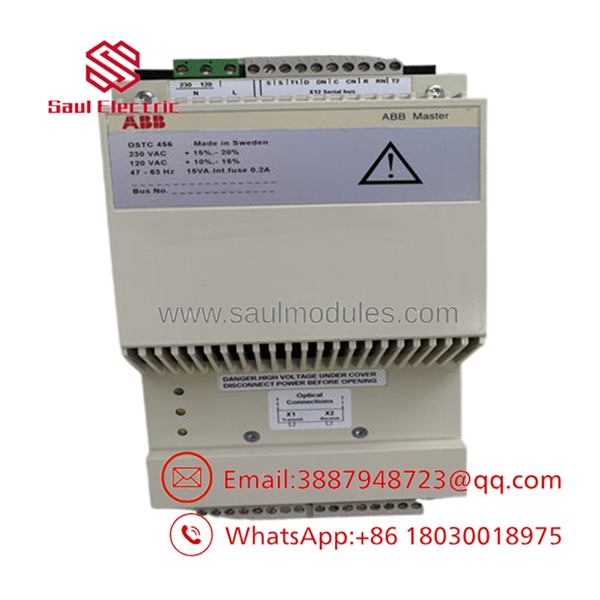
- DSTC456
Firmware/Software Versions & Upgrade Notes
- The DSTC456 is primarily a hardware interface module and does not normally require standalone firmware updates.
- Verify compatibility with the installed Advant Master controller software before replacement.
- Preserve controller configuration and engineering databases prior to maintenance.
- Avoid upgrading controller software during emergency hardware replacement unless the complete control system has been fully validated.
- Record rack location and cable assignments before removal.
- Maintain current backups of controller configuration, hardware documentation, and communication parameters to accelerate recovery after maintenance.
Frequently Asked Questions (FAQ)
Q1. Is this module genuinely new?
Yes. This is a New Original / New Surplus ABB module. It is not used, repaired, or refurbished. Every unit undergoes OEM serial verification, visual inspection, electrical testing, functional verification, and ESD-safe packaging before shipment.
Q2. Why is New Surplus priced below OEM factory supply but above refurbished modules?
Our pricing reflects the global cost of sourcing genuine New Surplus inventory. Although typically 20–30% higher than refurbished products, it eliminates hidden component aging, uncertain repair history, and premature failures that can result in expensive unplanned downtime.
Q3. Is the obsolete?
Yes. The supports the legacy ABB Advant Master platform, and worldwide availability is becoming increasingly limited. Facilities operating these systems should maintain 1–2 spare modules, review lifecycle status regularly, and implement a planned last-time-buy before inventory becomes difficult to obtain.
Q4. Can the be hot-swapped?
No. Hot-swapping is generally not recommended. Always follow ABB maintenance procedures and de-energize the control rack before removing or installing the module to prevent communication interruptions or hardware damage.
Q5. Will replacing the module require software modifications?
Normally, no. If the replacement module has the identical model number and hardware revision, the existing controller application should continue operating without modification. Verify communication and system diagnostics before returning the plant to production.
Q6. What quality verification is completed before shipment?
Each New Surplus follows a documented SOP including:
- OEM serial number verification
- Inbound traceability inspection
- Visual inspection
- Power-on diagnostics
- Communication interface testing
- Electrical continuity verification
- QC inspector approval
- ESD-safe packaging
- Heavy-duty export shipping preparation
Q7. What inventory strategy provides the lowest Total Cost of Ownership (TCO)?
For facilities operating ABB Advant Master systems, classify the as an A-Class critical spare. Maintain 1–2 modules as buffer stock, consolidate procurement through qualified vendors, implement cross-site inventory sharing where practical, and execute a planned last-time-buy before end-of-life inventory is exhausted. This strategy minimizes lead time variability, reduces stock-out incidents, controls carrying costs, and delivers a lower Total Cost of Ownership (TCO).

 Start Chat


