





Description
Key Technical Specifications
| Parameter | Value |
|---|---|
| Manufacturer | ABB |
| Model | PFTL101A 1.0 kN |
| Order Number | 3BSE004166R1 |
| Product Type | Pressductor® PillowBlock Load Cell |
| Measuring Direction | Horizontal |
| Rated Capacity | 1.0 kN |
| Accuracy Class | ±0.5% |
| Repeatability | < ±0.05% |
| Overload Capacity | 500% of rated load (5.0 kN) |
| Permitted Transverse Load | 10 kN |
| Deflection | 0.015 mm |
| Spring Constant | 65 kN/mm |
| Protection | Standard PFTL101A version (mill-duty and acid-resistant variants available separately) |
| Typical Applications | Paper machines, winders, coaters, calenders, slitters, steel strip processing |
The PFTL101A uses ABB’s patented Pressductor® magnetic sensing technology for reliable force measurement in demanding industrial environments.
Product Introduction & Supply Chain Strategy
The ABB PFTL101A 1.0 kN (3BSE004166R1) is a Pressductor® PillowBlock load cell designed for precise horizontal web tension measurement. Unlike conventional strain-gauge sensors, it employs ABB’s patented magnetic Pressductor technology, providing excellent resistance to overload, vibration, shock, and harsh industrial environments while maintaining long-term measurement stability. It is widely used in paper mills, printing presses, film production, textile machinery, and metal strip processing equipment.
Choosing a New Original / New Surplus sensor provides genuine ABB performance while avoiding the uncertainty associated with refurbished measurement devices. For continuous production lines, maintaining buffer stock, reducing lead time variability, implementing vendor consolidation, and planning last-time-buy purchases where appropriate can significantly reduce Total Cost of Ownership (TCO) and minimize unplanned downtime.
Installation & Configuration Guide
Stage 1 – Pre-Installation (Prep & Safety)
- Perform Lock-Out/Tag-Out (LOTO).
- Remove web tension from the machine.
- Record existing sensor wiring and transmitter settings.
- Inspect the bearing housing and mounting surfaces.
- Verify the replacement sensor matches the 1.0 kN rating.
Stage 2 – Removal
- Disconnect the signal cable.
- Remove bearing mounting hardware.
- Lift the bearing housing carefully.
- Remove the load cell without applying impact loads.
- Inspect cables and connectors for wear or damage.
Stage 3 – Installation
- Install the PFTL101A 1.0 kN in the original mounting position.
- Tighten mounting bolts according to ABB specifications.
- Reinstall the bearing housing.
- Connect the sensor cable to the tension electronics.
- Verify cable shielding and grounding.
Stage 4 – Commissioning
- Restore machine power.
- Zero the measurement system.
- Apply a known tension for verification.
- Confirm stable readings throughout the operating range.
- Validate communication with the controller or tension regulator before returning the line to production.
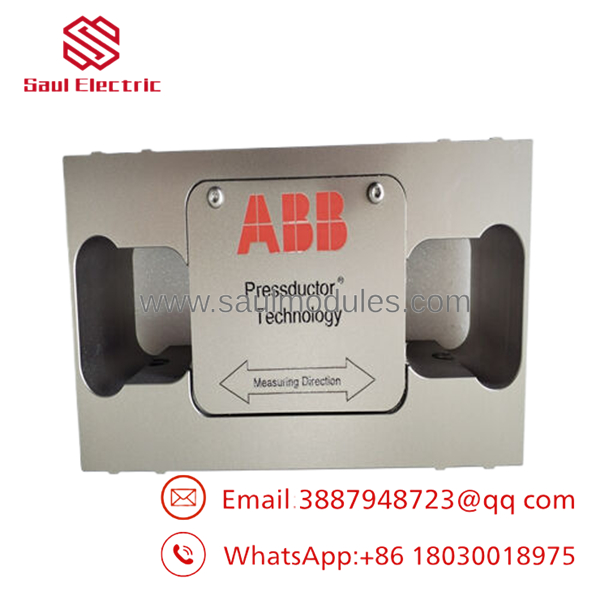
- PFTL101A 1.0 kN
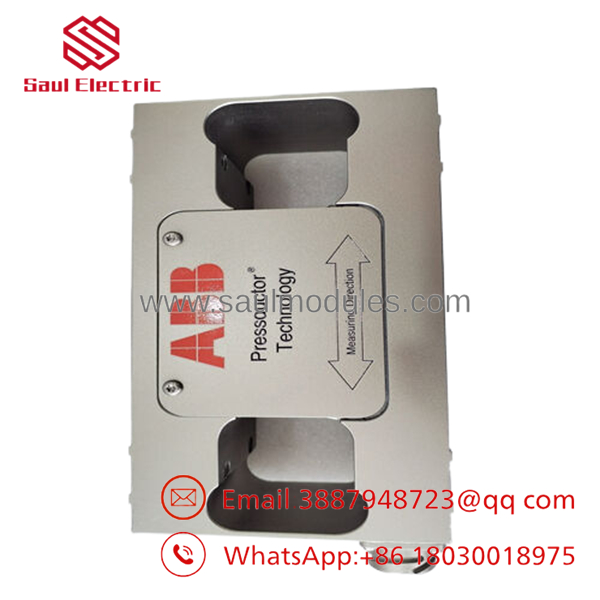
- 1.0 kN
Firmware / System Integration Notes
- The is a passive Pressductor® load cell and contains no programmable firmware.
- It operates with compatible ABB force measurement electronics and web tension controllers.
- Verify excitation and signal conditioning compatibility before replacement.
- After installation, perform zero adjustment and span verification using the associated transmitter or controller.
- Inspect the complete tension measurement chain—including cables, transmitter, and controller—to ensure optimal system performance.
Frequently Asked Questions (FAQ)
Q1. Is this sensor genuinely new?
Yes. This product is supplied as New Original / New Surplus. It is not used, repaired, or refurbished. Each sensor undergoes quality verification before shipment.
Q2. What makes Pressductor® technology different from strain gauges?
Pressductor® technology measures force through changes in the magnetic properties of steel rather than strain-gauge resistance. This provides exceptional overload resistance, long-term stability, and reliable operation in harsh industrial environments.
Q3. What does the 1.0 kN rating mean?
The 1.0 kN designation indicates the sensor’s nominal measuring capacity of 1,000 newtons of horizontal force, making it suitable for low- to medium-tension web handling applications.
Q4. Which industries commonly use the ?
Typical applications include:
- Paper and pulp manufacturing
- Printing presses
- Film and plastic converting
- Textile production
- Steel and aluminum strip processing
- Coating, laminating, and winding systems
Q5. Does this load cell require periodic calibration?
The sensor itself is highly stable, but ABB recommends periodic verification of the complete measurement system—including the transmitter, controller, and zero/span settings—as part of preventive maintenance.
Q6. What inspections are performed before shipment?
Each New Surplus unit undergoes:
- OEM part number verification
- Serial number traceability
- Mechanical housing inspection
- Cable and connector inspection
- Visual quality inspection
- Protective packaging
- Final QC approval
Q7. What spare parts strategy is recommended?
For continuous web processing operations:
- Maintain as on-site buffer stock.
- Standardize sensor ratings across production lines where possible.
- Implement vendor consolidation for instrumentation procurement.
- Plan last-time-buy purchases if lifecycle notices indicate declining availability, reducing lead time variability and lowering long-term Total Cost of Ownership (TCO).

 Start Chat


