





Description
Product Introduction
The Allen-Bradley 1794-IB16 is a high-density 16-point 24V DC sinking digital input card designed for the modular FLEX I/O platform. It acts as an efficient signal conversion node, bringing discrete field device telemetry—such as proximity switches, pushbuttons, photoelectric eyes, and limit sensors—directly into ControlLogix, CompactLogix, or PLC-5 control architectures over EtherNet/IP, ControlNet, or DeviceNet adapters.
Unlike chassis-bound I/O racks, the 1794-IB16 mounts on a terminal base unit (such as the 1794-TB3 or 1794-TB3S), decoupling field wiring from the active electronics. This modular approach allows engineers to drop high-density I/O clusters straight into field enclosures near actuators, cutting long multi-conductor home-run cable pulls and minimizing cabinet wiring footprint.
Key Technical Specifications
| Parameter | Value |
| Inputs | 16 Discrete Sinking (1 Group of 16) |
| Nominal Input Voltage | 24V DC |
| On-State Voltage Range | 10.0 to 31.2V DC |
| On-State Current | 2.0 mA minimum @ 10V DC, 8.2 mA maximum @ 31.2V DC |
| Off-State Voltage (Max) | 5.0V DC |
| Off-State Current (Max) | 1.5 mA |
| Flexbus Current | 30 mA @ 5V DC |
| Power Dissipation | 6.1 W maximum @ 31.2V DC |
| Hardware Filter Delay | Off-to-On: 0.25 ms to 0.5 ms |
| Compatible Terminal Bases | 1794-TB3, 1794-TB3S, 1794-TB3K, 1794-TB3SK |
| Isolation Voltage | 50V continuous (Tested at 850V DC for 1 s, Inputs-to-Flexbus) |
Application Scenarios & The “Trench” Experience
Here is a scenario from the field: A remote conveyor transfer bay in a logistics hub loses communication on an entire field box. Water dripping from an overhead steam line soaked the junction enclosure, corroding the backplane pin headers on an old input card. The sorting line stops dead, backing up thousands of packages. Clipping in a replacement 1794-IB16 onto the existing terminal base restores sensor tracking without touching a single field wire, getting the sorter moving again in minutes.
- Distribution & Warehousing – Photoeye Container Detection – Tracks high-speed package flow along extended sorting conveyor belts.
- Automotive Stamping & Body Shops – Clamp & Fixture Status – Reads sourcing 24V DC proximity sensors confirming part seating before robotic weld cycles.
- Food & Beverage Packaging – Rotary Indexing Stations – Captures discrete limit switch signals across high-speed capping and cartoning equipment.
- Water Treatment Facilities – Valving & Gate Telemetry – Routes valve-open/valve-closed limit switch statuses back to remote FLEX network adapters.
Field Case Study: A paper converting plant in Ohio suffered constant input drops on a rewinder machine due to severe machine vibration vibrating terminal screws loose. The maintenance crew spent hours hunting phantom sensor faults. We dispatched a bench-tested 1794-IB16 and a spring-clamp terminal base (1794-TB3S). The technician snapped the module in place, eliminating vibration-induced sensor drops and restoring 100% line uptime before the next shift.
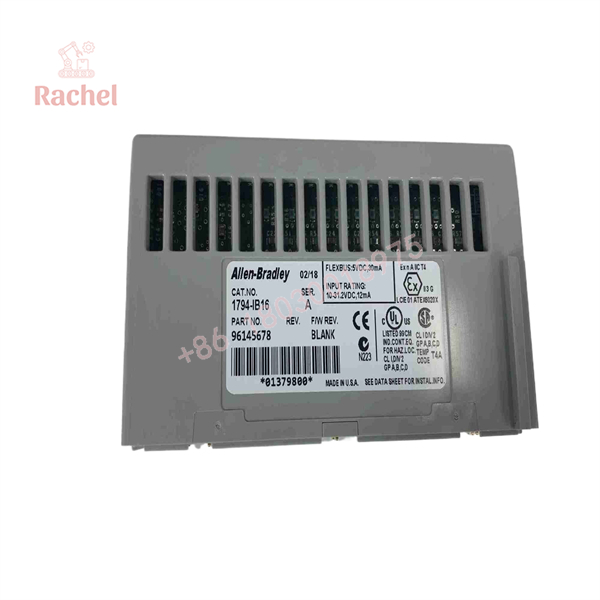
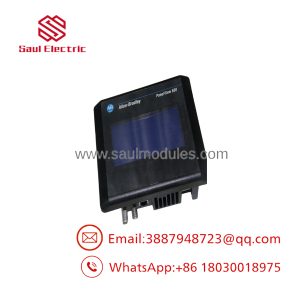
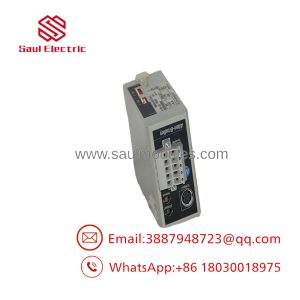
1794-IB16
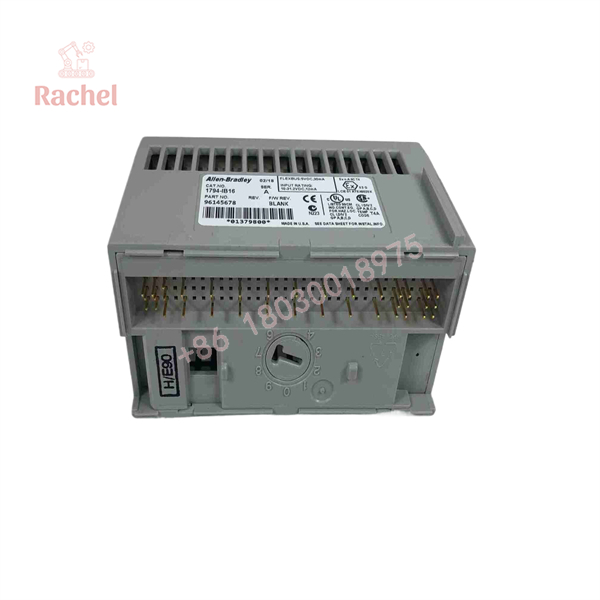
1794-IB16
Transparency SOP: Quality Assurance & Testing
We don’t just ship boxes; we test them on actual Allen-Bradley FLEX I/O racks. Every 1794-IB16 undergoes our strict 5-stage bench verification process:
- Inbound Physical Inspection: Check housing latching mechanism, keyswitch positioning pin, backplane bus pins, and confirm genuine Rockwell anti-counterfeit markings.
- Live Rig Power-On Testing: Snap the module onto a 1794-TB3 base tied to a 1794-AENT EtherNet/IP adapter. Power up and confirm the module passes self-test diagnostics (yellow channel LEDs flash, Flexbus LED turns solid).
- 16-Point Channel Injection Test: Apply 24V DC to each input channel (0–15) using a calibrated signal source. Verify channel LED illumination and check real-time bit transitions inside Studio 5000 / RSLogix controller tags.
- Flexbus Communication Stress Check: Run continuous cyclic data polling across the backplane bus to ensure zero dropped packets or backplane fault trips under sustained load.
- ESD Cleaning & Static Packaging: Clean module exterior with anti-static solution, seal inside protective ESD shielding bags, and pack using high-density foam casing.
The Veteran’s Tech Trap Guide (Crucial Value-Add)
- ⚠️ Match the Keyswitch Position! Before snapping the new 1794-IB16 onto the terminal base, check the base’s mechanical keyswitch dial. The 1794-IB16 requires Keyswitch Position 2. Forcing the module onto a base set to a different position will bend or break the internal bus pins!
- ❗ Understand Sinking vs. Sourcing: The 1794-IB16 has sinking inputs. That means it expects current to flow into the terminal module from a sourcing field device (PNP sensors or switching the 24V DC + side). If your field devices are NPN (sinking), you need a sourcing input module like the 1794-IV16 instead.
- ⚠️ Watch Terminal Base Compatibility: Make sure you use a 3-wire terminal base (like the 1794-TB3 or 1794-TB3S) if your field sensors require dedicated 24V DC power and ground connections at the base. A 2-wire base (1794-TB2) won’t provide enough common terminals for 16 3-wire proximity sensors without adding external terminal blocks!
- ❗ Hot-Swapping Rules (RIUP): FLEX I/O modules support Removal and Insertion Under Power (RIUP). You can slide the module off its terminal base while the rest of the FLEX node is powered. However, align the module straight when pushing it onto the base—cocking it at an angle can cause transient bus glitches that trip adjacent cards on the same adapter.
Frequently Asked Questions (FAQ for Conversion)
Q: Is the 1794-IB16 hot-swappable (RIUP)?
A: Yes. You can remove and insert the 1794-IB16 module under power without disturbing field wiring or shutting down power to other modules on the same 1794 FLEX backplane adapter.
Q: Does the 1794-IB16 module include the terminal base?
A: No. FLEX I/O modules and terminal bases (such as 1794-TB3 or 1794-TB3S) are sold separately. If you are replacing an existing card in an established panel, your new 1794-IB16 snaps directly onto the existing base.
Q: What is the difference between the 1794-IB16 and the 1794-IB16XT?
A: The “XT” variant stands for Extended Temperature. The 1794-IB16XT is conformal-coated and rated for extreme operating temperatures (-20 °C to +70 °C), making it suitable for harsh outdoor or unconditioned control cabinets.
Q: Can I use 12V DC input signals with the 1794-IB16?
A: The minimum On-State voltage for the 1794-IB16 is 10.0V DC, so it will recognize a 12V DC signal. However, it is optimized for nominal 24V DC industrial control loops.
Q: Why buy New Surplus from you instead of waiting for direct factory orders?
A: Lead times for discrete FLEX I/O cards through standard distributor channels can extend for weeks during supply chain pinches. Sourcing fully bench-tested, on-the-shelf surplus gets your machinery running immediately at a lower cost than factory list price.
Q: What warranty comes with this input card?
A: Every 1794-IB16 module (New Surplus or Refurbished) comes backed by our full 12-month functional replacement warranty. If a channel fails under normal operating conditions within a year, we replace the unit right away.

 Start Chat


