





Description
Product Introduction
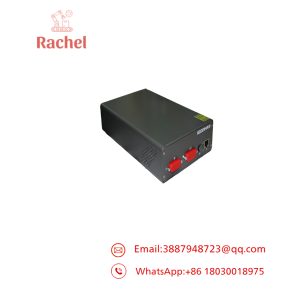
The GESAS GmbH CAN-DCM is an advanced digital control and signal amplifier module designed for demanding industrial automation, marine steering systems, and mobile machinery applications. Developed to handle precise closed-loop monitoring, this unit acts as a high-performance bridge for processing complex feedback loops and translating commands over an industrial CAN bus architecture.
Unlike basic signal converters, the CAN-DCM features robust onboard microprocessing and flexible hardware configuration options via internal DIP switches and jumpers. Its compact, DIN-rail mountable layout houses 32 heavy-duty screw terminals, making it exceptionally well-suited for tight control panels where stable signal conditioning and rapid motor speed response are critical.
Key Technical Specifications
| Parameter | Value |
| Manufacturer | GESAS GmbH |
| Model Designation | CAN-DCM (Digital Control Module / Amplifier) |
| Product Type | Digital Signal Processor & RPM Controller |
| Communication Interface | CAN Bus (Standard/Extended 2.0B protocol) |
| Terminal Configuration | 32 Industrial Screw Terminals |
| Nominal Power Supply | 24V DC |
| Mounting Type | DIN Rail Mountable (Enclosure IP20 rated) |
| Hardware Configuration | Onboard DIL/DIP Switches & Jumpers |
| Operating Temperature | -20°C to +65°C Ambient |
| Weight | Approx. 0.25 kg (0.55 lbs) |
Application Scenarios & The “Trench” Experience
It’s midnight at an automated marine propulsion and steering testing facility, and a critical control node drops offline, throwing communication faults across the network. The culprit is a fried digital amplifier module that succumbed to years of cumulative vibration and thermal stress. The facility faces severe testing delays. Dropping in a pre-tested, surplus GESAS CAN-DCM—after carefully matching the old unit’s internal jumper settings—restores the CAN data handshake and precise RPM regulation instantly, bypassing a costly system redesign.
Specific Application Scenarios:
- Marine Automation & Steering: Managing feedback loops and proportional signal control for vessel steering gear.
- Mobile Machinery & Hydraulics: Regulating actuator speeds and valve positioning in heavy-duty off-highway equipment.
- Industrial Motor Speed Control: Executing precise RPM monitoring and local loop compensation on automated production skids.
- Process Automation Test Benches: Interfacing multi-channel sensor arrays with central supervisory controllers over a CAN network.
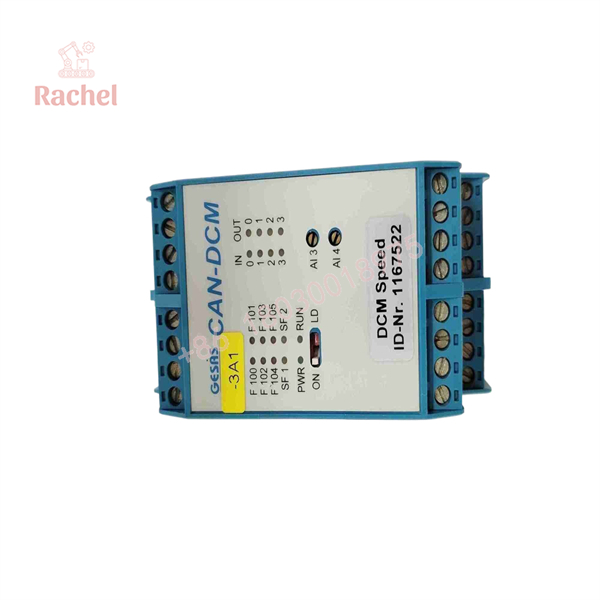
CAN-DCM
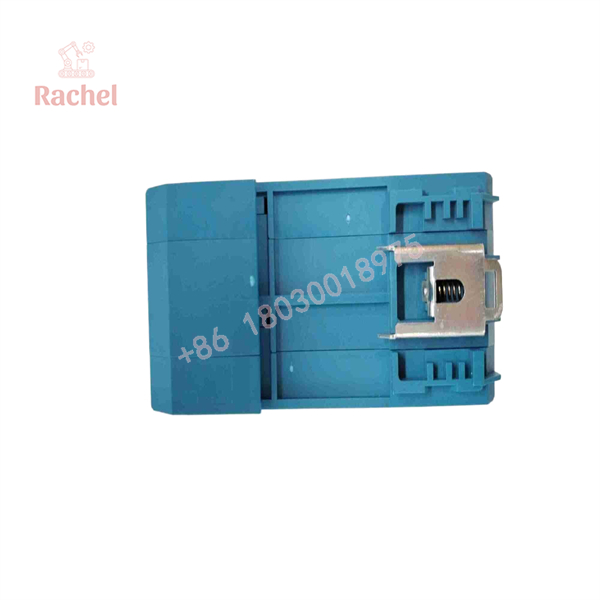
CAN-DCM
Transparency SOP: Quality Assurance & Testing
Every GESAS CAN-DCM module sourced for our inventory passes through a rigorous multi-stage verification protocol:
- Inbound Visual Audit: Inspection of the plastic housing, 32 screw terminal blocks, and internal PCB traces for signs of thermal discoloration, flux residue, or physical damage.
- Static Power Plane Check: Resistance testing across the 24V DC power rails to verify complete isolation and confirm zero short circuits on internal filtering components.
- Firmware & Processor Verification: Bench-powering the module to check version consistency (e.g., V2.20), ensuring stable CPU boot sequences and watchdog operation.
- CAN Bus & I/O Loop Testing: Connecting the module to a live CAN network simulator to test packet transmission, command execution, and response times across all terminal channels.
- Thermal Burn-In: Running a continuous stability test under operational load for 30 minutes to verify thermal dissipation and prevent component drift.
- Anti-Static Shielding: Sealed in heavy-duty dissipative ESD bags wrapped in dense, custom-molded protective foam for secure shipping.
The Veteran’s Tech Trap Guide
⚠️ 1. Document Jumper and DIL Switch Settings First
Do not swap a CAN-DCM blindly. The module relies heavily on physical jumpers and DIL switch configurations on its internal boards to set device addresses, analog output ranges (e.g., 4-20mA vs. voltage mode), and termination resistors. Always mirror the exact switch positions from your failed unit to the replacement before mounting it.
❗ 2. Verify Firmware Revision Compatibility
If you are running an older control system network, make sure the firmware revision of the replacement CAN-DCM matches or is backward compatible with your master controller’s node dictionary. Mismatched object dictionaries on the CANopen/CAN layer will cause silent node dropping.
⚠️ 3. Watch Out for Ground Loops on the CAN Shield
Ensure the CAN communication cable shield is grounded correctly at one end only according to your panel blueprint. Floating or multi-point grounded shields on these older digital modules frequently pick up high-frequency inverter noise, causing sporadic frame errors.
Frequently Asked Questions
Q: Is the GESAS CAN-DCM hot-swappable?
A: No. Always execute strict Lockout/Tagout (LOTO) procedures, cut the 24V DC cabinet power, and verify zero voltage on the terminal block before attempting to unbolt or replace this module.
Q: Can I use this module as a direct substitute for other GESAS amplifier variants like the CAN-DPV?
A: No. While they share similar physical form factors within the GESAS product ecosystem, their internal processing profiles, firmware maps, and channel functions are engineered for entirely different tasks. Check your exact part number suffix.
Q: Why choose a surplus CAN-DCM over a modern equivalent?
A: Replacing a legacy proprietary module with a modern third-party alternative often requires rewriting the controller’s communication stack, altering cabinet footprints, and dealing with extensive downtime. Using an exact-match tested surplus unit provides a drop-in solution.
Q: What kind of warranty comes with this module?
A: All our New Surplus and refurbished GESAS automation parts are backed by a comprehensive 12-month functional replacement warranty.

 Start Chat


