





Description
Product Introduction & Engineering Value
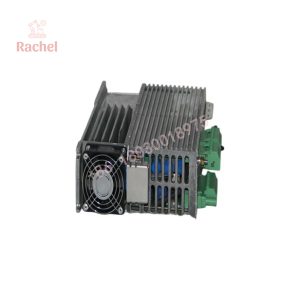
The 60WKS-M24022 is an older-generation analog servo amplifier intended for Kollmorgen SM-series synchronous servo motors with rotor-position and tachometer feedback. Its power stage uses three-phase PWM transistor technology, while PI control loops regulate motor speed and trapezoidal output current. This is a legacy drive, but that does not make it technically irrelevant; many machines remain dependent on this exact control architecture.
For maintenance teams, the key advantage is replacement compatibility without immediately redesigning the machine’s motion-control section. The amplifier provides differential setpoint inputs, an enable input, feedback interfaces, isolated control inputs, diagnostic LEDs, and an integrated ballast circuit. It is therefore particularly valuable when maintaining an older machine where changing the entire servo platform would require extensive electrical and mechanical validation.
Technical Specifications
| Specification | 60WKS-M24022 |
|---|---|
| Series | 60WKS |
| Drive Type | Analog transistor servo amplifier |
| Rated Supply Voltage | 3 × 60–172 VAC |
| Supply Frequency | 50–60 Hz, +10% maximum |
| Rated DC-Link Voltage | 240 VDC |
| Rated Output Current | 22 A |
| Peak Output Current | Approximately 50 A for up to 5 seconds |
| Nominal Input Power | Approximately 3.7 kVA |
| Maximum AC Fuse | 3 × 20 A |
| Ballast Pulse Power | 5.4 kW |
| Ballast Continuous Power | 135 W |
| Minimum Motor Inductance | 0.7 mH |
| Output Stage | Three-phase PWM transistor stage |
| Auxiliary Voltage | ±15 V |
| Control Method | PI speed/current control |
| Feedback | Rotor-position sensor and tachometer input |
The published Kollmorgen technical data gives the 22 A version a 3.7 kVA nominal supply rating, 50 A maximum pulse output current, 0.7 mH minimum motor inductance, and a 5.4 kW ballast pulse rating.
Control and I/O Characteristics
Setpoint inputs: Two differential setpoint inputs are provided, with the second setpoint adjustable.
Motor feedback: The 60WKS architecture accepts rotor-position feedback and tachometer signals used for phase switching and speed regulation.
PLC interface: Control signals use isolated optocouplers and 24 V logic, allowing integration with conventional machine-control circuitry.
Diagnostics: LEDs indicate important operating and fault states, including supply and protection conditions.
Protection: The design includes monitoring for undervoltage, overvoltage, effective current/I²t, power-transistor temperature, rotor-position feedback, tachometer feedback, and motor-side short circuit/earth fault conditions.
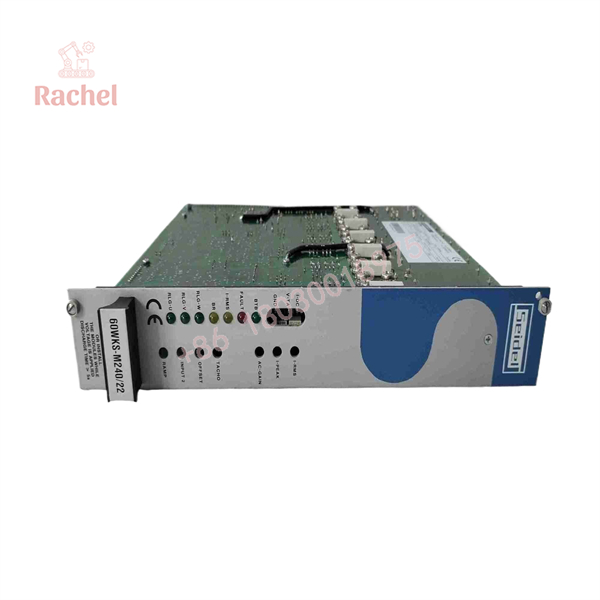
60WKS-M24022
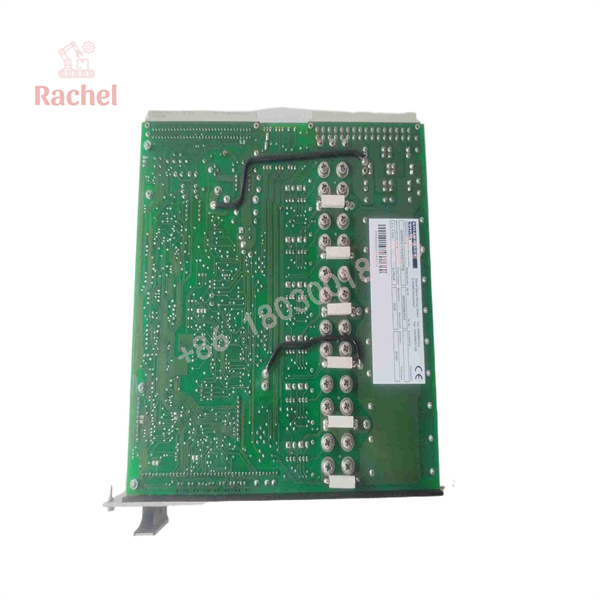
60WKS-M24022
Field Application & the “Trench” Experience
A maintenance team at an older automated converting machine gets a familiar problem: the servo axis suddenly stops during production, and the controller reports a drive fault. The PLC, motion command, and motor feedback wiring all test correctly. The failed component turns out to be the 60WKS servo amplifier.
The important decision is not simply “find a 22 A drive.” The replacement must match the machine’s feedback arrangement, motor inductance, control-voltage architecture, setpoint configuration, and the exact 60WKS variant. A modern digital servo may have considerably more functionality, but dropping one into the cabinet is not automatically an electrical equivalent.
A verified 60WKS-M24022 replacement allows the maintenance team to preserve the existing motor and machine-control architecture while avoiding an unnecessary controls retrofit.
Niche Applications
- Legacy converting-machine web tension axes — where analog speed references and tachometer feedback remain part of the original motion loop.
- Older machine-tool auxiliary positioning axes — particularly equipment using Kollmorgen/Seidel SM-series synchronous motors.
- Packaging-machine indexing mechanisms — where a discontinued analog amplifier must be replaced without changing the PLC and motor-control cabinet.
- Retrofit-maintenance programs for 1990s-era servo cabinets — where maintaining an identical spare is preferable to introducing a new drive platform during an emergency outage.
The 60WKS family was specifically designed around SM-series synchronous servo motors using RLG/tachometer feedback and trapezoidal commutation, so compatibility must be evaluated at the motor-and-drive level.
Transparency SOP: QA & Testing
For New Surplus stock, the term should mean unused inventory rather than refurbished equipment. The physical condition and electrical test history should be documented separately.
A sensible incoming inspection sequence is:
- Nameplate verification — confirm 60WKS-M240/22 identification, voltage/current rating, option suffix, serial information, and revision markings.
- Visual inspection — inspect the PCB, terminal blocks, heatsink, connectors, potentiometers, mounting hardware, and enclosure for storage damage or contamination.
- Electrical inspection — check for obvious shorts and abnormal resistance between relevant power terminals before controlled energization.
- Controlled power-up — verify the DC-link and auxiliary supply behavior under suitable test conditions.
- Control and diagnostic verification — check enable circuitry, indicator LEDs, setpoint inputs, and feedback interfaces where the available test equipment permits.
- Functional load test — where practical, operate the amplifier with a compatible motor/load arrangement and verify current regulation, speed response, fault monitoring, and thermal behavior.
For refurbished units, the test record should explicitly identify which components or assemblies were repaired or replaced. A cleaned enclosure alone does not constitute refurbishment.
The Veteran’s Tech Trap Guide
⚠️ Trap #1: Buying the wrong 60WKS variant
The 60WKS family contains multiple current ratings and option configurations. The 22 A rating alone is not sufficient identification. Related -PB and -PO versions are commercially listed, and the original machine may depend on a particular option board or configuration. Verify the complete nameplate before issuing a purchase order.
⚠️ Trap #2: Treating it like a modern digital servo
This is an analog servo amplifier. Parameterization, setpoint scaling, feedback, potentiometer settings, and external control circuitry are fundamentally different from commissioning a current-generation digital drive. Do not assume that a replacement drive can simply be configured from software.
PRO TIP: Photograph every potentiometer, plug-in board, terminal connection, and jumper position before removing the failed amplifier. On legacy equipment, that photograph can be more useful than a generic wiring diagram.
⚠️ Trap #3: Ignoring motor inductance and feedback
The published specification gives a 0.7 mH minimum motor inductance for the 22 A version. The drive also depends on rotor-position and tachometer feedback for its control architecture. A motor that physically fits the machine is not necessarily electrically compatible.
⚠️ Trap #4: Skipping the ballast circuit check
The 60WKS-M240/22 has a substantial ballast circuit, with a published 5.4 kW pulse capability and 135 W continuous rating. During replacement, inspect the associated braking/ballast components rather than assuming the amplifier is the only failed element.
Dynamic FAQ
Is the 60WKS-M24022 a servo motor or a servo amplifier?
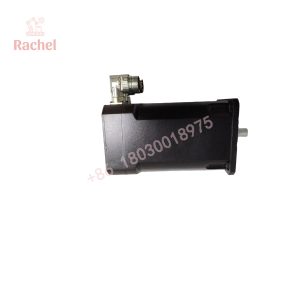
It is a servo amplifier/drive, not the motor itself. The 60WKS family was designed to drive compatible Kollmorgen SM-series synchronous servo motors.
What is the rated current of the 60WKS-M24022?
The 22 version is rated at 22 A output current, with a published peak output current of approximately 50 A for up to five seconds.
What voltage does this amplifier use?
The published 60WKS-M240/22 data specifies a three-phase 60–172 VAC supply at 50–60 Hz, with a nominal 240 VDC intermediate/DC-link voltage.
Can I replace a 60WKS-M240/22 with a modern servo drive?
Possibly, but it is not a drop-in assumption. The existing motor feedback, analog command signals, control voltage, motor inductance, braking arrangement, cabinet wiring, and machine PLC logic all need to be reviewed. For an outage repair, an exact or properly validated 60WKS replacement is usually the lower-risk route.
Is a New Surplus 60WKS-M24022 the same as a refurbished unit?
No. New Surplus should mean previously unused inventory that has entered secondary distribution rather than factory-fresh current production. Refurbished equipment has been previously used and subsequently inspected, repaired, or tested. Buyers should request photographs of the actual unit, nameplate data, condition statement, and applicable test report.
What warranty should I expect?
Warranty terms depend on the supplier and condition category. Do not assume that a third-party warranty is equivalent to a Kollmorgen manufacturer warranty. The quotation should clearly state the warranty period, whether it covers parts and labor, and the procedure for handling a failure after installation.
Is the 60WKS-M24022 still a current Kollmorgen product?
The 60WKS-M240/22 is treated in current secondary-market listings as a legacy/retired servo amplifier, so availability is primarily through industrial spare-parts channels rather than normal current-product distribution.

 Start Chat


