





Description
Product Introduction
The Watlow Anafaze CLS204 is built for applications where several heating zones must be controlled independently from one controller. Its four-loop architecture can simplify temperature regulation in thermal-processing machinery, reducing the need for separate single-loop controllers when the application and wiring configuration are compatible.
For maintenance and replacement projects, verify more than the CLS204 front-panel designation. The original ordering code can specify firmware, terminal-board arrangement, power-supply option, and serial communication settings. A controller with the same base model but different options may not be a direct replacement.
Key Technical Specifications
| Parameter | Specification |
|---|---|
| Manufacturer | Watlow Anafaze |
| Model | CLS204 |
| Product family | CLS200 |
| Number of control loops | 4 |
| Product type | Multi-loop temperature/process controller |
| Supported inputs | Thermocouples and low-level linear inputs on standard configurations |
| Analog input signal | Standard unit supports thermocouples and −10 to +60 mV linear inputs |
| Controller firmware | Standard, ramp-and-soak, enhanced, or custom options |
| Serial interface | EIA/TIA-232 or EIA/TIA-485, depending on configuration |
| Terminal interface | SCSI connector or optional terminal-board arrangement |
| Power supply | Depends on ordered configuration; the CLS200 ordering guide lists a 120/240 VAC, 50/60 Hz adapter option with 15 VDC output |
| Mounting and form factor | Panel-mounted controller; confirm cutout and terminal arrangement against the unit |
| Operating temperature | Verify against the applicable model documentation |
| Lifecycle | Legacy product; current factory availability requires confirmation |
The CLS200 ordering documentation is the key reference for configuration options. Do not assume every CLS204 has the same power supply, terminal board, communications jumper settings, or firmware.
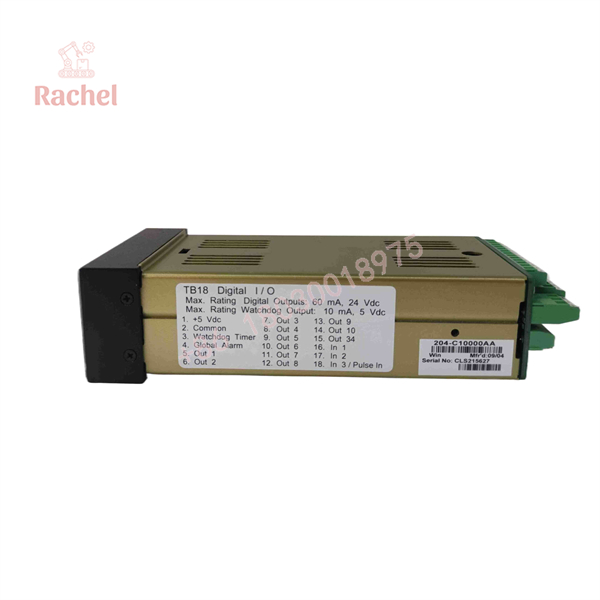
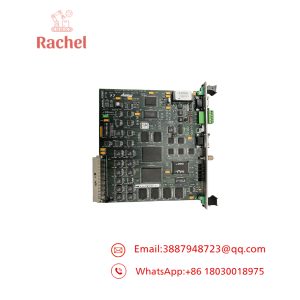
CLS204
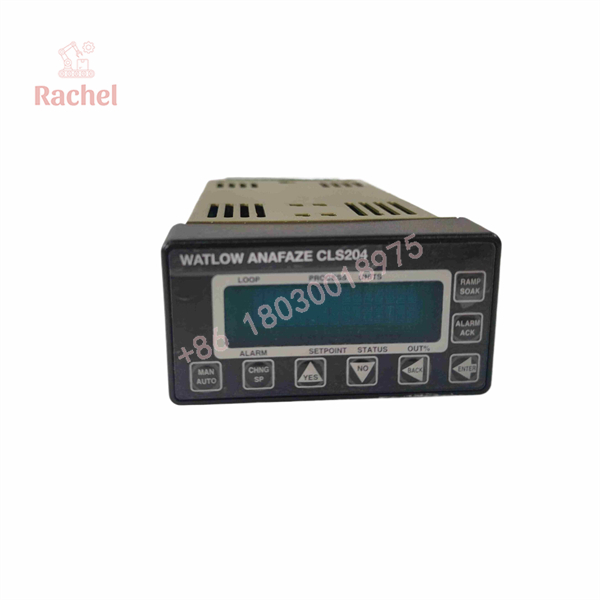
CLS204
Application Scenarios & Field Experience
Typical applications
- Plastic extrusion: Controls multiple barrel or die heating zones with separate temperature setpoints.
- Thermal processing equipment: Regulates several heating zones in ovens, dryers, or similar machinery.
- Industrial heating systems: Coordinates independent temperature loops within a machine or process skid.
- Ramp-and-soak processes: Supports applications that require programmed temperature changes when the installed firmware includes that option.
- Legacy machinery maintenance: Allows continued operation of existing equipment where the original controller configuration must be preserved.
These are representative applications for a multi-loop controller; actual suitability depends on the installed input, output, and firmware configuration.
Field troubleshooting example
Illustrative scenario, not a verified customer case.
A production line experiences unstable temperatures in one heating zone after a controller replacement. The other zones continue to operate normally.
The maintenance team should verify the thermocouple type and polarity, input configuration, output wiring, loop parameters, and the replacement controller’s firmware option. If the original unit used ramp-and-soak or custom firmware, a standard-firmware replacement may behave differently even when the base model number matches.
Transparency SOP: Quality Assurance & Testing
The following is a recommended test procedure for a surplus or refurbished CLS204. It does not mean a particular unit has already been tested.
- Part identification: Record the full model and ordering code, including firmware, terminal-board, power, and communications options.
- Physical inspection: Check the housing, display, keypad, connectors, and terminal hardware for damage or corrosion.
- Power verification: Confirm the installed power arrangement against the unit’s label and applicable documentation before energizing it.
- Input simulation: Apply suitable calibrated thermocouple-simulator or millivolt signals to each intended input channel.
- Loop function test: Check that each control loop reads its input correctly and responds to the configured setpoint and control parameters.
- Output verification: Test the installed output interface using an appropriate safe test setup; output hardware must be confirmed for the specific configuration.
- Communications test: Verify serial communications using the correct EIA/TIA-232 or EIA/TIA-485 wiring, settings, and host protocol.
- Final QC report: Record channel-by-channel results, firmware identification, configuration details, faults, and warranty conditions.
Important: Do not connect a replacement controller to live heating equipment until its output behavior and control parameters have been verified. Incorrect configuration can cause uncontrolled heating or process interruption.
Veteran’s Tech Trap Guide
- ⚠️ The base model is not the full ordering code. Confirm the complete CLS200 configuration. Terminal-board and cable options can differ.
- ⚠️ Check the firmware before swapping. Ramp-and-soak, enhanced, and custom firmware can affect machine behavior. A standard version may not reproduce the original program.
- ⚠️ Verify serial settings physically and in software. EIA/TIA-232 and EIA/TIA-485 use different electrical interfaces. Check jumper settings, cabling, and host configuration before troubleshooting the protocol.
- ⚠️ Do not assume the power supply is included. Some ordering configurations specify a separate power-supply adapter; others may not include one. Inspect the full part code and supplied accessories.
- ⚠️ Treat controller replacement as a process-safety task. Verify input scaling, output action, setpoints, alarms, and interlocks before returning heaters or other controlled equipment to operation.
Frequently Asked Questions
Q1: What does the Watlow Anafaze CLS204 do?
It is a four-loop temperature/process controller designed to regulate multiple independent zones in industrial thermal and process applications.
Q2: Does the CLS204 support thermocouple inputs?
Yes. The CLS200 documentation states that the standard unit supports thermocouples and −10 to +60 mV linear inputs. Verify the exact input configuration and sensor type for the installed unit.
Q3: Can I replace my CLS204 with another CLS204?
Potentially, but compare the full ordering code, firmware, terminal-board arrangement, power option, and serial settings. Matching only the base model is not sufficient to guarantee a drop-in replacement.
Q4: Does it support RS-485 communications?
Applicable CLS200 configurations support EIA/TIA-485 serial communications. The actual interface setting and termination option must be verified from the ordering code and hardware configuration.
Q5: Is the CLS204 still manufactured?
The CLS204 is a legacy product, and industrial suppliers list related CLS204 variants as discontinued. Confirm availability with Watlow or the seller rather than assuming new factory stock exists.
Q6: Can I purchase a refurbished unit?
Specialist industrial parts suppliers may offer used, surplus, or refurbished units. Request the exact ordering code, photographs, a functional test report, warranty terms, and a return policy.
Q7: What information should I provide for a replacement quote?
Provide the full model and suffix, required quantity, installed power supply, terminal-board or cable arrangement, serial interface, firmware requirements, preferred condition, and delivery destination. A clear photo of the original nameplate is especially useful.

 Start Chat


