





Description
Key Technical Specifications
| Parameter | Value |
|---|---|
| Manufacturer | ABB |
| Part Number | AI04 |
| Product Description | Analog Input module |
| Channel Count | Up to 16 channels |
| Signal Types | Thermocouples and millivolts |
| Thermocouple Types | E, J, K, R, S, T, B, L, N, U; Chinese E and S |
| mV Ranges | 0 to 100 mV or -100 to +100 mV |
| A/D Resolution | 16 bits with polarity |
| Update Time | 16 channels in 300 ms |
| Calibration | Automatic; no manual calibration required |
| Cold Junction Compensation | Configurable via base RTD, external RTD, or application input |
| Accuracy | ±0.05 percent of full scale range |
Product Introduction & Supply Chain Strategy
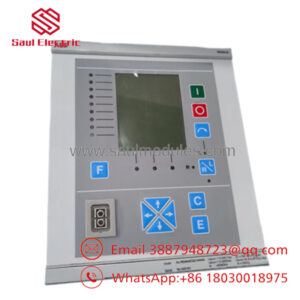
ABB AI04 is a temperature-focused analog input module for Symphony Plus SD Series I/O. It is used to bring thermocouple and millivolt process signals into the control system, making it a key interface for furnace, boiler, turbine, and similar high-temperature applications.
From a supply-chain standpoint, this is a good candidate for controlled buffer stock. The module is a legacy control spare with direct process impact, so New Surplus helps protect uptime, reduce stock-out risk, and manage TCO without overbuying.
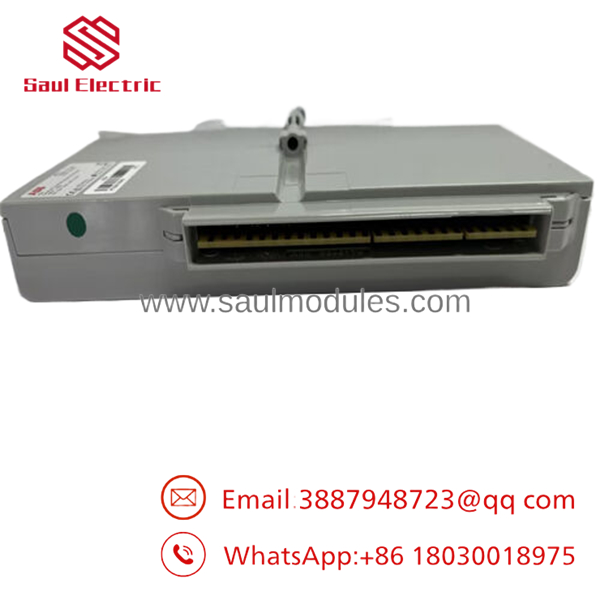
- AI04
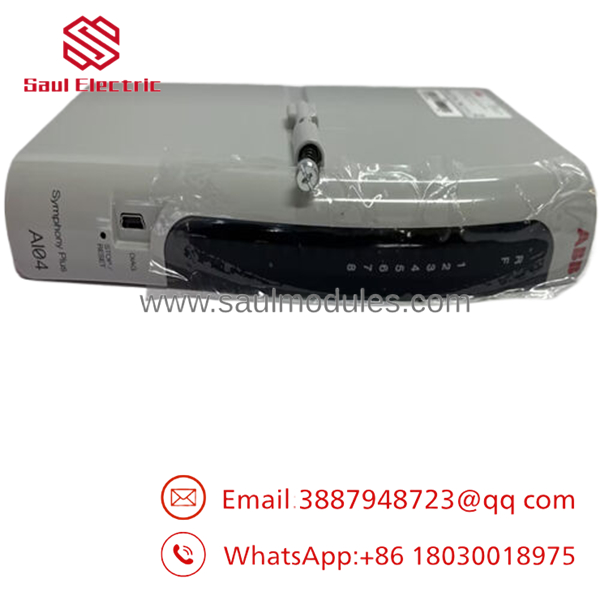
- AI04
Installation & Configuration Guide
Stage 1: Pre-Installation
- Apply lock-out/tag-out and verify the cabinet is safe.
- Use an ESD strap and document all wiring, labels, and channel assignments.
- Record the current thermocouple type, millivolt range, and cold-junction compensation method.
- Confirm the exact base and module type before removal.
Stage 2: Removal
- Remove power and confirm discharge.
- Release the module from the rack or base.
- Pull it straight out to avoid connector damage.
- Inspect the slot and terminal area for wear or contamination.
Stage 3: Installation
- Verify the replacement is the exact AI04 module.
- Reconnect field wiring to the documented channel map.
- Restore thermocouple type, range, and compensation settings exactly as before.
- Seat the module fully and secure the hardware.
Stage 4: Power-On & Testing
- Check supply rails and field loops for shorts before energizing.
- Power up and confirm normal status indications.
- Validate each input channel against a known signal source.
- Confirm the controller reads temperature values correctly before returning to service.
Firmware/Software Versions & Upgrade Notes
ABB’s published material indicates that AI04 uses FC 221 for device definition and FC 222 for channel configuration.
Keep the existing controller and I/O configuration unchanged during replacement unless the site documentation explicitly requires a change.
Firmware upgrades or downgrades are usually unnecessary for a like-for-like swap and can create scaling or compensation errors.
Frequently Asked Questions (FAQ)
Is this really new? Public listings describe it as new original or original inventory, which is the right condition target for a critical spare.
Why is it cheaper than OEM new but higher than a low-cost offer? New Surplus usually sits between OEM list pricing and lower-trust inventory because it preserves genuine OEM condition while avoiding full factory pricing.
Is this part obsolete or EOL? It remains part of the Symphony Plus SD Series I/O family, but treat it as lifecycle-sensitive if your installed base is aging.
Can I hot-swap it? Do not assume hot-swap capability. Isolate power first and follow the cabinet procedure.
Will my programming be retained automatically? Not by the module alone. Back up channel types, ranges, and cold-junction settings before removal.
What warranty should I expect? Public listings commonly show standard seller coverage, but exact terms vary by supplier.
How should I stock it? Keep 1 to 2 units on site if the plant depends on these temperature channels, and use cross-site sharing where possible.

 Start Chat


