





Description
Key Technical Specifications
| Parameter | Value |
|---|---|
| Product family | ABB Relion 615 series |
| Application | Feeder protection, control, measurement, supervision |
| Primary use | Overhead lines and cable feeders in utility and industrial power distribution |
| Protection functions | Directional and non-directional overcurrent, earth-fault, voltage, frequency, power-based functions |
| Communication | IEC 61850, Modbus, DNP3, IEC 60870-5-103 |
| Time synchronization | SNTP, IRIG-B, IEEE 1588 V2 on supported variants |
| Installation style | Withdrawable plug-in unit |
| Operating environment | Suitable for industrial and substation environments |
| Standard configurations | Multiple factory standard configurations available |
| Display/HMI | Graphical display with customizable single-line diagrams |
| Lifecycle note | Commonly used in long-life installed bases; check current revision and exact ordering code before substitution |
Product Introduction & Supply Chain Strategy
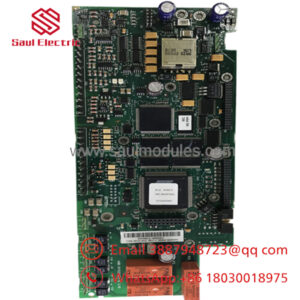
ABB REF615E is a feeder protection and control relay used to protect, monitor, and control medium-voltage feeders in industrial and utility distribution systems. It combines protection, measurement, supervision, and communications in one IED, making it a direct fit for radial, looped, and meshed feeder architectures.
Buying REF615E as New Surplus makes strategic supply-chain sense when the installed base is aging or the exact variant is hard to source. It lowers Total Cost of Ownership versus emergency OEM pricing, reduces stock-out risk for critical feeders, and avoids the hidden failure exposure that comes with questionable prior-use parts. For this class of asset, a small buffer stock is usually smarter than waiting on lead time variability.
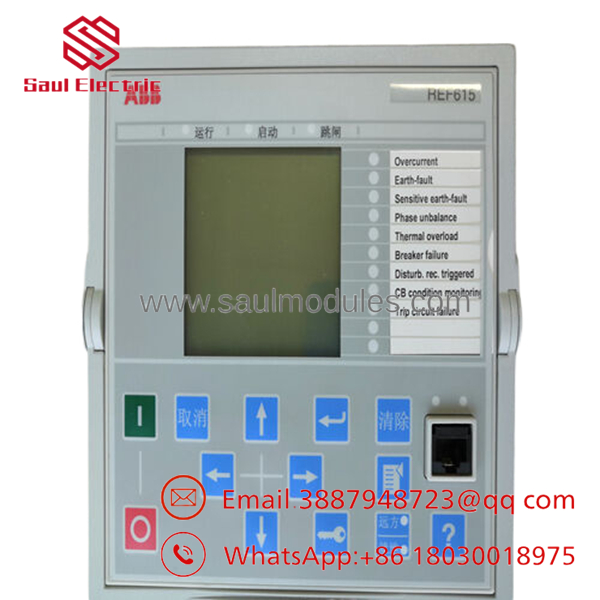
- REF615E
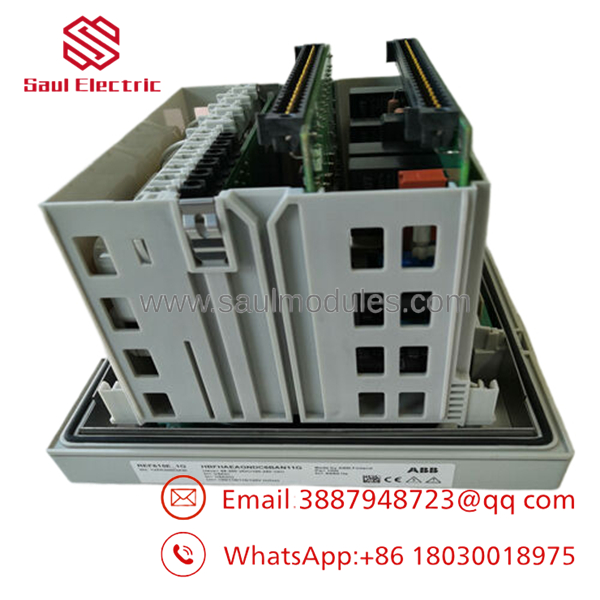
- REF615E
Installation & Configuration Guide
Stage 1: Pre-Installation
- Apply lock-out/tag-out to the feeder and verify the panel is de-energized.
- Use an ESD strap, insulated hand tools, and the exact terminal documentation for the installed variant.
- Photograph the DIP switch positions, communication settings, terminal labels, and wiring before removal.
- Confirm the target replacement has the same ordering code and hardware variant.
Stage 2: Removal
- Remove control power and verify zero voltage on the relevant rails.
- Release the module using the correct extraction method for the panel or rack.
- Pull straight out without twisting to avoid bending backplane pins or stressing the connector.
- Inspect the connector and mounting surfaces for dust, corrosion, or pin damage.
Stage 3: Installation
- Copy the DIP switch and node address settings exactly from the old unit.
- Verify any jumper or communication-card settings before seating the relay.
- Insert the module evenly and fully until the connector is completely engaged.
- Reconnect all wiring only after confirming terminal numbering matches the old unit.
Stage 4: Power-On & Testing
- Apply control power and check the 24 V supply rail for shorts before full energization.
- Confirm LED status: RUN should indicate healthy operation, while ERR should remain clear.
- Verify the relay boots without configuration alarms.
- Download or restore logic, settings, and disturbance records as required.
- Perform a functional check of trip, alarm, and communication signals before returning the feeder to service.
Firmware/Software Versions & Upgrade Notes
The exact firmware revision should match the installed bay logic and engineering standard before swap-in, because REF615E variants can differ by configuration and communication options. In practice, the safest rule is to preserve the original firmware level unless there is a documented compatibility requirement from the site engineering standard.
Upgrading firmware during a hardware replacement can create protocol mismatches, setting-file differences, or unexpected behavior in legacy station automation. Downgrading can be just as risky if the replacement unit ships with newer hardware support dependencies. For a feeder protection swap, document the original firmware, settings file, and communication parameters before installation.
Frequently Asked Questions
Is this really new, or is it refurbished?
This offering should be treated as New Original / New Surplus inventory, not refurbished. For protection relays, that distinction matters because hidden wear in relays, capacitors, or communication hardware can create avoidable downtime.
Why is it cheaper than OEM new but still not “cheap”?
Because New Surplus typically comes from secured excess inventory, not from fresh factory production. That usually lands between OEM list pricing and refurbished market pricing, with better assurance and less risk than prior-use stock.
Is REF615E obsolete?
REF615 remains in active life-cycle use across many installed bases, but exact availability depends on the specific ordering code and regional stock position. Even when the product family is still supported, individual variants may require strategic stocking.
Can I hot-swap this relay?
No, not as a casual field action. Feeder protection relays should be isolated and verified de-energized before replacement unless the site design explicitly supports a controlled maintenance procedure.
Will my settings stay in the replacement unit?
Not automatically. You should assume settings, logic, and communication parameters must be restored from a backup or copied manually during commissioning.
What warranty should I expect?
For New Surplus industrial spares, warranty terms usually depend on the supplier and the exact traceability package. Buyers should verify serial traceability, QC documentation, and the written warranty period before committing to purchase.
What is the best stocking approach for this part?
For a critical feeder relay, keep 1 to 2 units on-site as buffer stock if the installation base is important to production continuity. For slower-moving spares, use vendor consolidation, last-time-buy planning, and lifecycle tracking to avoid obsolescence write-offs.

 Start Chat


