





Description
Product Introduction
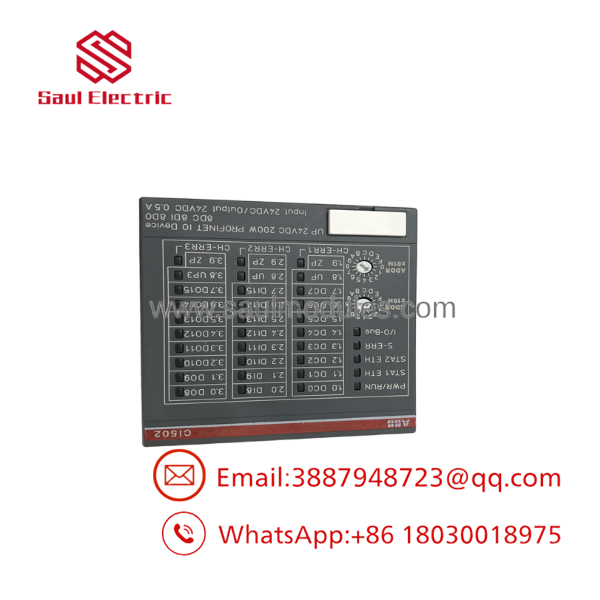
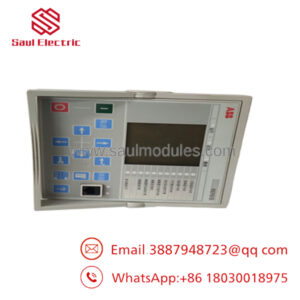
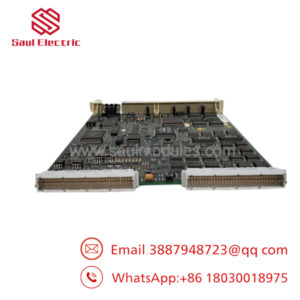
The ABB CI502-PNIO is a PROFINET RT communication interface module engineered for distributed automation architectures within the ABB AC500 platform. Installed on a TU507-ETH or TU508-ETH terminal unit, it acts as a decentralized head station, allowing an AC500 CPU or third-party PROFINET controller to manage remote S500 I/O expansion racks seamlessly over Ethernet.
Engineers specify the CI502 because it combines fieldbus routing and high-density onboard digital I/O in a single compact footprint. Featuring 8 dedicated digital inputs, 8 digital outputs, and 8 software-configurable digital input/output (DC) channels, it drastically reduces cabinet space requirements by eliminating the need for standalone I/O expansion cards on smaller remote drops.
Key Technical Specifications
| Parameter | Specification |
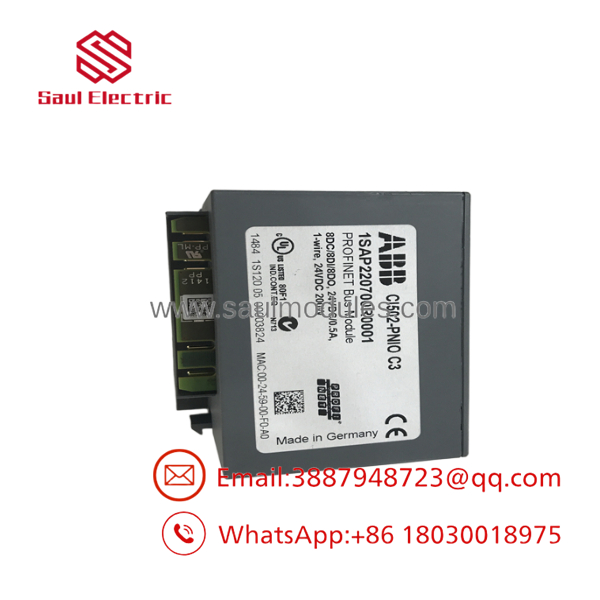
| Part Number | CI502-PNIO (1SAP220700R0001) / Extreme Conditions: 1SAP420700R0001 |
| Fieldbus Protocol | PROFINET IO RT (Real-Time) |
| Ethernet Interfaces | 2x RJ45 ports (integrated 2-port switch) via Terminal Unit |
| Process Voltage (UP/UP3) | 24 V DC (19.2 V to 30 V DC range) |
| Dedicated Digital Inputs | 8 channels (24 V DC, sink/source configurable) |
| Dedicated Digital Outputs | 8 channels (24 V DC, 0.5 A max per channel) |
| Configurable I/O (DC) | 8 channels (Software configurable as DI or DO) |
| Local Expansion Bus | Supports up to 10 additional S500 I/O expansion modules |
| Addressing Method | 2x rotary hex switches (00h to FFh) for IO Device name assignment |
| Compatible Terminal Units | TU507-ETH or TU508-ETH |
Application Scenarios & The “Trench” Experience
A food and beverage packaging line in Wisconsin hit a dead stop when a washdown pressure spray penetrated an aging remote junction box, shorting out the primary PROFINET bus interface. The plant was losing roughly $12,000 an hour in halted conveyor throughput. The maintenance team snapped off the failed module from its TU507 terminal base, dialed the two rotary hardware switches on the new CI502 to match the old station address, and clicked the unit back onto the DIN rail. System handshakes restored automatically in less than 15 minutes without touching a line of code in Automation Builder.
- Automotive Assembly – Robot Tool Changer Sub-Racks – Connects pneumatic sensors and solenoid valves directly to PROFINET masters across articulated arm cables.
- Material Handling – High-Speed Conveyor Sorting – Manages local photo-eyes and diverter gates using onboard high-speed digital channels while passing encoder data back to the central CPU.
- Water Treatment – Distributed Pumping Stations – Acts as a field remote I/O head over long-distance fiber-to-Ethernet rings to monitor flow switches and valve limits.
- HVAC & Building Automation – Chiller Plant Skids – Collects digital run/fault statuses and drives compressor enable contactors locally.
Transparency SOP: Quality Assurance & Testing
We test every CI502-PNIO module on live AC500 racks before it leaves our static-safe workspace:
- Visual & Mechanical Check: Inspect the spring-loaded DIN latching clips, terminal base connector pins, and rotary switch detents for physical damage or wear.
- Power & Isolation Verification: Apply 24 V DC to UP/ZP terminals. Verify onboard 3.3V/5V logic generation and check galvanic isolation between the Ethernet physical layer and field I/O channels.
- PROFINET Loopback & Switch Test: Plug both RJ45 ports into an active PROFINET tester ring. Run full-duplex traffic at 100 Mbps to verify integrated switch packet handling and check for frame dropouts.
- I/O Channel Drive Check: Cycle all 8 dedicated inputs, 8 outputs, and 8 configurable channels using automated loopback rigs to confirm channel LEDs match physical state changes.
- Clean & Anti-Static Seal: Clean bus contacts with residue-free solvent, enclose in ESD-shielded bags, and pack with fresh moisture desiccant.
- CI502
The Veteran’s Tech Trap Guide (Crucial Value-Add)
⚠️ The Independent UP3 Power Rail: The dedicated digital output channels run off an isolated power terminal labelled UP3. If you wire main power to UP/ZP but forget to jump 24 V DC to UP3, the will boot up, talk to PROFINET, and show green status LEDs—but your physical output relays will stay completely dead.
❗ Rotary Switch Settings vs. Name Assignment: PROFINET relies on Device Names rather than IP addresses. The two rotary switches on the front panel set the hexadecimal ID prefix. Take a photo of the old card’s rotary switch positions before pulling it off the DIN rail! If the hex switches don’t match, the PROFINET controller will refuse to assign the IP address and throw a “Station Name Not Found” bus fault.
⚠️ Terminal Unit Seating Angle: When snapping the onto a TU507-ETH or TU508-ETH terminal unit, push straight down perpendicular to the backplane. Rocking the card sideways during insertion can bend or shear the fine edge-connector pins inside the terminal base socket.
Frequently Asked Questions (FAQ for Conversion)
Q: Does the -PNIO require an external PROFINET switch?
A: No. The underlying terminal unit (TU507-ETH or TU508-ETH) incorporates an integrated 2-port Ethernet switch. This allows you to daisy-chain PROFINET cables directly from one to the next in a line topology without adding external field switches.
Q: Can I attach standard S500 expansion modules to the side of a ?
A: Yes. The acts as a full fieldbus slave head unit. You can snap up to 10 additional S500 digital, analog, or multifunctional I/O modules onto the right-hand side of the local expansion bus.
Q: What is the difference between -PNIO and CI501-PNIO?
A: The main difference lies in channel density and signal types. The CI501-PNIO features analog inputs and outputs alongside digital channels, whereas the -PNIO is strictly dedicated to high-density 24V DC digital I/O (8 DI, 8 DO, and 8 Configurable DC).
Q: Is a special firmware update required when replacing a card?
A: Generally, no. As long as your GSDML file in Automation Builder or Siemens TIA Portal ma the profile, the replacement unit will accept the hardware parameters pushed down by the PROFINET controller upon bootup.
Q: What warranty comes with these modules?
very module—whether new surplus or factory reconditioned—is backed by our full 12-month advance replacement warranty. If a channel fails or bus communications drop within a year, we ship out a replacement immediately.

 Start Chat


