





Description
Product Introduction
The ABB CM10 ControlMaster is a compact controller for regulating variables such as temperature, pressure, flow, and level. Its configurable control strategies allow it to operate as a single-loop PID controller or support other control arrangements, depending on the installed functionality and I/O configuration.
The 1/8 DIN format suits control panels where space is limited. The color display provides process values, alarm messages, and diagnostic information, while optional communications can connect the instrument to a PLC, SCADA system, or other compatible automation equipment. Confirm the complete order code before replacing an installed unit.
Key Technical Specifications
| Parameter | Specification |
|---|---|
| Manufacturer | ABB |
| Model | CM10 |
| Product family | ControlMaster |
| Product type | Universal process controller |
| Panel format | 1/8 DIN |
| Display | 2.2-inch full-color TFT |
| Control methods | On/off, time-proportioning, analog PID; other strategies depend on configuration |
| Process inputs | Universal analog input options; supported signal types depend on the ordered configuration |
| Setpoints | Local and remote setpoint arrangements, depending on configuration |
| Output options | Relay and analog outputs; exact number and type depend on order code |
| Communications | MODBUS and optional Ethernet; verify installed option |
| Configuration software | ABB ConfigPilot |
| Front-panel protection | IP66 / NEMA 4X when installed according to ABB instructions |
| Power supply | Confirm the voltage range from the specific model label and datasheet |
| Mounting | Panel-mounted |
| Lifecycle | Confirm current availability and support with ABB or an authorized supplier |
ABB offers multiple CM10 configurations, so the base model alone does not establish the exact input range, output count, communication interface, or power-supply specification. Use the full ordering code and the applicable datasheet to verify these details.
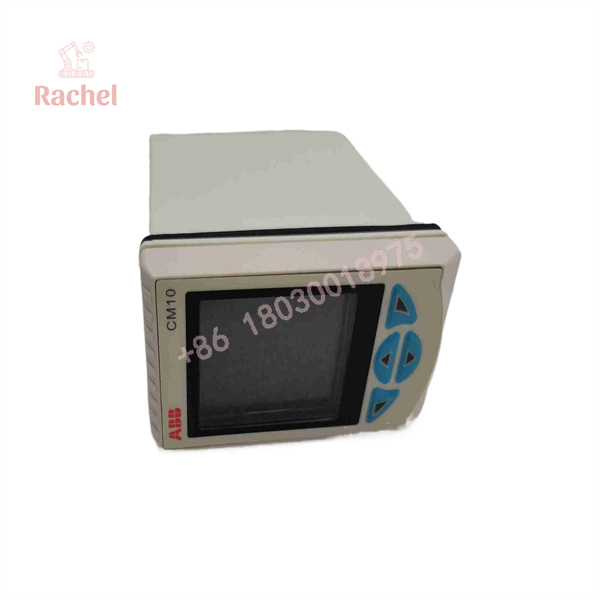
CM10
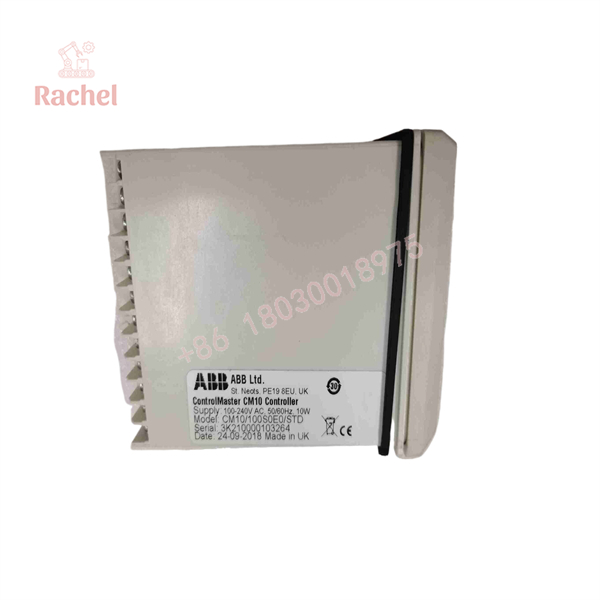
CM10
Application Scenarios & Field Experience
Typical applications
- Temperature control: Regulates heaters and thermal processes using a compatible sensor input and configured output.
- Flow control: Maintains a flow setpoint through a compatible control valve or actuator.
- Pressure regulation: Uses process feedback to adjust a control element within the limits of the application.
- Water and wastewater treatment: Supports process regulation in applications such as aeration and related process-control duties.
- Industrial skid systems: Provides local operator display, alarm indication, and process control in a compact panel.
ABB identifies the CM10 as suitable for a broad range of process-control applications, including control strategies and math-and-logic functions. Actual suitability depends on the configured inputs, outputs, and control functionality.
Field troubleshooting example
Illustrative scenario, not a verified customer case.
A process temperature fluctuates after a CM10 controller is replaced. The displayed temperature appears reasonable, but the heater output cycles more frequently than before.
Before changing the PID settings, check the sensor type, input scaling, output assignment, control action, setpoint source, and configuration backup. If the original controller used a particular output type or control strategy, a replacement with a different order code may require additional wiring and configuration work.
Transparency SOP: Quality Assurance & Testing
The following is a recommended inspection procedure for a new-surplus, used, or refurbished CM10. It does not mean that a particular unit has already passed these tests.
- Model identification: Record the complete order code, supply rating, communication options, and I/O configuration from the label.
- Physical inspection: Check the display, front-panel buttons, housing, rear terminals, and mounting hardware for damage.
- Power verification: Confirm the rated supply from the unit label and relevant ABB documentation before energizing the controller.
- Input simulation: Apply a suitable calibrated signal to the configured input and compare the displayed process value with the reference.
- Control-function test: Verify setpoint entry, control mode, alarm thresholds, and output action using a controlled test setup.
- Output verification: Test the installed relay or analog output options against the expected configuration before connecting actual field loads.
- Communications test: If required, verify MODBUS or Ethernet functionality using the appropriate interface, settings, and host software.
- Final QC report: Document the test equipment, measured values, configuration, faults, and warranty conditions.
Safety note: ABB warns that hazardous voltage may be present at the controller terminals. Isolate the supply before accessing terminal covers and follow the commissioning instructions.
Veteran’s Tech Trap Guide
- ⚠️ Do not order by “CM10” alone. The complete order code determines important hardware and functionality options. Match the existing unit’s full designation.
- ⚠️ Check the output type. Relay, analog, and other configured outputs are not interchangeable without checking the wiring and control design.
- ⚠️ Confirm communications options. MODBUS availability does not automatically mean the unit has Ethernet, and a compatible protocol still requires correct wiring and settings.
- ⚠️ Do not overlook panel sealing. The IP66/NEMA 4X rating applies to the front panel when installed correctly; it does not mean the rear terminals can be exposed to water.
- ⚠️ Preserve the original configuration. Record input scaling, control action, setpoints, alarms, and PID values before replacing a controller. Incorrect settings can cause unstable control or unsafe process conditions.
Frequently Asked Questions
Q1: What is the ABB CM10 used for?
The CM10 is a universal process controller used to regulate variables such as temperature, pressure, flow, and level through configurable control strategies.
Q2: Does the CM10 support PID control?
Yes. ABB lists analog PID among its supported control functions, alongside on/off and time-proportioning control. Additional strategies depend on the selected configuration.
Q3: Does it support MODBUS and Ethernet?
ABB offers MODBUS and Ethernet communication options. Verify the complete model code and installed communication hardware before planning a connection to a PLC or SCADA system.
Q4: Can I replace an existing CM10 directly?
A direct replacement may be possible if the complete configuration matches. Compare the order code, supply rating, inputs, outputs, communications, and programmed settings before installation.
Q5: Can the CM10 be configured without a computer?
Yes. ABB supports configuration through the front-panel menus. ConfigPilot software is also available for PC-based configuration tasks.
Q6: Is the CM10 still available as new equipment?
ABB continues to publish CM10 product documentation and parts information, but this does not guarantee stock for every configuration. Confirm current availability with ABB or the supplier.
Q7: What should I include in a purchase inquiry?
Provide the complete CM10 order code, required quantity, supply rating, input/output requirements, communication options, preferred condition, and delivery destination. A clear photo of the existing nameplate helps avoid ordering a mismatched configuration.

 Start Chat


