





Description
Product Introduction & Engineering Value
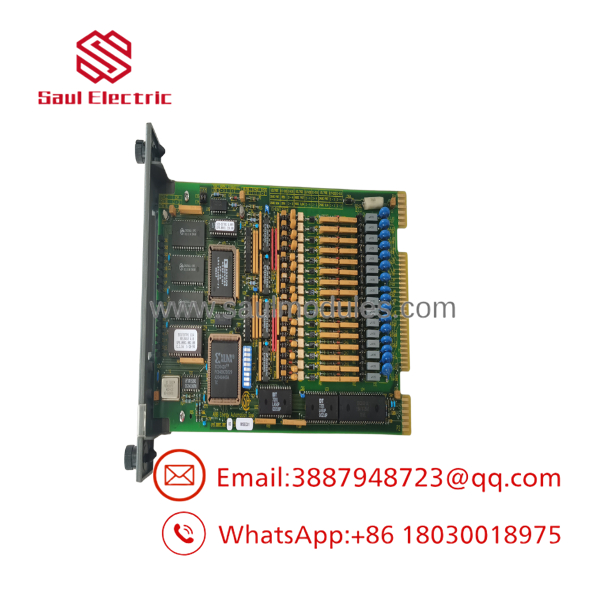
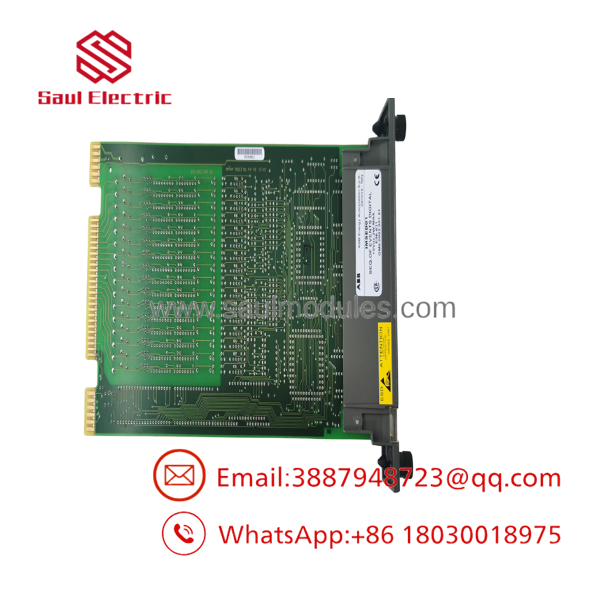
When troubleshooting a plant trip, the first question is usually, “Which signal changed first?” The ABB IMSED01 answers that question by recording digital input transitions with precise event sequencing, allowing engineers to reconstruct fault conditions instead of relying on alarm timestamps alone.
Designed for the ABB Harmony and Bailey INFI 90 architecture, the IMSED01 provides high-speed digital event acquisition while working alongside the IMSET01 timing module and Harmony controller. It is commonly installed in power generation and continuous-process facilities where event chronology is essential for post-trip analysis.
Technical Specifications
| Parameter | Specification |
|---|---|
| Manufacturer | ABB |
| Model | IMSED01 |
| Product Type | Sequence of Events Digital Input Module |
| System Platform | Harmony / INFI 90 |
| Digital Inputs | 16 optically isolated channels |
| Operating Modes | Standard Digital Input Mode and SOE Mode |
| Event Resolution | 1 millisecond acquisition in SOE mode |
| Maximum Modules | Up to 63 IMSED01 modules with one IMSET01 per I/O expander bus |
| Communication | Harmony I/O Expander Bus |
| Mounting | Standard Harmony module mounting unit |
| Operating Temperature | 0°C to 70°C (32°F to 158°F) |
| Relative Humidity | 5–95% RH (non-condensing) |
Field Application & The “Trench” Experience
Following an unexpected turbine shutdown, operators discovered that multiple protective contacts had changed state within milliseconds. Conventional alarm logs could not determine whether the breaker opened before the protection relay operated or vice versa.
An existing IMSED01-based Sequence of Events system provided the missing evidence. The recorded event sequence showed that an auxiliary contact briefly oscillated before the trip signal was issued, allowing maintenance personnel to identify a deteriorating switch instead of replacing an otherwise healthy protection relay.
Typical application scenarios include:
- Generator protection event recording in utility power stations
- Emergency shutdown (ESD) sequence analysis for LNG compressor trains
- Boiler trip and burner management diagnostics
- High-speed breaker status monitoring in electrical substations
Transparency SOP: QA & Testing
Before shipment, every IMSED01 undergoes a documented inspection and functional verification procedure.
- Module identification, hardware revision, and serial number verification.
- Visual inspection for PCB damage, oxidation, connector wear, and mechanical defects.
- Functional power-up using a compatible Harmony/INFI 90 test rack.
- Digital input simulation across all 16 channels.
- Event timestamp verification under Sequence of Events operating mode.
- Final ESD-safe packaging with traceable inventory documentation.
Functional testing confirms event acquisition capability rather than relying solely on cosmetic inspection.
The Veteran’s Tech Trap Guide
⚠️ Do not install the by itself in an SOE system expecting absolute time synchronization. Unlike the IMSET01, the does not receive the external time-sync link directly. It obtains synchronized time through the controller, which broadcasts timing information from the IMSET01.
⚠️ Verify input filtering parameters before commissioning. Debounce settings that are too aggressive may suppress legitimate short-duration field events, while insufficient filtering can produce nuisance event records.
PRO TIP: If troubleshooting intermittent trips, compare the SOE records with relay oscillography and controller logs. Event sequencing is significantly more valuable when correlated with protection data.
PRO TIP: During cabinet maintenance, inspect termination wiring carefully. Loose field wiring often creates repeated state transitions that resemble equipment faults.
Dynamic FAQ
Q1. What is the primary purpose of the ABB ?
The acquires and records digital input changes for Sequence of Events applications, enabling precise reconstruction of equipment trips and process disturbances.
Q2. How many digital inputs does the support?
The module supports 16 optically isolated digital input channels, each monitored for state changes.
Q3. Can the operate without an IMSET01?
For standard digital input functions, operation depends on the system configuration. However, synchronized SOE applications require an IMSET01 to distribute the master time reference through the controller.
Q4. How many modules can be installed on one I/O expander bus?
A single Harmony controller can support one timing module and up to 63 digital input modules on the same I/O expander bus segment.
Q5. How is New Surplus authenticity verified?
Each module is inspected for part number accuracy, hardware revision, connector integrity, functional operation, and proper ESD handling before shipment. Functional testing records are maintained for traceability.
Q6. What warranty is typically available?
Warranty terms vary by supplier. Most professional industrial automation distributors provide a functional warranty covering operational defects under normal installation and operating conditions after documented testing.

 Start Chat


