





Description
Key Technical Specifications
| Parameter | Value |
|---|---|
| Manufacturer | ABB |
| Model | LM80.A |
| Product Type | Laser Level Transmitter |
| Measurement Technology | Pulsed Laser Time-of-Flight |
| Measurement Range (Level) | Up to 100 m (330 ft) |
| Measurement Range (Positioning) | Up to 150 m (500 ft) |
| Output Signal | 4–20 mA with relay outputs (configuration dependent) |
| Measured Media | Granular solids and opaque liquids |
| Laser Pointer | Integrated for alignment |
| Enclosure | Rugged aluminum housing (stainless steel option available) |
| Hazardous Area Certifications | CSA, ATEX, IECEx (model dependent) |
| Mounting | Flange or bracket mounting |
| Maintenance | Non-contact, maintenance-free operation |
Product Introduction & Supply Chain Strategy
The ABB LM80.A is a non-contact laser level transmitter designed to measure level, distance, and positioning in demanding industrial environments. Using pulsed laser technology, it delivers accurate measurements for silos, crushers, stockpiles, bins, and tanks containing granular solids or opaque liquids. Its narrow laser beam minimizes false echoes from vessel walls and internal structures.
Purchasing the LM80.A as New Surplus provides genuine OEM hardware while avoiding the uncertainty associated with refurbished instrumentation. For facilities where continuous inventory or level monitoring is production-critical, maintaining buffer stock, reducing lead time variability, implementing vendor consolidation, and planning last-time-buy purchases when necessary can reduce Total Cost of Ownership (TCO) and prevent unplanned shutdowns.
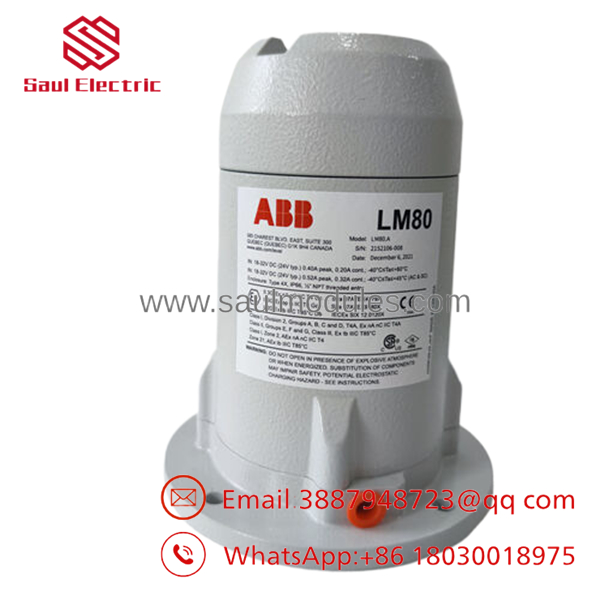
- LM80.A
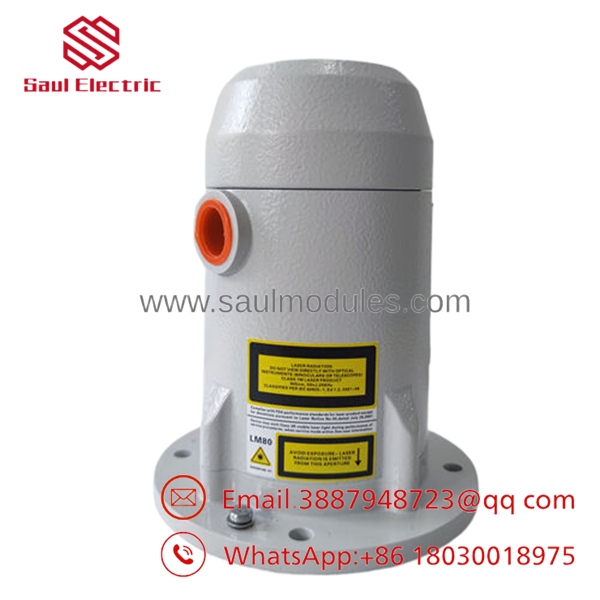
- LM80.A
Installation & Configuration Guide
Stage 1 – Pre-Installation (Prep & Safety)
- Perform Lock-Out/Tag-Out (LOTO).
- Verify the mounting location provides an unobstructed line of sight to the target.
- Wear appropriate PPE and an ESD wrist strap when wiring.
- Photograph wiring and existing configuration.
- Use shielded signal cables and separate them from high-voltage wiring.
Stage 2 – Removal
- Isolate power.
- Disconnect signal and power cables.
- Remove mounting hardware carefully.
- Inspect brackets and cable glands.
- Clean the mounting surface before installing the replacement.
Stage 3 – Installation (Align & Configure)
- Confirm the replacement model is ABB LM80.A.
- Secure the transmitter to the mounting bracket or flange.
- Connect power and signal wiring according to ABB documentation.
- Use the built-in laser pointer to align the instrument with the target.
- Configure the measuring range and output parameters.
Stage 4 – Power-On & Testing
- Restore power.
- Verify normal startup status.
- Confirm stable 4–20 mA output.
- Compare measured level with a known reference.
- Verify alarm relay operation and communication with the control system.
Firmware/Software Versions & Upgrade Notes
- Verify configuration compatibility with the plant PLC, DCS, or SCADA system.
- Back up all instrument parameters before replacement.
- Reproduce output scaling, relay settings, and alarm thresholds after installation.
- Avoid changing firmware and field configuration simultaneously during scheduled maintenance.
- After commissioning, verify measurement accuracy over the complete operating range.
- Follow ABB recommendations for cable shielding and mounting to maintain measurement stability.
Frequently Asked Questions (FAQ)
Q1. Is this transmitter genuinely new?
Yes. This product is supplied as New Original / New Surplus. It is not used, not repaired, and not refurbished. Every unit undergoes quality verification before shipment.
Q2. Why is New Surplus priced below OEM list price?
New Surplus inventory comes from excess project inventory and authorized surplus channels. It provides genuine OEM equipment at a lower acquisition cost while avoiding the reliability concerns associated with refurbished devices.
Q3. What materials can the .A measure?
The .A measures granular solids and opaque liquids without contacting the material. Typical applications include silos, crushers, stockpiles, hoppers, bins, and storage tanks.
Q4. Does the transmitter require calibration?
Under normal operating conditions, the is designed for straightforward commissioning and generally does not require routine calibration. Proper alignment and parameter configuration are the primary setup tasks.
Q5. Can sunlight or dust affect measurements?
The includes advanced signal processing and Last Pulse Detection to improve performance in light to moderate dust. As with most optical instruments, extremely heavy dust, dense vapor, or direct environmental interference can affect measurement quality, so installation location should be selected carefully.
Q6. What quality inspections are completed before shipment?
Each New Surplus unit undergoes:
- OEM part number verification
- Serial number traceability
- Optical window inspection
- Housing and connector inspection
- Functional verification where applicable
- ESD-safe packaging
- Final QC approval documentation
Q7. What inventory strategy is recommended?
For critical inventory measurement systems:
- Maintain as on-site buffer stock.
- Implement vendor consolidation to simplify procurement.
- Share spare inventory across multiple facilities where practical.
- Monitor lifecycle status and execute a last-time-buy strategy if availability declines, reducing lead time variability and lowering long-term Total Cost of Ownership (TCO).

 Start Chat


