





Description
Product Introduction
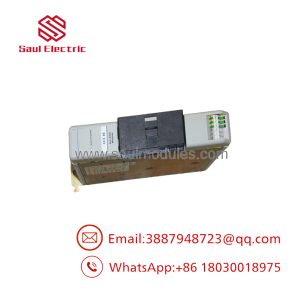
The Allen-Bradley 1769-HSC is a high-speed counter module built for the CompactLogix platform and MicroLogix 1500 systems. It acts as a real-time bridge for feedback devices like incremental optical encoders, pulse generators, and proximity switches that pulse far faster than standard digital input cards can read.
Because typical PLC scan times drop or miss fast-moving pulses, the 1769-HSC processes incoming signals locally at up to 1 MHz. It handles quadrature counting, rate calculations, and fast-onboard output triggers off the main CPU, ensuring total tracking accuracy on fast-moving industrial lines.
Key Technical Specifications
| Parameter | Value |
| Channels | 2 Quadrature (A, B, Z inputs per channel) or 4 Single-Ended |
| Max Input Frequency | 1 MHz (Differential), 250 kHz (Single-ended) |
| Input Voltage Categories | 5V DC, 12V DC, 24V DC differential/single-ended |
| Onboard Outputs | 4 Fast Sinking/Sourcing FET outputs (12-24V DC) |
| Output Response Time | Turn-on: < 10 µs |
| Backplane Current | 201 mA @ 5V DC, 0 mA @ 24V DC |
| Power Dissipation | 1.9 W |
| Operating Distance Rating (Power Supply Distance) | 4 modules (Must be installed within 4 slots of the power supply) |
| Isolation Voltage | 30V continuous (Basic Insulation Type, Inputs-to-Backplane) |
| Operating Temperature | 0 °C to 60 °C (32 °F to 140 °F) |
Application Scenarios & The “Trench” Experience
Here is a classic nightmare: A high-speed rotary cutter on a flexible packaging line starts drifting by 1/4 inch every 50 yards. The tech blames the encoder, swaps it twice, and the error persists. The real culprit? They wired a 100 kHz encoder feedback loop straight to a standard 24V DC input card, losing pulses whenever the CPU scan time spiked. Replacing that input setup with a dedicated 1769-HSC locks the position down to the exact encoder count.
- High-Speed Labeling & Conveying – Bottle Position Tracking – Tracks quadrature encoder pulses from conveyor drives to trigger precision spray markers or label application arms.
- Flying Cut-Off Machines – Rotary Shears & Saws – Uses fast onboard outputs to fire a shear solenoid the instant the pulse target is met, bypassing CPU scan delays.
- Flow Meter Monitoring – High-Frequency Turbine Meters – Measures rapid pulse trains from liquid turbine flowmeters to calculate total volume and real-time flow rate simultaneously.
- Web Handling & Winding – Material Stretch Measurement – Compares pulse rates between two differential encoders to calculate stretch percentage across tension rolls.
Field Case Study: A plastic pipe extruder in Ohio lost its 1769-HSC module to a dead 24V field supply short during a weekend run. The line stopped cutting pipe to length, backing up extrusion resin at $8,000 an hour. We verified a replacement 1769-HSC on our test rig, preset the voltage jumpers for their 5V RS-422 encoder, and had it delivered same-day. The customer clipped the terminal block in and cleared the fault before the night shift ended.
Transparency SOP: Quality Assurance & Testing
We don’t just ship boxes; we test them on actual Allen-Bradley CompactLogix racks. Every 1769-HSC undergoes our strict 5-stage bench verification process:
- Inbound Physical Inspection: Check terminal housing pins, plastic bus lever mechanisms, backplane connectors, and verify original Rockwell labels.
- Live Rig Power-On Testing: Connect to a 1769-L33ER rack via a 1769-PA4 power supply, confirming status LEDs (OK green, no bus fault).
- Signal Generator Pulse Test: Inject 5V and 24V pulse trains (up to 1 MHz) from a signal generator into A, B, and Z channel terminals to confirm accurate pulse accumulation in Studio 5000.
- Onboard Output Verification: Trigger the 4 fast FET outputs under load to verify switching speeds and sinking/sourcing circuit health.
- ESD Cleaning & Static Packaging: Clean module exterior with anti-static solution, seal in ESD shielding bags, and securely wrap with high-density foam.
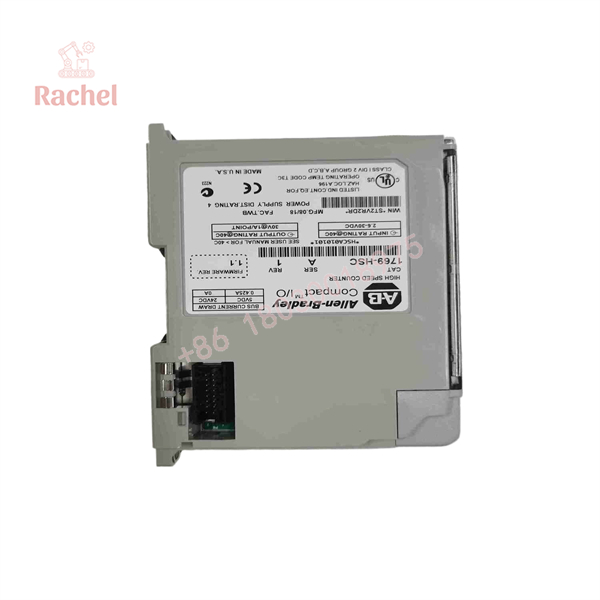
1769-HSC
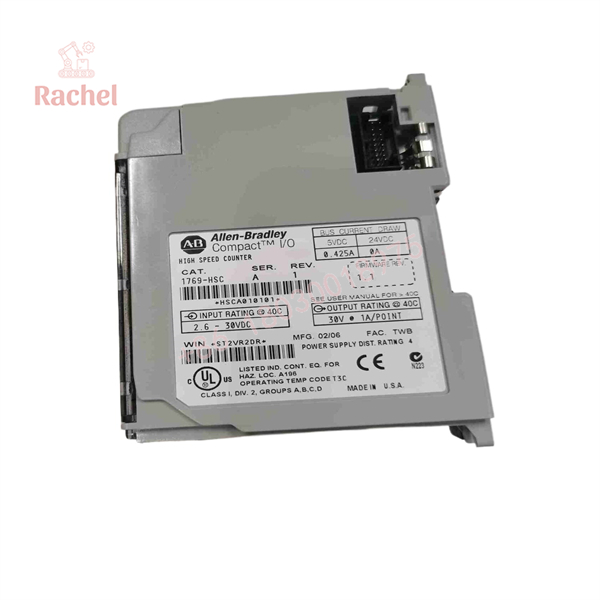
1769-HSC
The Veteran’s Tech Trap Guide (Crucial Value-Add)
- ⚠️ Watch the Power Supply Distance Rating! The 1769-HSC has a power supply distance rating of 4. That means it CANNOT be placed more than 4 slots away from the 1769 power supply (e.g., 1769-PA4 or 1769-PB4). Put it in slot 5 or 6, and the card will fail to communicate or drop offline randomly under load!
- ❗ Double-Check Your Voltage Level Jumpers: The module supports 5V, 12V, or 24V DC inputs, but you must wire to the correct specific terminal connections on the front block for that voltage class. Wiring a 24V encoder signal to the 5V terminal pin will permanently fry the input channel optocoupler!
- ⚠️ Quadrature A/B Phase Relationships: If your counter reads in reverse or decrements when the machine rolls forward, swap the A and A-not (or A and B) field wires. Do not waste time trying to fix it in code if a physical wire swap gets your direction aligned in 30 seconds.
- ❗ Shield Cables at ONE End Only: High-speed counter lines are magnetic noise magnets. Always use shielded twisted-pair cabling for encoder runs, and ground the drain wire at the panel enclosure end ONLY. Leaving both ends grounded creates ground loops that cause ghost counts and false position triggers.
Frequently Asked Questions (FAQ for Conversion)
Q: Can I use the 1769-HSC with 5V TTL differential encoders?
A: Yes. The 1769-HSC natively supports 5V DC differential (RS-422) encoder signals, as well as 12V and 24V single-ended or differential inputs.
Q: Does the 1769-HSC require an external power supply for outputs?
A: Yes. The 4 fast onboard outputs require an external 12 to 24V DC field power supply connected to the terminal block to drive external relays, solenoids, or drive enable inputs.
Q: Can the 1769-HSC be used with MicroLogix processors?
A: Yes. The 1769-HSC functions as an expansion I/O card for MicroLogix 1500 controller bases, in addition to standard CompactLogix L2 and L3 systems.
Q: How do the fast outputs on the 1769-HSC work?
A: The onboard outputs can be tied directly to count comparisons inside the module’s internal firmware. This allows the card to energize an output in under 10 microseconds when a target count is hit, completely bypassing the controller scan time.
Q: Is the 1769-HSC hot-swappable?
A: No! CompactLogix 1769 I/O modules do NOT support Removal and Insertion Under Power (RIUP). You must completely disconnect power from the 1769 system before pulling or inserting this card, or you risk blowing the bus driver chips on adjacent modules.
Q: Why buy New Surplus from you over direct factory orders?
A: Factory lead times for specialized 1769 motion/counter cards can be long and unpredictable. Our new surplus modules are physically on site, fully tested on real PLC racks, and ship immediately with zero lead-time delays.
Q: What warranty comes with this counter card?
A: We stand behind all our 1769-HSC modules (New Surplus and Refurbished) with a comprehensive 12-month replacement warranty. If a module fails during operation within a year, we ship out a replacement immediately.

 Start Chat


