





Description
Product Introduction & Engineering Value
A CAN-based instrument does not need to be replaced simply because the plant PLC network is PROFIBUS. The Anybus AB7312-B handles the protocol boundary: CAN on the field-device side and PROFIBUS DP-V1 on the controller side. It supports standard CAN 2.0A/2.0B frames as well as configurable transaction methods.
For retrofit work, the important feature is configurability. The gateway supports cyclic, on-data-change, single-shot, and trigger-byte CAN transactions, allowing engineers to adapt existing CAN equipment to a PROFIBUS architecture without writing custom PLC communication code for every message.
Technical Specifications
| Specification | AB7312-B |
|---|---|
| CAN Mode | Generic CAN |
| CAN Standard | CAN 2.0A / 2.0B |
| CAN Identifier | 11-bit / 29-bit |
| CAN Baud Rate | 20 kbit/s–1 Mbit/s |
| CAN Transactions | 128 transactions / up to 256 CAN frames |
| PROFIBUS Mode | DP Device / DP-V1 Slave |
| PROFIBUS Baud Rate | 9.6 kbit/s–12 Mbit/s |
| PROFIBUS Address | 0–125 |
| Power Supply | 24 VDC, -10% to +10% |
| Typical Current | 100 mA @ 24 VDC |
| Maximum Current | 250 mA @ 24 VDC |
| Mounting | DIN rail, EN 50022 |
| Dimensions | 27 × 120 × 75 mm |
| Operating Temperature | -25°C to +55°C |
| Storage Temperature | -40°C to +85°C |
| Protection | IP20 |
| Isolation | Yes |
HMS specifies a 27 mm-wide DIN-rail housing, reverse-polarity protection, short-circuit protection, and electrical isolation. The unit uses a 9-pin D-sub connection for CAN and a 9-pin PROFIBUS connector.
The PROFIBUS side supports DP-V1 functionality, including acyclic Class 1 and Class 2 communication, synchronization, freeze functions, watchdog operation, and diagnostic/user-parameter data of up to 237 bytes.
Field Application & the “Trench” Experience
Consider an older machine with a CAN-based drive controller, sensor cluster, or weighing device that is still performing correctly. The plant’s replacement PLC, however, is connected through PROFIBUS DP. Replacing the field device would mean revalidating the machine interface and potentially changing the control application.
Instead, an engineer can place the AB7312-B in the control cabinet, connect the CAN device to the CAN port, connect the PROFIBUS network to the PLC, and configure the required CAN frames. The PLC then sees the mapped data through the PROFIBUS process image. The PROFIBUS organization specifically lists applications including frequency drives, sensors, actuators, HMIs, barcode readers, RFID readers, and industrial scales.
Specific application scenarios
- CAN-based variable-frequency drive → PROFIBUS PLC: Transfer status words, operating values, and diagnostic information into an existing PROFIBUS control architecture.
- Industrial weighing system integration: Bring CAN measurement data into a Siemens or other PROFIBUS-based controller.
- CAN sensor network retrofit: Preserve installed CAN instrumentation while migrating the supervisory controller to PROFIBUS.
- Barcode/RFID equipment: Map CAN-based identification data into the PLC process image.
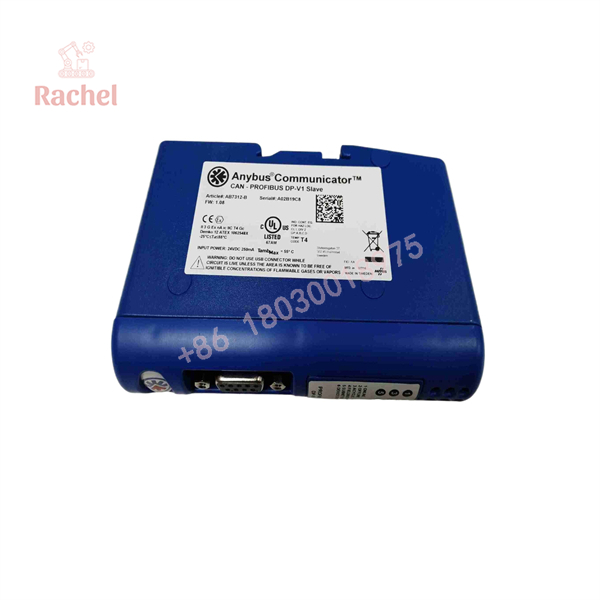
AB7312-B
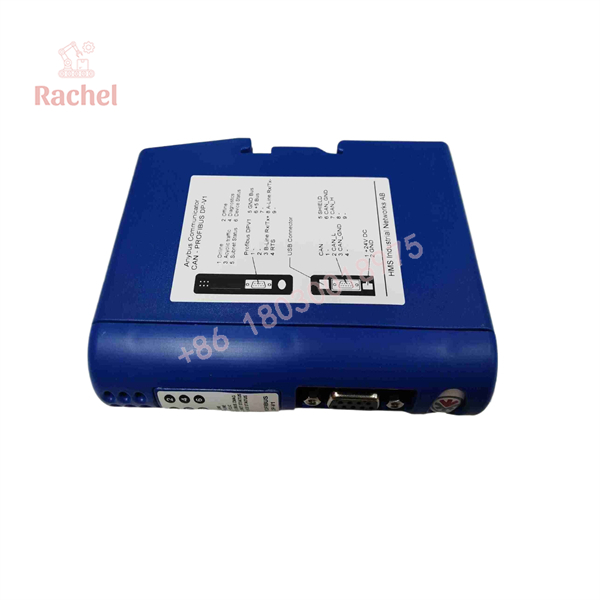
AB7312-B
Transparency SOP: QA & Testing
For New Surplus or refurbished AB7312-B inventory, functional testing should cover both sides of the gateway rather than stopping at a power-up check.
Hardware inspection: Verify the AB7312-B nameplate, CAN and PROFIBUS connectors, rotary address switches, DIN-rail latch, and enclosure.
Power test: Apply 24 VDC within the specified ±10% range and verify normal startup and current consumption.
CAN-side test: Connect a known-good CAN device or test interface and verify the required CAN 2.0A/2.0B frame transactions.
PROFIBUS test: Connect the gateway to a PROFIBUS master, configure the correct node address and GSD information, and verify cyclic I/O exchange.
Configuration test: Confirm that the intended CAN transactions are correctly mapped to the PROFIBUS process data.
HMS documentation lists CE, UL, and WEEE certifications, and the product specification includes reverse-polarity, short-circuit, and isolation features. The physical unit’s certification markings should be checked when certification is required for a particular installation.
The Veteran’s Tech Trap Guide
⚠️ Trap #1 — Confusing CAN baud rate with PROFIBUS baud rate
These are separate network parameters. AB7312-B supports CAN from 20 kbit/s to 1 Mbit/s, while PROFIBUS can operate from 9.6 kbit/s to 12 Mbit/s. Configure both sides independently.
⚠️ Trap #2 — Assuming “CAN compatible” means CANopen-compatible without configuration work
AB7312-B operates in Generic CAN mode and supports CAN 2.0A/2.0B. The actual CAN message identifiers, data bytes, transaction type, timing, and update behavior still have to match the connected device. HMS specifically provides CAN frame-building functionality for this purpose.
PRO TIP: Record the two PROFIBUS address-switch settings before removing an old unit. The AB7312-B uses rotary switches for its node address, and a replacement with the wrong address can look like a hardware failure when the real problem is simply network configuration.
⚠️ Trap #3 — Forgetting PROFIBUS termination
The installation documentation identifies the PROFIBUS connector pins associated with bus termination and power. A gateway replacement is a good time to verify the connector’s termination setting and the physical network topology rather than assuming the existing connector is correctly configured.
Dynamic FAQ
What does Anybus AB7312-B do?
AB7312-B converts CAN-based protocols to PROFIBUS DP-V1, allowing CAN equipment to communicate with a PROFIBUS control system.
Does AB7312-B support CANopen?
The unit provides Generic CAN operation and supports CAN 2.0A and 2.0B, including 11-bit and 29-bit identifiers. This allows CANopen and other CAN-based communication structures to be handled when the required frame configuration is correctly defined.
What PROFIBUS address range is available?
The PROFIBUS device address can be set from 0 to 125 using the two rotary address switches.
What is the power requirement?
AB7312-B requires 24 VDC ±10%. HMS specifies typical consumption of 100 mA at 24 VDC and maximum consumption of 250 mA at 24 VDC.
Can AB7312-B be used as a PROFIBUS master?
No. The documented PROFIBUS operating mode is DP Device / DP-V1 Slave. The PLC or other PROFIBUS master controls the network communication.
What should be checked when buying New Surplus AB7312-B?
Verify the exact ordering code, physical label, connector condition, hardware revision, packaging, and configuration history. For functional verification, test both CAN and PROFIBUS communications rather than relying solely on a power-on test. HMS’s published documentation specifies a 3-year warranty for the product, but the warranty attached to a particular New Surplus or refurbished unit should be confirmed with the seller in writing.

 Start Chat


