





Description
Product Introduction & Engineering Value
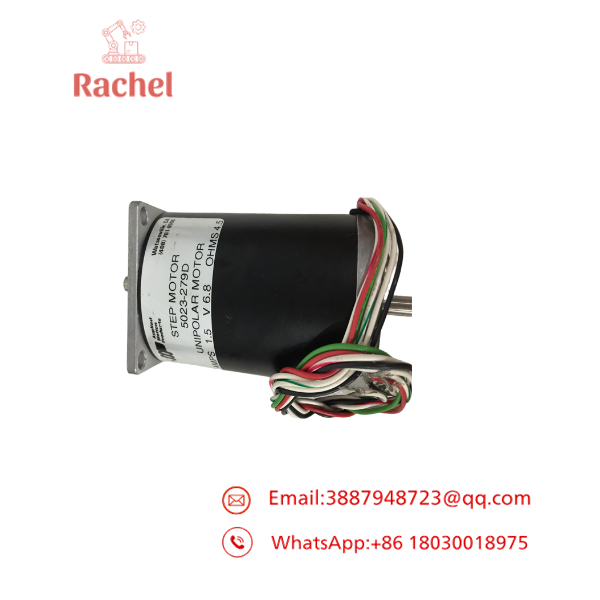
The Applied Motion 5023-279D is a legacy stepper motor intended for controlled incremental motion. Available part records identify it as a 7.6 VDC, 1.69 A, 200-step/revolution motor, with references associating it with a Y-axis C-Drive application.
For replacement work, the electrical numbers are only part of the equation. The motor’s mechanical mounting, shaft dimensions, connector/wiring, load, and driver compatibility must also match the original assembly. A motor that has the correct voltage but the wrong mechanical configuration is not a useful spare.
Technical Specifications
- Manufacturer: Applied Motion Products
- Part Number: 5023-279D
- Motor Type: Stepper motor
- Nominal Voltage: 7.6 VDC
- Current Rating: 1.69 A
- Step Resolution: 200 steps/revolution
- Nominal Step Angle: Approximately 1.8° per full step
- Motion Type: Incremental rotary positioning
- Application Reference: Y-axis / C-Drive
- Control Method: Requires compatible stepper drive/controller
- Mechanical Interface: Verify against the installed motor
- Electrical Interface: Verify connector and winding configuration before replacement
- Lifecycle: Legacy/specialized motion-control component
Engineering note
The 200 steps/revolution specification corresponds to approximately 1.8° per full step. However, do not use that number alone to determine positioning accuracy. Actual system resolution can be affected by microstepping, mechanical transmission, backlash, load, and the controller/drive configuration.
Field Application & the “Trench” Experience
A positioning axis on an older semiconductor or precision-equipment platform begins missing its target position. The controller and drive appear operational, but the axis stalls intermittently under load.
The maintenance team finds that the original motor is an Applied Motion 5023-279D. Rather than immediately increasing drive current or changing acceleration parameters, they compare the replacement motor’s electrical and mechanical characteristics with the original.
That matters. Stepper motors depend heavily on the relationship between motor winding characteristics and the drive. A mismatch can produce excessive heating, inadequate torque, or unreliable positioning.
Specific application scenarios
- Y-axis positioning — The 5023-279D has been identified in parts listings specifically as a Y-axis stepper motor/C-Drive component.
- Precision equipment positioning — Incremental motion for stages, actuators, or other machine axes.
- Legacy semiconductor equipment — Maintaining an established motion-control assembly where the original motor is no longer readily available through normal distribution.
Transparency SOP: QA & Testing
For new-surplus or refurbished 5023-279D inventory, the motor should be tested mechanically as well as electrically.
- Part-number verification — Confirm the motor is marked 5023-279D.
- Visual inspection — Check the housing, shaft, mounting face, connectors, and labels.
- Winding verification — Measure winding resistance and compare the phases for consistency.
- Insulation check — Perform an appropriate insulation test according to the motor’s construction and supplier procedure.
- Driver test — Operate the motor using a compatible stepper drive.
- Low-speed rotation — Check for abnormal noise, vibration, or missed steps.
- Direction test — Verify both rotational directions where applicable.
- Load test — If practical, test under representative mechanical load.
- Final inspection — Record electrical measurements and test results.
A simple continuity check is not enough to establish that a stepper motor is mechanically sound.
5023-279D
The Veteran’s Tech Trap Guide
⚠️ Trap #1 — Matching voltage but ignoring current.
The identified specification is 7.6 VDC / 1.69 A. The compatible drive must be capable of operating the motor correctly. Do not assume that any 7.6 V supply is an appropriate stepper drive.
PRO TIP: Match the motor to the original drive/controller rather than selecting the drive from the motor voltage alone.
⚠️ Trap #2 — Wiring the phases incorrectly.
A stepper motor can appear electrically healthy while rotating incorrectly or producing very little torque if the winding pairs or phase sequence are wrong.
⚠️ Trap #3 — Ignoring the mechanical interface.
Check shaft diameter, shaft length, mounting pattern, body dimensions, and coupling arrangement. Electrical equivalence does not guarantee mechanical interchangeability.
⚠️ Trap #4 — Assuming 200 steps/revolution equals positioning accuracy.
It defines the nominal full-step resolution, not the complete machine positioning performance. Gear reduction, leadscrew pitch, backlash, microstepping, and servo/stepper tuning can all affect the final axis behavior.
Dynamic FAQ
What is Applied Motion 5023-279D?
The 5023-279D is an Applied Motion Products stepper motor. Available records identify it as a 7.6 VDC, 1.69 A, 200-step/revolution motor, with references to a Y-axis C-Drive application.
What is the voltage and current rating?
Available part information lists 7.6 VDC and 1.69 A. Verify these values against the physical motor label and original equipment documentation before commissioning.
How many steps per revolution does it have?
The motor is listed at 200 steps per revolution, equivalent to approximately 1.8° per full step.
Is 5023-279D a servo motor?
Available records identify it as a stepper motor, not a conventional servo motor.
Can I replace it with any 200-step stepper motor?
No. The replacement must match the required winding/current characteristics, mechanical dimensions, shaft configuration, connector/wiring, and drive compatibility.
How should refurbished 5023-279D stock be tested?
Ideally, verify winding characteristics, insulation condition, and actual operation on a compatible stepper drive. Check smooth rotation and torque behavior rather than relying only on an electrical continuity test.
Is new-surplus 5023-279D stock suitable as a spare?
Yes, provided the motor is correctly identified and has been stored appropriately. For critical equipment, request photographs of the actual motor and confirmation of electrical and functional testing.
What warranty should I request?
Obtain written warranty coverage for functional operation. For used or refurbished motion-control motors, also clarify whether the warranty covers winding faults, mechanical defects, and intermittent operation.

 Start Chat


