





Description
Product Introduction & Engineering Value
The AIO288/1 combines measurement and control functions in a single M1-series module: eight analog inputs, eight ±10 V analog outputs, and support for Pt100/Pt1000 temperature measurement. That combination makes it useful where a controller needs both process feedback and proportional analog commands without consuming separate input and output modules.
The AIO288/1 is the non-isolated variant of the AIO288 family. The published technical documentation specifies 14-bit conversion, 200 µs sampling, ±10 V voltage inputs, 0–20 mA current inputs, and four configurable Pt100/Pt1000 temperature inputs.
Technical Specifications
| Parameter | AIO288/1 Specification |
|---|---|
| Manufacturer | Bachmann electronic |
| Model | AIO288/1 |
| Alternative Reference | AIO2881 |
| Part Number | 00014470-10 |
| Analog Inputs | Max. 8 |
| Voltage Input Range | ±1 V or ±10 V |
| Current Input Range | 0–20 mA |
| Input Impedance | >100 kΩ for voltage inputs; 243 Ω for current inputs |
| Input Resolution | 14 bit |
| Analog Outputs | Max. 8 |
| Output Voltage | ±10 V |
| Output Resolution | 14 bit |
| Pt100/Pt1000 Inputs | Up to 4 |
| RTD Connection | 2-wire or 4-wire |
| RTD Temperature Range | -100 to +500 °C |
| Sample / Refresh Time | 200 µs |
| Potentiometer Supplies | Up to 4, ±10 V |
| External Supply | 18–34 VDC |
| Operating Temperature | -30 to +60 °C |
| Galvanic Isolation | Not isolated from the system on AIO288/1 |
The official Bachmann datasheet gives the AIO288 family a 14-bit resolution, 200 µs sample time, ±10 V/±1 V voltage inputs, 0–20 mA current inputs, and ±10 V analog outputs. It also specifies up to four Pt100/Pt1000 temperature inputs and four potentiometer supplies.
One important distinction is the suffix: AIO288/1 is specifically the non-isolated version, while the standard AIO288 provides 500 V galvanic isolation from the system.
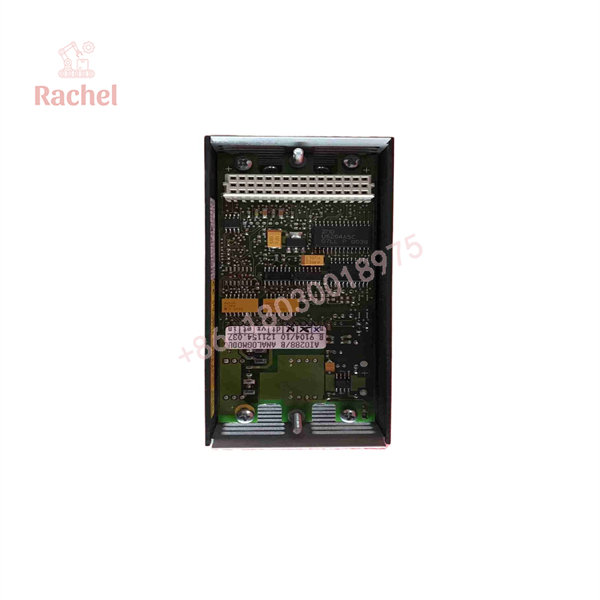
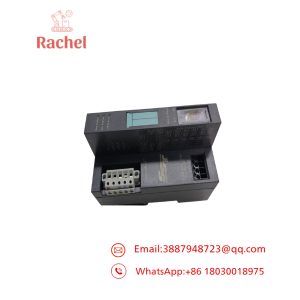
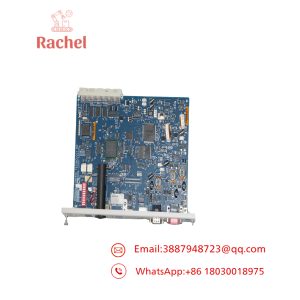
AIO288/1
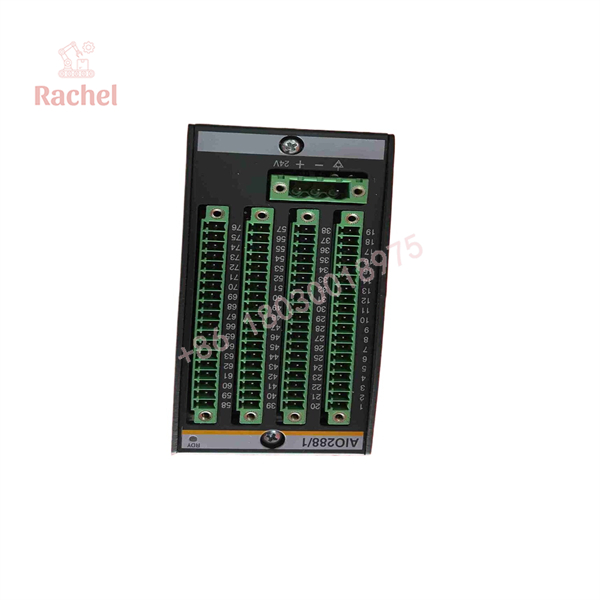
AIO288/1
Field Application & the “Trench” Experience
Imagine an older wind-turbine control cabinet where the controller handles both sensor acquisition and analog actuator commands. Several process values arrive as voltage/current signals while proportional control outputs are sent to hydraulic or electrical actuators. A failed AIO288/1 can stop the entire control sequence even though the main M1 controller remains operational.
The practical advantage of the AIO288/1 is channel density. One module provides 8 analog inputs and 8 analog outputs, allowing the existing cabinet architecture to remain largely unchanged when an exact replacement is available. The technician still needs to verify the original wiring, channel configuration, sensor type, and output scaling before returning the machine to service.
Specific application scenarios
- Wind-turbine pitch control: analog feedback from position or pressure sensors combined with proportional actuator commands.
- Marine automation: temperature and process-variable acquisition with ±10 V control signals.
- Hydraulic power-unit control: pressure/position feedback paired with proportional valve command outputs.
- Industrial test benches: simultaneous measurement and analog command generation.
- Process-control skids: RTD temperature measurement plus voltage/current process instrumentation.
Transparency SOP: QA & Testing
For New Surplus or refurbished AIO288/1 inventory, testing should follow the module’s actual architecture rather than stopping at a power-on check.
Identity → Physical → Electrical → I/O → Functional
- Identity: Verify the Bachmann label, AIO288/1 designation, and 00014470-10 part number.
- Physical: Inspect the housing, PCB area where accessible, connectors, terminal interfaces, locking features, and coding components.
- Power: Verify appropriate M1-system power behavior and inspect for abnormal current draw or startup faults.
- Analog inputs: Simulate representative voltage/current signals and check conversion values.
- Temperature channels: Where applicable, verify Pt100/Pt1000 acquisition using an appropriate RTD simulator.
- Analog outputs: Command representative ±10 V output values and measure the actual output.
- Diagnostics: Check channel and module status through the applicable Bachmann engineering environment.
- Record: Keep the test results with the module’s serial-number and condition record.
The manufacturer specifically identifies wire-break detection for voltage and temperature inputs, short-circuit protection for outputs, potentiometer-supply overload monitoring, and external supply-voltage monitoring as AIO288/x features.
The Veteran’s Tech Trap Guide
⚠️ Trap #1 — Missing the “/1” suffix.
This is the big one. AIO288 and AIO288/1 are not identical electrically. The AIO288 has galvanic isolation from the system, while the AIO288/1 is specified as not isolated. Do not substitute one simply because the front-panel designation looks similar.
⚠️ Trap #2 — Assuming every input is the same signal type.
The module supports voltage and current acquisition, plus up to four Pt100/Pt1000 temperature inputs. Channel configuration matters. A channel wired for an RTD should not be treated like a conventional ±10 V input.
PRO TIP: Before removing the failed card, photograph the terminal wiring and record the channel assignment. For an 8-channel mixed-signal module, this is much faster than reconstructing the I/O map from memory.
⚠️ Trap #3 — Confusing AIO2881 with a generic “AIO2881” product.
Some aftermarket listings use AIO2881 as an alternative search reference for . One current parts listing explicitly identifies AIO2881 as the alternative reference for AIO288/1.
For procurement, use the complete designation Bachmann AIO288/1, 00014470-10 whenever possible.
Dynamic FAQ
What is the Bachmann AIO288/1?
The AIO288/1 is a Bachmann analog input/output module for the M1 automation system. It provides up to eight analog inputs and eight analog outputs.
Is AIO2881 the same as AIO288/1?
Yes. In aftermarket industrial-parts listings, is used as an alternative reference for . The official Bachmann designation is AIO288/1, with part number 00014470-10.
What signals can the analog inputs handle?
The published AIO288/x specification includes ±1 V, ±10 V, and 0–20 mA analog inputs. Up to four inputs can be configured for Pt100/Pt1000 temperature sensors using 2-wire or 4-wire connections.
What is the analog output range?
The eight analog outputs provide ±10 V signals with 14-bit digital resolution. The published maximum settling time is 400 µs.
Is AIO288/1 galvanically isolated?
No. This is a critical difference from the standard AIO288. The published Bachmann family documentation specifies 500 V system isolation for the AIO288, while the AIO288/1 is explicitly listed as not isolated.
What should I verify when purchasing New Surplus AIO288/1?
Request photographs of the actual module label and part number, especially the 00014470-10 marking. Also verify whether the unit is unused surplus or refurbished, whether the connectors/terminal accessories are included, what functional testing was performed, and what warranty the supplier provides. A supplier warranty is not necessarily the same as a Bachmann factory warranty; one aftermarket listing, for example, explicitly states that its own 12-month warranty applies and that factory warranty may not apply.

 Start Chat


