





Description
Product Introduction
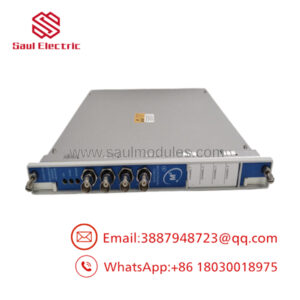
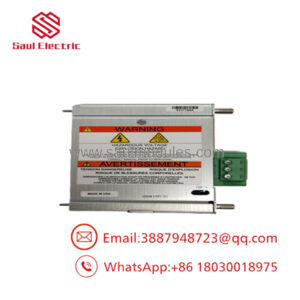
The Bently Nevada 330850-90-05 is an extended-range signal conditioning module engineered specifically for the 3300 XL 25mm Proximity Transducer System. Designed to measure massive shaft displacement over a wide linear range (up to 500 mils / 12.7 mm), it is heavily deployed on large steam turbines and hydro generators for differential expansion, axial thrust position, and rod drop monitoring where standard 8mm probes lack sufficient measurement span.
Configured with the 9.0-meter system length option (-90) and multiple hazardous agency approvals (-05), this Proximitor generates a continuous high-frequency RF excitation signal sent down the extension cable to the 25mm tip probe. The 3300 XL architecture provides exceptional thermal stability and RFI rejection, delivering a conditioned negative DC voltage output calibrated to 20 mV/mil (0.787 V/mm) direct to Bently Nevada 3500 or 2300 machinery protection systems.
Key Technical Specifications
| Parameter | Options / Configuration Value |
| Total System Length Option (-90) | 9.0 meters (29.5 feet) |
| Mounting & Approval Option (-05) | Panel Mount Hardware with Multiple Agency Approvals (CSA, ATEX, IECEx) |
| Hazardous Area Certifications | Class I, Div 1/Div 2; Zone 0/Zone 2 (Ex ia / Ex nA) intrinsically safe loops |
| Linear Measurement Range | 500 mils (12.7 mm) starting at 50 mils (1.27 mm) gap |
| System Scale Factor | 20 mV/mil (0.787 V/mm) nominal on AISI 4140 steel targets |
| Power Requirements | -17.5 VDC to -26 VDC at 12 mA max (nominal -24 VDC loop power) |
| Frequency Response | 0 Hz (DC) to 2.0 kHz (-3 dB bandwidth) |
| Operating Temperature | -51°C to +100°C (-60°F to +212°F) |
| Driver Output Distance | 50\ \Omega impedance; drives up to 300 meters (1000 feet) of field wiring |
Application Scenarios & The “Trench” Experience
Picture this: It’s during an annual turnaround startup on a 500 MW utility steam turbine. As the turbine heats up and rolls up to speed, the differential expansion channel monitoring rotor growth relative to the heavy outer casing starts reporting erratic voltage spikes. The technician inspects the local explosion-proof junction box on the turbine deck and finds an older non-XL Proximitor board drifting wildly under heat waves. Swapping in a sealed Bently Nevada 330850-90-05 module stabilizes the gap voltage immediately, allowing operations to safely bring the turbine to full load without triggering false differential expansion shutdowns.
- Large Steam Turbine Sets – Rotor Differential Expansion & Casing Growth – Tracks micro-inch expansion differences between high-pressure rotor shafts and turbine casings across thermal startup cycles.
- Hydroelectric Power Plants – Generator Thrust Bearings & Axial Shaft Position – Measures massive axial play and thrust disk movement under varying hydraulic loads.
- Reciprocating Gas Compressors – Crosshead & Piston Rod Drop Sinking – Tracks long-range rod positioning to detect wear in PTFE rider bands before piston skirts contact cylinder liners.
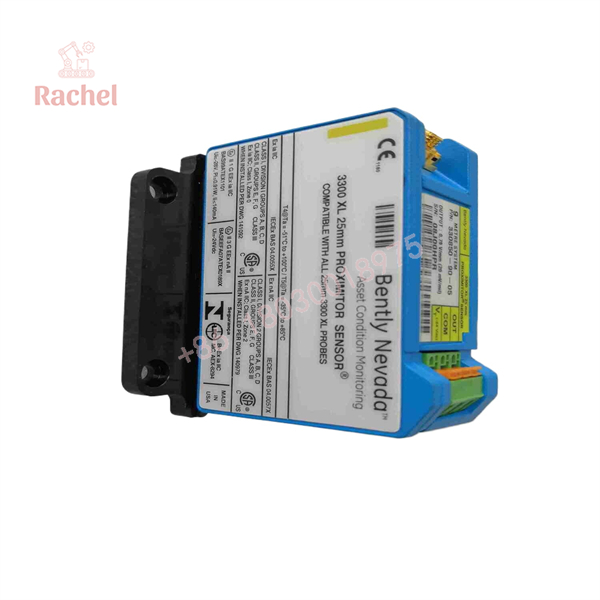
330850-90-05
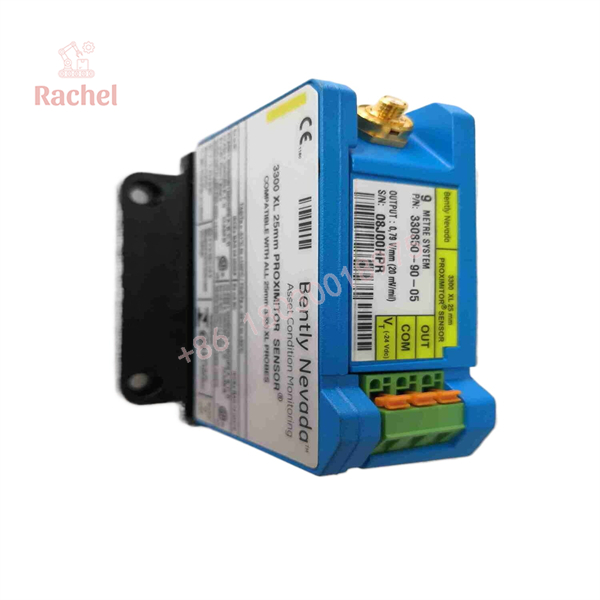
330850-90-05
Transparency SOP: Quality Assurance & Testing
We test every Proximitor unit on dedicated bench-test rigs prior to shipment:
- Inbound Visual & Markings Audit: Inspect enclosure integrity, check terminal screws, and verify ATEX/IECEx/CSA hazardous area laser markings.
- Power Supply & Bias Verification: Connect unit to a calibrated -24 VDC power supply rail to verify internal quiescent current and regulator stability.
- 25mm System Scale Factor Calibration Sweep: Pair with a matching 3300 XL 25mm probe and 8.0m extension cable on a precision micrometer stand with an AISI 4140 steel target; measure DC voltage output across 50-mil to 550-mil gaps in 50-mil increments to verify 20 mV/mil linearity.
- Noise Floor & Ground Isolation Check: Test dynamic output port for ground loop hum or RF interference susceptibility.
- Final QC & ESD Shielding: Cap coaxial input ports, wrap in anti-static ESD shielding bags, and pack inside custom foam transit boxes.
The Veteran’s Tech Trap Guide
- ⚠️ Scale Factor Differences (25mm vs 8mm Systems): Do NOT confuse a 25mm system (20 mV/mil) with a standard 8mm system (200 mV/mil). Because the 25mm probe measures 5 times the distance (500 mils vs 80 mils), its voltage change per mil of movement is 10 times smaller. Connecting a 330850 Proximitor to a rack channel configured for an 8mm probe will scale your readings off by a factor of 10!
- ❗ Strict 9.0m Cable System Matching: The -90 option requires an overall probe-plus-extension-cable length of exactly 9.0 meters (e.g., 1.0m 25mm probe + 8.0m extension cable). Using a 5.0m extension cable with a 9.0m Proximitor will cause severe non-linearity and scale factor errors.
- ⚠️ Negative Power Polarity: Bently Nevada Proximitors require negative DC power (nominal -24 VDC). Terminal 1 is Power (-24V), Terminal 2 is Common, Terminal 3 is Signal Output. Applying +24 VDC will damage internal circuit protection.
- ❗ Target Surface Diameter Requirement: Because a 25mm probe tip emits a massive magnetic field cone, the shaft or target collar must be at least 75 mm (3.0 inches) in diameter or larger. Target surfaces smaller than 3 inches will cause side-view metal interference, altering the Proximitor scale factor.
Frequently Asked Questions (FAQ)
Q: What do the “-90” and “-05” option codes stand for?
A: -90 = Calibrated for a 9.0-meter total system length (probe + extension cable). -05 = Multiple Agency Approvals (CSA, ATEX, IECEx) for Class I Div 1/Div 2 and Zone 0/Zone 2 hazardous location installations.
Q: Can I use a 330850-90-05 Proximitor with a standard 8mm probe?
A: No. The 330850 Proximitor is specifically tuned to drive the internal capacitance and inductance of 3300 XL 25mm probes. Pairing it with an 8mm or 11mm probe will produce incorrect output voltages.
Q: What DC voltage should I read when gapping a 25mm probe at mid-range?
A: Mid-range on a 25mm system is approximately 300 mils (7.62 mm) gap. At 20 mV/mil scale factor starting from -2.0 VDC at 50 mils, a mid-span gap will read approximately -7.0 VDC to -8.0 VDC relative to Common.
Q: How does this module mount inside a field enclosure?
A: It features direct-mount screw holes on its baseplate and supports snapping onto standard 35mm DIN rails using Bently Nevada DIN-rail adapter clips.

 Start Chat


