





Description
Product Introduction
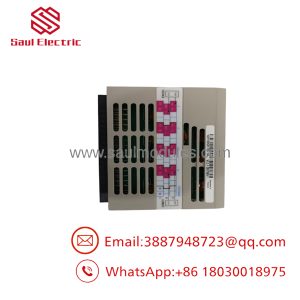
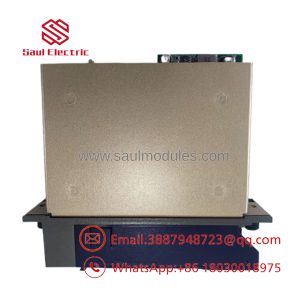
The Emerson A6312 is a two-channel speed and phase (Keyphasor) monitoring module engineered specifically for the CSI 6500 Machinery Health Monitor platform (integrated into the AMS Machinery Protection suite). Designed for critical turbo-machinery, the A6312 converts pulse signals from eddy current displacement sensors, Hall-effect transducers, or magnetic pickups into real-time rotational speed, phase angle reference, acceleration, and rotation direction data.
Compliant with strict API 670 machinery protection guidelines, the A6312 provides high-speed trip interlock logic for overspeed, underspeed, and zero-speed conditions. By delivering precise 1X phase timing pulses to neighboring vibration channels (like the A6110 shaft displacement cards) and monitoring speed transients during turbine startup or coast-down, the A6312 acts as the core rotational timing engine for heavy power and petrochemical plant assets.
Key Technical Specifications
| Parameter | Specification / Value |
| Manufacturer | Emerson Process Management (EPRO / CSI) |
| Model Number | A6312 (Variants include A6312/06) |
| System Compatibility | CSI 6500 / AMS 6500 Machinery Health Monitor Rack |
| Input Channels | 2 Independent Speed / Keyphasor Channels |
| Supported Sensors | Eddy Current Proximity Probes, Magnetic Pickups, Hall-Effect Sensors |
| Pulse Frequency Range | 0.01 Hz to 20 kHz (Sub-RPM up to high-speed turbine applications) |
| Signal Outputs | Buffered raw pulse (BNC front panel), 0/4-20mA proportional speed outputs |
| Protection Functions | Overspeed trip, Underspeed/Zero-speed, Reverse Rotation, Acceleration |
| Relay Logic | Integrated trip limits with external relay card expansion (A6312-8 Relay Module) |
| Standards Compliance | API 670 compliant for machinery protection systems |
| Physical Dimensions | 3U high 1-slot rack card format |
Application Scenarios & The “Trench” Experience
Picture a large steam turbine-generator during a full-load rejection test. As the electrical grid drops away, steam pressure pushes the turbine shaft into an immediate acceleration spike. If the overspeed protection card fails to process the pulse train or experiences trigger chatter, the turbine can reach runaway speeds within seconds, resulting in catastrophic rotor disintegration. Having a fully bench-tested Emerson A6312 module monitoring keyphasor notch pulses ensures clean trip relay actuation milliseconds after crossing overspeed setpoints.
Primary Field Applications:
- Power Generation Turbines: Real-time speed measurement, phase reference timing, and primary overspeed trip protection on steam and gas turbines.
- High-Pressure Gas Compressors: Zero-speed and reverse-rotation detection to prevent gas backflow driver damage on centrifugal compressors.
- Hydroelectric Power Generators: Low-RPM rotational monitoring and creep detection for massive water-wheel shaft assemblies.
- Combined Vibration Analysis: Providing 1X/2X revolution pulse timing to AMS vibration software to construct Bode and Nyquist plots during machine startups.
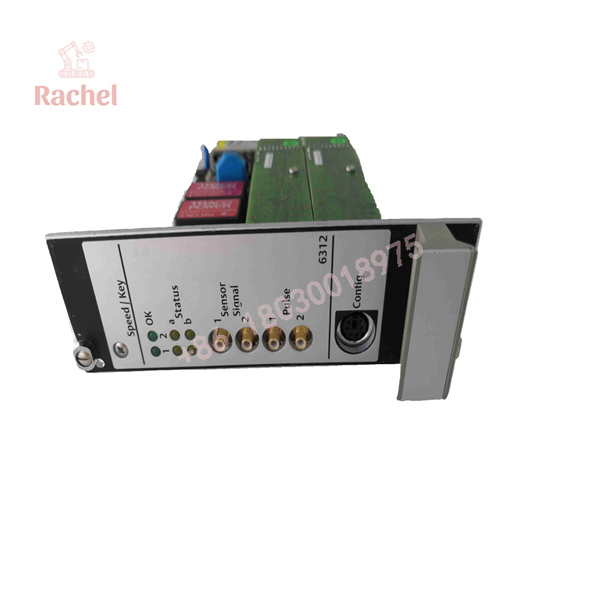
A6312
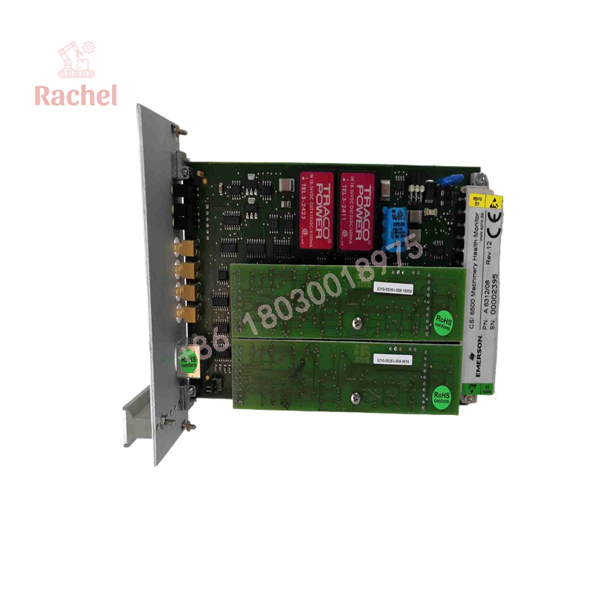
A6312
Transparency SOP: Quality Assurance & Testing
Speed and overspeed protection cards handle critical safety interlocks where false negatives mean catastrophic equipment loss. Every Emerson A6312 card undergoes a strict 5-step hardware testing procedure prior to entering our shippable stock:
- Inbound Mechanical & Backplane Check: Pin inspection, gold connector edge audit, capacitor ESR testing, and conformal coating condition checks.
- Power-Up & System Communication Test: Insertion into a live CSI 6500 rack to verify backplane bus communications, power supply draw, and system watchdog handshakes.
- High-Frequency Function Generator Simulation: Injecting precision TTL, square, and sine waveforms from 1 Hz up to 20 kHz across both channels to verify trigger threshold accuracy and hysteresis margins.
- Phase Alignment & 4-20mA Output Calibration: Verifying proportional current outputs against calibrated pulse frequencies and checking 1X phase timing pulse distribution to backplane buses.
- ESD Cleaning & Protective Packaging: Contact cleaning with electrical restorer, anti-static shielding, and heavy foam-cushioned packaging.
The Veteran’s Tech Trap Guide (Crucial Value-Add)
- ⚠️ Check Trigger Threshold Settings (Auto-Hy vs. Fixed Voltage): Proximity probes watching a shaft keyway generate a distinct negative voltage pulse. If your A6312 is configured for a fixed 2.5V threshold but your probe gap delivers a weak signal that barely crosses -1.5V, the card will drop pulses at higher RPMs. Configure the card’s pulse detection logic in the AMS software to match your target probe gap voltage.
- ❗ Never Disconnect Keyphasor Probes Live Without Bypassing Trips: If the A6312 is configured for zero-speed or underspeed interlocks, pulling a sensor lead on a running machine might cause the module to read 0 RPM immediately, triggering a process trip. Always inhibit or bypass relay outputs before servicing field wiring.
- ⚠️ Match Target Gear Tooth Counts in Software: When configuring speed channels watching a multi-tooth gear wheel (e.g., a 60-tooth gear vs. a single keyway), ensure parameter setup in the CSI software reflects the exact tooth count. Entering “1 pulse/rev” on a 60-tooth shaft will make the monitor read 60 times higher than actual speed, instantly tripping overspeed relays upon startup!
- ❗ Verify Rear Terminal Board Jumpers: If replacing an older EPRO or CSI speed card, verify the jumper arrangement on the rack rear terminal block. Mismatched jumper positions for open-collector versus differential magnetic inputs will drown out input signals in electrical noise.
Frequently Asked Questions (FAQ for Conversion)
Q: Is the Emerson A6312 hot-swappable in a live CSI 6500 rack?
A: Yes, the A6312 module is hot-swappable. However, because this card drives safety trip logic, you must manually bypass or bridge downstream shutdown relays in the safety PLC/ESD system prior to pulling the module.
Q: What is the primary difference between using an eddy current probe versus a magnetic pickup with the A6312?
A: Eddy current proximity probes require a -24V DC power supply and can measure down to 0 RPM (static zero-speed monitoring). Passive magnetic pickups generate their own voltage via coil induction and require minimum rotational speed (>100 RPM) to produce a readable voltage amplitude.
Q: How does the A6312 send phase signals to other vibration cards in the same CSI 6500 rack?
A: The A6312 conditions the input pulse and routes a high-speed 1X Keyphasor signal directly across the CSI 6500 internal backplane bus, allowing adjacent A6110/A6120 displacement cards to compute phase angles without requiring separate field wiring.
Q: What warranty is provided on this surplus Emerson card?
A: Every Emerson A6312 module supplied from our inventory comes backed by a comprehensive 12-month full-replacement warranty. If the card fails under normal operational parameters within one year, we replace it directly from stock.
Q: Why source surplus A6312 cards instead of replacing the entire rack with new hardware?
A: Replacing an entire rack requires taking a long outage, re-wiring field junction boxes, re-mapping turbine safety interlocks, and re-certifying API 670 safety compliance. Dropping in a direct replacement A6312 card takes 10 minutes and preserves existing safety certifications.

 Start Chat


