





Description
Product Introduction & Engineering Value
The 85UVF1A-1QD is designed to make flame supervision part of the scanner itself rather than requiring a separate remote flame amplifier. During setup, the Phoenix scanner automatically stores characteristics of the target flame and establishes appropriate ON/OFF criteria and sensor gain. It also incorporates self-diagnostics and electronic self-checking.
The 1QD designation is important. This is the connectorized quick-disconnect configuration, and Fireye specifies the 59-546-XX cable family for the new connectorized versions. It should not be confused with the CEX explosion-protected housing versions, which have a different certification and connection arrangement.
Technical Specifications
| Specification | 85UVF1A-1QD |
|---|---|
| Manufacturer | Fireye |
| Product Family | Phoenix Type 85UVF/IRF |
| Scanner Type | UV flame scanner |
| Detection Wavelength | 295–340 nm |
| Flame Relay | Internal |
| Flame Response | Selectable FFRT |
| Supply Voltage | 24 VDC |
| Electrical Connector | 8-pin quick disconnect |
| Analog Output | 4–20 mA flame strength |
| Housing Protection | NEMA 4X / IP66 |
| FM Approval | Yes |
| UL C/US | Yes |
| CE | Yes |
| Class I Division 2 | Yes |
| ATEX/IECEx | No CEX certification for this particular 1QD model |
| Safety Capability | Fireye states Phoenix scanners are suitable for applications up to SIL 3 based on the cited FMEDA assessment |
Fireye’s part-number table confirms FM, UL C/US, CE, Class I Division 2, NEMA 4X, IP66, and DIN CERTCO-related approvals for the 85UVF1A-1QD, while the ATEX/IECEx hazardous-area certification shown for the CEX versions does not apply to the standard 1QD model.
UV Detection and Flame Processing
The scanner detects ultraviolet radiation in the 295–340 nm range. It does not merely look for a fixed UV intensity; the Phoenix architecture evaluates flame modulation or “flicker” characteristics and automatically establishes operating thresholds during setup.
The 4–20 mA output provides an analog representation of flame strength, which can be useful for diagnostics and supervisory systems. The internal flame relay eliminates the need for a separate remote flame switch in the standard Phoenix architecture.
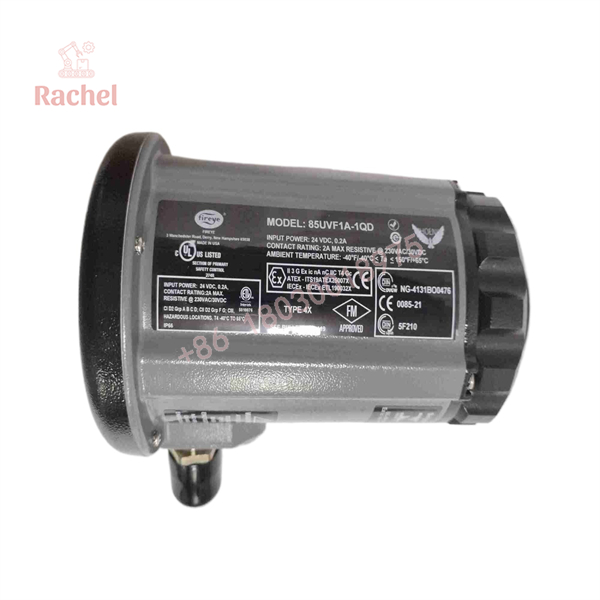
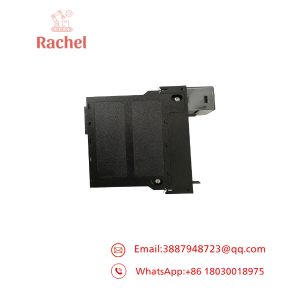
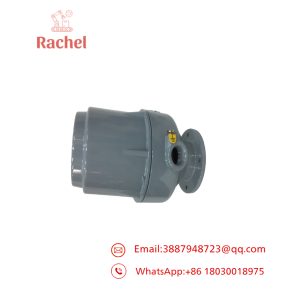
85UVF1A-1QD
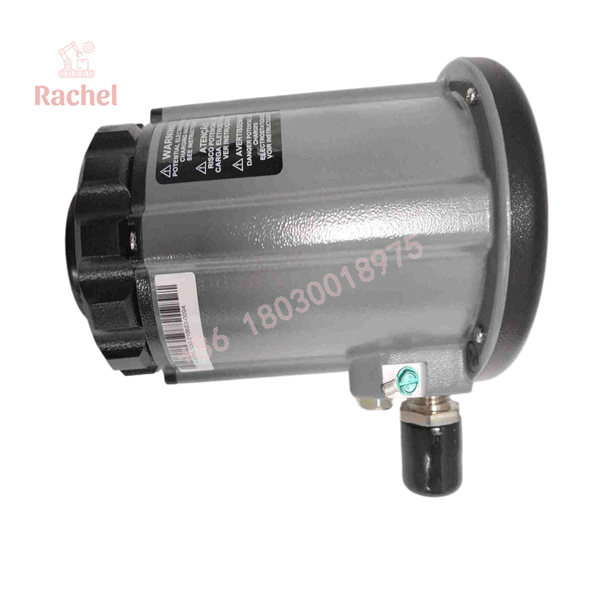
85UVF1A-1QD
Field Application & the “Trench” Experience
A boiler burner begins producing intermittent flame-failure trips. The operator sees the burner light successfully, but the BMS occasionally drops the flame signal a few seconds later.
The first instinct is to replace the scanner.
A more experienced technician checks the sighting position, burner flame shape, scanner lens, wiring, purge arrangement, and actual flame signal first. If the scanner is confirmed faulty, the replacement is specified as 85UVF1A-1QD, including the correct 24 VDC supply and 59-546-XX quick-disconnect cable.
That distinction matters. The Phoenix scanner performs automatic flame setup, so simply swapping hardware without repeating the appropriate setup procedure can leave a healthy replacement behaving incorrectly.
Specific Application Scenarios
- Industrial boiler burner management — UV flame supervision for gas- or oil-fired burners.
- Process heater flame monitoring — continuous verification of pilot/main flame conditions.
- Fired furnace burner trains — applications requiring internal flame relay functionality and analog flame-strength feedback.
- Legacy Phoenix scanner upgrades — Fireye’s 2023 documentation lists several older 85UVF scanner part numbers as replaced by the 85UVF1A-1QD.
Transparency SOP: QA & Testing
For a New Surplus or refurbished 85UVF1A-1QD, the acceptance procedure should include:
1. Nameplate verification
Confirm the complete 85UVF1A-1QD part number and serial information.
2. Housing inspection
Inspect the enclosure, viewing window, mounting threads, connector, and sealing surfaces.
3. Connector inspection
Verify that the 8-pin quick-disconnect connector is undamaged. Confirm the required 59-546-XX cable is available for installation.
4. Controlled power test
Apply the specified 24 VDC supply and verify normal startup and diagnostic behavior.
5. Flame-simulation/functional test
Where appropriate test equipment is available, verify flame-detection behavior, internal relay operation, FFRT response, self-checking, and analog output.
6. System test
Install on a compatible burner test setup and verify reliable flame recognition and flame-failure response.
7. Setup verification
Repeat the manufacturer’s scanner setup procedure for the target flame rather than assuming the replacement retains the configuration of the removed unit.
Fireye currently lists 85UVF1A-1QD as in stock in its availability database, dated August 20, 2026.
The Veteran’s Tech Trap Guide
⚠️ Trap #1 — Confusing 1QD with 1CEX
These are not equivalent variants.
85UVF1A-1QD is the standard quick-disconnect configuration and carries several North American/international approvals. 85UVF1-1CEX is a different hazardous-area housing configuration with ATEX/IECEx protection. Fireye’s approval table clearly separates them.
PRO TIP: If the original installation is in a classified hazardous area, do not substitute the standard 1QD model simply because its electrical signals match.
⚠️ Trap #2 — Forgetting the cable
Fireye’s current documentation states that the new connectorized part numbers require a 59-546-XX cable assembly, with the CEX versions being the exception. A replacement scanner without the appropriate cable can leave the machine down even though the scanner itself is correct.
⚠️ Trap #3 — Assuming any UV source will work for testing
The Phoenix scanner is designed around the characteristics of the actual flame, including modulation/flicker behavior. A crude UV lamp test is not equivalent to a burner functional test.
⚠️ Trap #4 — Ignoring automatic setup
The Phoenix scanner automatically stores target-flame characteristics and selects appropriate sensor gain during setup. If the burner geometry or scanner position changes, repeat the setup procedure rather than blindly copying an old configuration.
Dynamic FAQ
What is Fireye 85UVF1A-1QD?
It is a Fireye Phoenix Series II integrated ultraviolet flame scanner with an internal flame relay and selectable FFRT. It is intended for burner flame supervision applications.
What wavelength does the 85UVF1A-1QD detect?
The 85UVF1A-1QD detects ultraviolet radiation in the approximately 295–340 nm range.
What power supply does it use?
The Phoenix 85UVF/IRF scanner is specified for 24 VDC operation.
What cable does it require?
The 1QD connectorized configuration uses the Fireye 59-546-XX cable family. The exact cable length should be selected according to the installation.
Is 85UVF1A-1QD explosion-proof?
Do not describe it as an ATEX explosion-proof scanner. Fireye’s approval table gives the 85UVF1A-1QD several approvals including Class I Division 2, NEMA 4X and IP66, while the 85UVF1-1CEX family carries the ATEX/IECEx Ex db/tb classifications.
Is it still available from Fireye?
Yes. Fireye’s current availability page lists 85UVF1A-1QD as “In Stock” as of August 20, 2026.
Is New Surplus 85UVF1A-1QD the same as New OEM?
No. Fireye’s own current availability is evidence that the part remains commercially supplied, but a seller’s New Surplus designation means secondary-market unused inventory and should not automatically be represented as current factory-direct stock. A legitimate quotation should identify the actual condition and warranty.
What warranty should I request?
For a new OEM unit, request the applicable manufacturer warranty. Secondary-market sellers may offer their own coverage; for example, one current listing specifies a 1-year warranty, while another lists the unit as New OEM Original with manufacturer warranty.

 Start Chat


