





Description
Product Introduction & Engineering Value
The GE DS200UPSAG1A is a UPSA board from the DS200 family, associated with GE Mark V control equipment. Because this board sits within the control-power architecture, its condition can affect the availability of downstream control electronics rather than just one individual I/O channel.
Replacement work deserves extra attention to power connections and system configuration. Before energizing a replacement, verify the complete DS200UPSAG1A identification, cabinet wiring, input/output requirements, and the specific Mark V system documentation.
Technical Specifications
Manufacturer: General Electric (GE)
Product Family: DS200
Control Platform: Mark V
Board Designation: UPSA
Part Number: DS200UPSAG1A
Board Type: Power supply / control-power interface board
Revision: G1A
Primary Role: Control-system power supply and related power-interface functions
Typical Installation: GE Mark V control cabinet
Application: GE turbine and industrial control equipment
Electrical Configuration: Must be verified against the applicable cabinet drawings and board documentation
Replacement Requirement: Exact part-number and electrical-configuration verification required before installation
Technical caution: Do not infer voltage input, output ratings, fuse specifications, terminal assignments, or power capacity from the DS200UPSAG1A part number alone. Those values should be verified against the documentation for the specific GE Mark V installation.
Field Application & the “Trench” Experience
A plant maintenance crew is preparing a Mark V cabinet for a planned turbine restart. During pre-start checks, control power becomes unstable and several downstream boards show abnormal indications. The maintenance team identifies the installed power board as DS200UPSAG1A.
The experienced technician does not immediately swap the board. First, the incoming power, fusing, cabinet wiring, and downstream load are checked. A failed power board can be the symptom rather than the original cause. Once the supply path is confirmed, the replacement board is compared against the removed unit and installed under controlled conditions.
That distinction matters. Installing a good replacement into a cabinet with an upstream electrical fault can damage the replacement as well.
Specific application scenarios
- Gas turbine control cabinets: Maintaining control-power availability for legacy Mark V electronics.
- Turbine startup systems: Replacing aging power-interface hardware during planned outages.
- Legacy control-system spare inventory: Holding a verified DS200UPSAG1A to reduce exposure to long lead times for obsolete hardware.
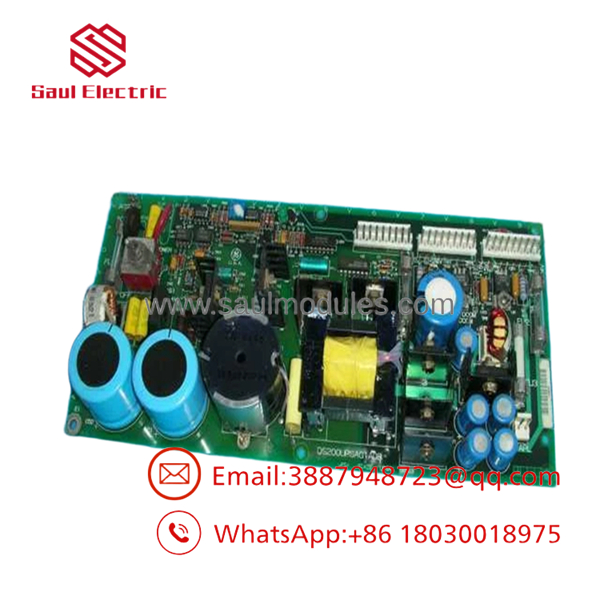
DS200UPSAG1A
Transparency SOP: QA & Testing
A power board should receive a more careful inspection than a simple visual check.
- Verify identity — Confirm and the G1A revision.
- Inspect power circuitry — Check visible components, connectors, terminal points, fuses, and PCB condition.
- Check for storage damage — Look for corrosion, contamination, cracked components, or evidence of previous installation.
- Review electrical requirements — Compare the replacement with the applicable Mark V cabinet documentation before applying power.
- Controlled power test — If appropriate test equipment and a compatible test setup are available, verify input and output behavior under controlled conditions.
- Load verification — Where practical, evaluate the board with an appropriate load rather than relying only on an unloaded power-up.
- ESD-safe packaging — Protect the board during storage and transportation.
For refurbished stock, request the test report and details of any replaced components. A board labeled “tested” should have a defined test scope.
The Veteran’s Tech Trap Guide
⚠️ Trap #1 — Replacing the board without checking upstream power
If an input-voltage problem, shorted load, wiring error, or protection-device issue caused the original failure, a replacement board may fail immediately.
PRO TIP: Troubleshoot the complete power path first: source → protection → wiring → board → downstream load.
⚠️ Trap #2 — Treating fuses as the root cause
A blown fuse is often a symptom. Replacing the fuse repeatedly without identifying why it opened is poor troubleshooting practice and can create additional damage.
⚠️ Trap #3 — Assuming “power is present” means the board is healthy
Verify the required output rails and their behavior under appropriate load conditions. An unloaded voltage measurement alone does not establish proper operation.
Dynamic FAQ
What is the GE ?
The is a GE UPSA-series power supply/control-power board associated with the DS200 family and compatible Mark V control equipment.
Is used in GE Mark V systems?
It is associated with GE Mark V control hardware. The exact application should be confirmed against the specific cabinet documentation because Mark V systems can contain site-specific configurations.
Can I substitute another DS200 UPSA board?
Do not assume interchangeability. Verify input/output requirements, revision, connector configuration, protection circuitry, and the host system’s documentation before substitution.
What should be checked before installing the replacement?
Check the incoming power source, fuses and protection devices, cabinet wiring, downstream load, board identification, and electrical requirements. This is especially important for a power-supply board.
How can I verify New Surplus authenticity?
Request photographs of the , including the GE identification label, PCB markings, connectors, and overall condition. Confirm whether the unit is unused, previously installed, or refurbished.
Is a warranty available?
Warranty terms depend on the supplier and condition of the inventory. Confirm the warranty period, functional-test scope, DOA coverage, return procedure, and any commissioning support before purchasing.

 Start Chat


