





Description
Key Technical Specifications
| Parameter | Specification / Value |
| Form Factor | PMC (PCI Mezzanine Card) compliant with IEEE P1386.1 |
| Memory Capacity | 64 MB high-speed SDRAM shared network storage |
| Network Architecture | Deterministic, redundant token ring topology |
| Transceiver Type | Multimode Fiber Optic |
| Connection Port | LC Duplex connector |
| Network Transfer Rate | 2.125 Gbaud raw serial rate; 174 MB/s sustained throughput |
| Maximum Node Count | Up to 256 active network nodes per ring |
| Dynamic Packet Size | 4 to 64 bytes containing payload data |
| Jitter / Network Latency | Less than 1 microsecond per node hop |
| Interrupt Generation | 4 channel-selectable network interrupts with data passing |
| PCI Interface Support | 32-bit/64-bit, 33 MHz or 66 MHz PCI operation (3.3 V or 5 V signaling) |
| Operating Temperature | 0 to +65°C case temperature under continuous airflow |
Product Introduction
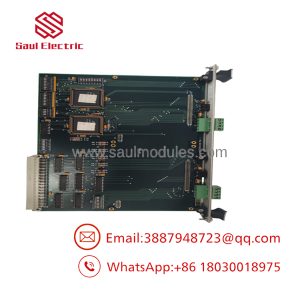
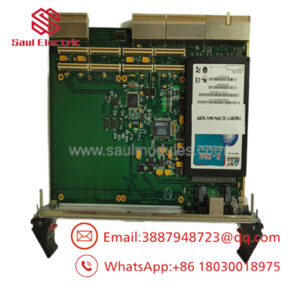
The GE Fanuc VMIVME-5565-110000 is a high-speed, deterministic Reflective Memory interface module in a PMC form factor. Engineered for low-latency, real-time data distribution, this board enables multiple host processors (typically seated on VME, PCI, or CompactPCI carrier cards) to share a common memory database over a fiber-optic ring network without software routing overhead or network collision penalties.
Operating independently of host operating systems, the VMIVME-5565-110000 automatically replicates local memory writes across the entire optical loop at a sustained data rate of 174 MB/s. Plant maintenance teams and system integrators rely on this specific 64 MB multimode card for flight simulators, complex industrial control test benches, and highly synchronized power generation systems where Ethernet or fieldbus architectures introduce unmanageable transmission jitter.
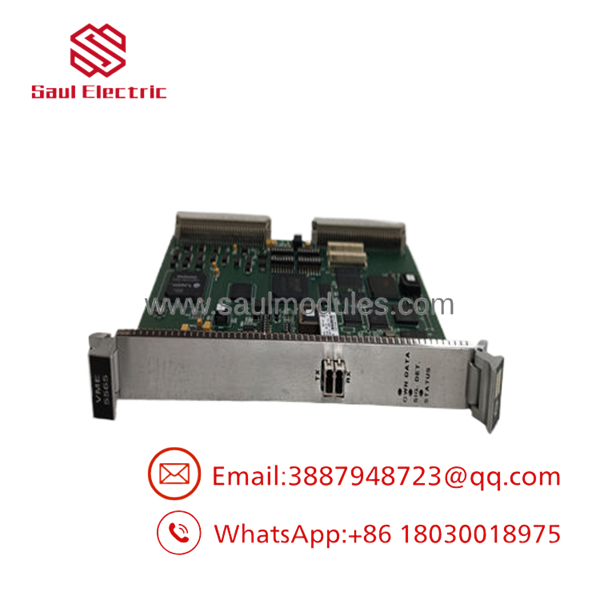
- VMIVME-5565-110000
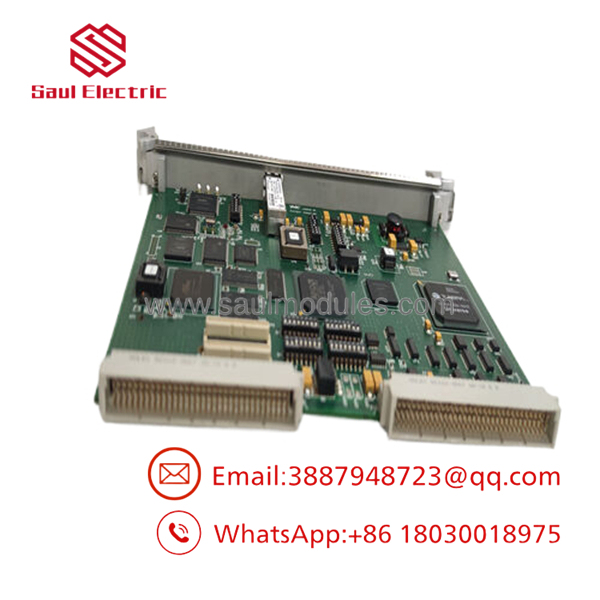
- VMIVME-5565-110000
Troubleshooting Quick Reference
| Symptom | Possible Cause | Relevance to this Part | Quick Check Method | Recommendation |
| Front panel LINK LED is dark or flashing amber | Optical fiber breakage, incorrect Rx/Tx cross-connection, or adjacent node power loss | ✅ High | Clean fiber tips. Swap the Rx and Tx cable ends at the LC connector. Check if the upstream node is powered up. | If the cable is verified good and properly oriented, the multimode optical transceiver is degraded; replace the module. |
| Host system experiences intermittent PCI Bus Errors or system lockups | Incorrect PMC carrier card seating or VCC signaling voltage mismatch | ❌ Low | Ensure the PMC card is completely flat against the carrier board and that mounting screws are tightened to spec. | Check if the carrier board supports 66 MHz/64-bit signaling. If seating is perfect but errors persist under load, the on-board FPGA control logic is failing. |
| Memory data is modified locally but does not replicate to adjacent nodes | Transmitter circuit failure or host system mapping errors | ✅ High | Run a local write test. Check if the on-board TX buffer counters increment in the host control registers. | If local writes do not trigger optical transmission but the link is physically up, the internal network controller chip has failed; replace the unit. |
| High data error rates or dropped packets on the ring | Excessively long fiber runs or compromised optical attenuation | ✅ High | Measure the optical signal level using an optical power meter at the Rx port. Max fiber distance is 300 meters for multimode. | If the run exceeds 300 meters, you must add an inline repeater or migrate nodes closer together. Clean all connectors using lint-free optic wipes. |
Note: For complex timing synchronization anomalies or memory mapping issues, please export your driver’s register allocation logs and hardware topography maps, and submit them to our engineering team for technical support.
Frequently Asked Questions (FAQ)
Q: Can I plug this PMC card directly into a standard VME slot?
A: No, you cannot drop this module straight onto a VME backplane by itself. The VMIVME-5565-110000 is a PMC (PCI Mezzanine Card) daughterboard. To run it on a VME host, you must mount it onto a compatible PMC carrier card (such as a GE VMIVME-7750 or similar single-board computer). Ensure the alignment pins match and the interface connectors are firmly locked before sliding the complete assembly into the VME slot.
Q: Can I mix this 64 MB multimode card with a 128 MB single-mode card on the same ring?
A: No, this setup will completely break your network topology for two critical reasons. First, you cannot mix multimode and single-mode optical transceivers without dedicated inline conversion hardware due to differing wave frequencies (850 nm vs. 1310 nm). Second, all nodes in a Reflective Memory ring must share the exact same memory allocation size to maintain deterministic mapping. Mixing a 64 MB node with a 128 MB node will cause addressing overflows and corrupt the common database.
Q: My system uses a 5 V signaling carrier, but your datasheet mentions 3.3 V. Will I fry the card?
A: To be honest, this is a common point of confusion. The VMIVME-5565-110000 uses a universal PCI interface design. The connector keying is engineered to handle both 3.3 V and 5 V signaling limits on the host carrier board without requiring hardware jumper changes. It safely accommodates either standard out of the box, provided the carrier complies with standard IEEE P1386.1 PMC specifications.
Q: What is the exact reason these “New Surplus” parts are cheaper than buying direct from the manufacturer?
A: Because this specific product series is legacy hardware, getting rapid fulfillment or allocation directly from the factory is either subject to lengthy lead times or entirely closed out due to obsolescence. Our “New Surplus” inventory comprises original, authentic GE boards bought out from unused plant maintenance reserves. They are unused, complete with their components, and fully functional, but priced aggressively to clear shelf stock.
Q: How do you verify the integrity of the 64 MB memory banks before shipping the card?
A: We do not rely on simple power-on checks. Every we ship undergoes full-spectrum testing. We mount the PMC card to an active host carrier, link it into an internal multi-node fiber ring test bed, and run a continuous 24-hour memory loop test. We execute high-density algorithmic write/read cycles across every address block up to 64 MB at the full 174 MB/s transfer rate. The unit is only cleared for anti-static packaging after it produces a completely zero-error log, a copy of which is included in your shipment box.

 Start Chat


