





Description
Core Product Summary
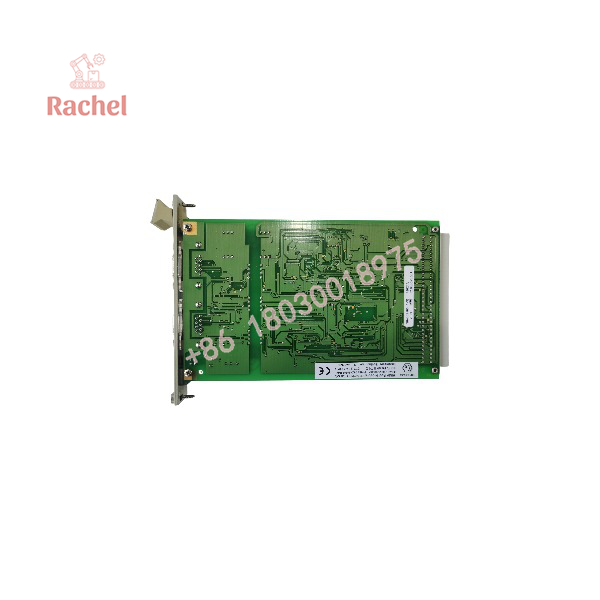
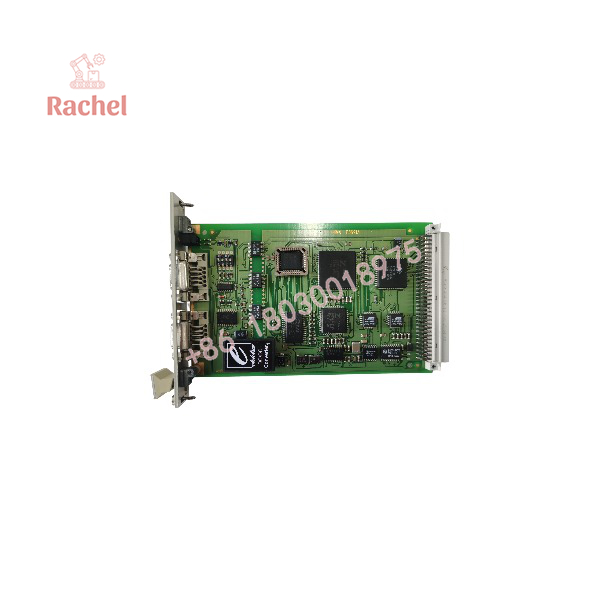
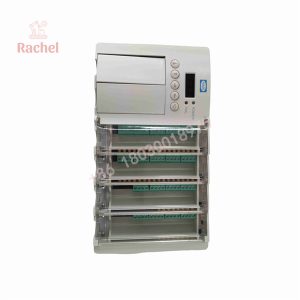
The HIMA F8621A is a coprocessor module for the HIQuad H41q and H51q programmable electronic safety (PES) systems, manufactured by HIMA Paul Hildebrandt GmbH. It installs in the central rack of an H41q/H51q controller alongside the central modules, where it offloads communication and interface processing tasks from the safety-related central processing units. The module carries the HIMA order number 984862160.
The F8621A operates with its own HD 64180 microprocessor running at a 10 MHz clock frequency and provides 384 kbyte of static memory, implemented as CMOS-RAM and EPROM on two ICs. Its battery-backed RAM is monitored through the F7131 power supply monitoring module. The module offers two galvanically isolated RS-485 half-duplex serial interfaces with programmable transmission rates from 300 to 57,600 bps, and a dual-port RAM that gives the second central unit fast access in redundant configurations. Current consumption is 360 mA at 5 V DC, and the module occupies 4 TE of rack space in the 19-inch subrack.
Key Technical Specifications
| Parameter | Value |
|---|---|
| Product type | Coprocessor module |
| Order number | 984862160 |
| Manufacturer | HIMA Paul Hildebrandt GmbH |
| System family | HIQuad H41q / H51q PES |
| Processor | HD 64180 |
| Clock frequency | 10 MHz |
| Memory | 384 kbyte static memory (CMOS-RAM and EPROM on 2 ICs) |
| RAM backup | Battery-backed; monitored via F 7131 power supply monitoring module |
| Serial interfaces | 2 × RS-485, half-duplex, galvanically isolated |
| Transmission rates | 300 / 600 / 1200 / 2400 / 4800 / 9600 / 19200 / 38400 / 57,600 bps (programmable, or values set on the CU via DIP switch) |
| Inter-processor access | Dual Port RAM for fast access from the second central unit |
| Current consumption | 360 mA at 5 V DC |
| Rack space requirement | 4 TE |
| Mounting | 19-inch subrack, central rack of the H41q/H51q system |
| Engineering tool (system level) | ELOP II, programming per IEC 61131-3 |
Detailed Product Overview
In a HIQuad H41q or H51q safety controller, the central modules execute the safety-related user program, but a plant-level installation also needs serial communication with engineering and operator stations, higher-level systems, and third-party devices. The F8621A exists so that this communication load does not sit on the safety processors. As a coprocessor module, it runs its own HD 64180 microprocessor at 10 MHz and handles its own interface processing, functioning as an autonomous processing element within the central rack rather than a passive I/O card.
The module’s 384 kbyte of static memory is split across CMOS-RAM and EPROM on two ICs. The RAM portion is battery-backed, and its backup condition is monitored through the F7131 power supply monitoring module — a detail that matters for maintenance planning, because a failing buffer battery affects the F8621A’s retained data before it affects the central modules. Checking the F7131’s battery indication should therefore be part of routine system inspection in any rack that contains coprocessor modules.
Its two RS-485 half-duplex interfaces are galvanically isolated, which allows the F8621A to connect serial devices and engineering PCs without coupling ground potential differences into the safety controller. Transmission rates are software-configurable in standard steps from 300 to 57,600 bps, or can adopt values set on the central unit via DIP switch. For the PADT (programming and diagnostics terminal) workflow of the H41q/H51q family — programming, configuration, testing, and monitoring per IEC 61131-3 with ELOP II — this serial path is the link through which the PC connects to the PES.
The dual-port RAM is the feature that makes the F8621A useful in redundant H41q/H51q configurations, where two central units operate in parallel. It gives the second central unit fast, direct access to the coprocessor’s memory, so both central modules can work with the coprocessor without a bottleneck. In the redundant system kits of the H51q family, up to six F8621A coprocessor modules can be populated per central rack, distributed across the two central units.
For procurement and replacement, the important identification points are the module designation F 8621 A and the order number 984862160. The F8621A is a functional module of the H41q/H51q hardware generation, is installed in 19-inch subracks, and draws 360 mA at 5 V DC from the rack power supply — a load that must be counted when verifying the 5 V budget of the power supply modules feeding the rack.
F8621A
F8621A
System Compatibility & Integration Requirements
| Item / Dependency | Verified Compatibility or Requirement | Practical Note |
|---|---|---|
| Controller family | HIQuad H41q / H51q PES | Installs in the central rack of the system |
| Rack format | 19-inch subrack | 4 TE space requirement per module |
| Central units | Operates alongside the central modules; dual-port RAM gives the second CU fast access | Relevant in redundant HS/HRS configurations |
| Serial interfaces | 2 × RS-485 half-duplex, galvanically isolated | Rates programmable 300–57,600 bps or set on the CU via DIP switch |
| Battery backup monitoring | Via F 7131 power supply monitoring module | Include the F7131 in racks using the F8621A |
| Power supply | 5 V DC, 360 mA from the rack supply | Count in the 5 V budget of the F7126/F7130A power supply modules |
| Engineering tool | ELOP II, IEC 61131-3 programming (H41q/H51q family) | PADT connects to the PES via the serial interface |
| Safety certification context | H41q/H51q systems are TÜV certified and applicable up to SIL 3 per IEC 61508 | System-level certification; the coprocessor is a communication module within this architecture |
Engineering Selection Highlights
- System fit: The F8621A is designed for the HIMA H41q/H51q PES family. It is not a HIMax or HIQuad X module, so selecting it only makes sense for racks built on the H41q/H51q hardware generation.
- Communication separation: Because the coprocessor runs its own HD 64180 at 10 MHz, serial communication processing is separated from the safety-related central units — relevant when a project needs PADT access or serial data exchange without adding load to the safety processors.
- Serial interface requirement: Two galvanically isolated RS-485 half-duplex interfaces with programmable rates from 300 to 57,600 bps determine what can be connected; devices requiring other physical interfaces need a different module or a converter.
- Redundant configurations: The dual-port RAM enables fast access from the second central unit, so the module supports the redundant central architectures used in H51q-HS/HRS configurations.
- Power budget: The module draws 360 mA at 5 V DC and occupies 4 TE, which must be included in the rack’s 5 V supply calculation and slot planning.
- Battery dependency: Retained RAM depends on a buffer battery whose condition is monitored via the F7131 module; a rack with an F8621A should always have the F7131 monitoring function in operation.
- Engineering toolchain: H41q/H51q systems are programmed with ELOP II per IEC 61131-3; projects standardized on other HIMA toolchains (e.g., SILworX) are not the context for this module.
FAQ
What is the HIMA F8621A?
The F8621A is a coprocessor module with the HIMA order number 984862160, used in the central racks of HIQuad H41q and H51q safety controllers.
What does the F8621A do?
It handles serial communication and interface processing with its own HD 64180 processor (10 MHz), offloading these tasks from the safety-related central modules, and provides two galvanically isolated RS-485 half-duplex interfaces.
How much memory does the F8621A have?
The module contains 384 kbyte of static memory, implemented as CMOS-RAM and EPROM on two ICs, with the RAM portion battery-backed and monitored via the F7131.
Which transmission rates do its RS-485 interfaces support?
Programmable rates of 300, 600, 1200, 2400, 4800, 9600, 19,200, 38,400, and 57,600 bps, or values set on the central unit via DIP switch.
Can it be used with redundant central modules?
Yes. Its dual-port RAM gives the second central unit fast access, and it is listed as an optional coprocessor in redundant H51q-HS/HRS system kits.
How much power does the F8621A consume?
It draws 360 mA at 5 V DC from the rack power supply and requires 4 TE of rack space.
Which engineering software is associated with this module?
H41q/H51q systems are engineered with ELOP II, programmed per IEC 61131-3; the programming and diagnostics PC connects via the serial interface.
Verification & Troubleshooting Notes
- Module not recognized in the rack: Confirm the module is seated in a valid central-rack slot and that the rack’s 5 V supply is within specification; the F8621A depends on the central units for integration into the system configuration.
- Serial communication fails: Verify that the configured transmission rate (software setting or DIP-switch value on the central unit) matches the connected device, and check the RS-485 wiring against the module’s 9-pin interface assignment (data lines RxD/TxD-A and RxD/TxD-B, data ground DGND).
- Ground-potential or noise issues on the serial link: The interfaces are galvanically isolated; confirm that the isolation is not bypassed by the external cable shielding or grounding arrangement.
- Unexpected loss of retained data: Check the battery indication of the F7131 power supply monitoring module — the F8621A’s RAM backup is monitored through it.
- Redundant system behavior: In dual-CU configurations, verify that both central units are healthy; a fault in the redundant partner can change how the coprocessor’s dual-port RAM is accessed.
- Any intervention on a safety-related system should follow the applicable HIMA system documentation and the plant’s safety procedures; do not modify modules or bypass monitoring functions.

 Start Chat


