





Description
Product Introduction
The Keysight 5517B (formerly Agilent / HP 5517B) is a precision dual-frequency Helium-Neon (HeNe) laser head designed specifically for laser interferometer position measurement systems. Installed in high-precision lithography steppers, coordinate measuring machines (CMMs), and advanced CNC tool beds, it outputs a stabilized, two-frequency orthogonally polarized optical beam that serves as the baseline measurement standard for nanometer-scale displacement tracking.
Compared to standard single-frequency lasers or entry-level models like the 5517A, the 5517B delivers a higher optical reference split frequency (1.9 to 2.4 MHz). This frequency boost translates directly into higher maximum allowable axis velocity—up to 538 mm/s—without risking signal phase-loss or receiver dropouts during fast stage moves.
Key Technical Specifications
| Parameter | Value |
| Manufacturer | Keysight Technologies (HP / Agilent) |
| Model Number | 5517B |
| Laser Source Type | Helium-Neon (HeNe), Continuous Wave, Zeeman Split |
| Nominal Vacuum Wavelength | 632.991372 nm |
| Wavelength Accuracy | ±0.1 ppm standard (±0.02 ppm calibrated) |
| Reference Split Frequency | 1.9 MHz to 2.4 MHz |
| Minimum Power Output | 180 µW (Typical operational range 180 µW – 1.0 mW) |
| Standard Beam Diameter | 6.0 mm nominal |
| Maximum Axis Linear Velocity | 538 mm/sec (with linear optics) |
| Supply Voltage Requirements | +15V DC ±0.3V @ 2.2A max, -15V DC ±0.3V @ 0.02A max |
| Power Dissipation | ~35W during warm-up; ~23W normal operation |
| Warm-up Time to Lock | < 10 minutes (typical lock in ~4–5 minutes) |
| Unit Weight | 3.4 kg (7.5 lbs) |
Application Scenarios & The “Trench” Experience
A wafer fab in Texas suffered a sudden loss-of-signal alarm on an older semiconductor exposure stage at 1:45 AM. The tool’s axial receiver reported a “Reference Frequency Dropout” error code. The culprit? An aging 5517B laser tube whose output power had degraded below the 120 µW threshold after 60,000 continuous operating hours. The fab line was losing $22,000 per hour in idle capacity. Swapping in a pre-calibrated surplus 5517B laser head, waiting 8 minutes for the thermal cavity tuning loop to stabilize, and checking alignment through the beam shutter got the exposure stage back on-line before sunrise.
- Semiconductor Photolithography – Wafer and Reticle Stage Positioning – Delivers sub-nanometer position feedback required to maintain overlay alignment during step-and-scan sequences.
- Precision CMMs & Calibrators – Ultra-High Accuracy Metrology – Acts as the primary standard for calibrating multi-axis machine tool positioning across 40-meter path lengths.
- Flat Panel Display (FPD) Manufacturing – Glass Substrate Inspection Beds – Provides wide-bandwidth position tracking across dynamic high-speed gantry axes.
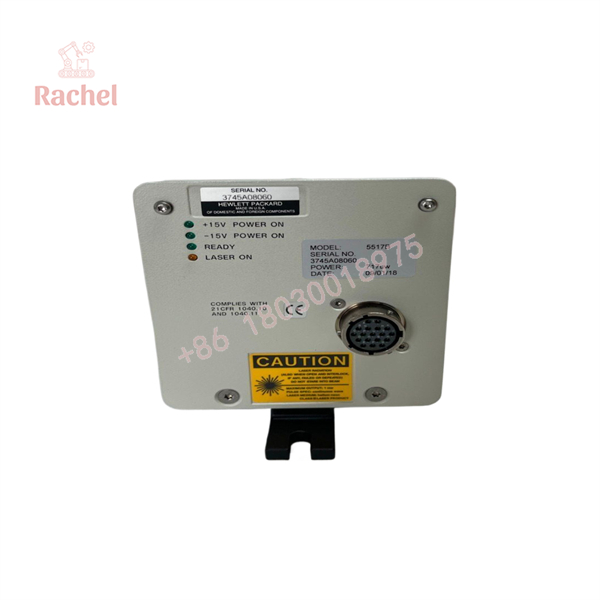
5517B
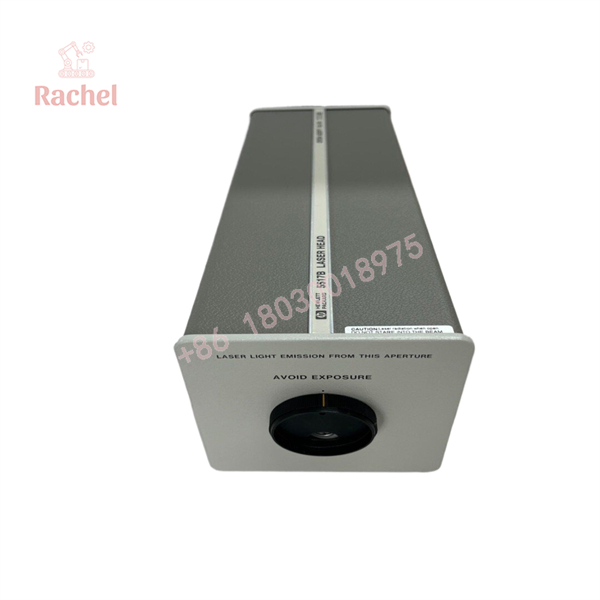
5517B
Transparency SOP: Quality Assurance & Testing
We don’t just ship boxes; we test them on actual interferometry test benches.
- Inbound Mechanical & Optical Inspection: Check outer shroud integrity, examine optical exit windows for micro-scratches, and verify front shutter wheel operation.
- Warm-Up & Thermal Tuning Verification: Power the tube with a stable ±15V DC supply; verify the internal heater coil locks frequency (READY LED solid) in under 10 minutes.
- Optical Power Output Measurement: Measure raw output power using an optical power meter across the 633 nm spectrum to ensure output strictly exceeds 180 µW.
- Reference Frequency & Signal Integrity Test: Pipe the optical output through a polarization beam splitter into a receiver module; confirm the REF split frequency sits clean within the 1.9 MHz – 2.4 MHz window on a high-frequency spectrum analyzer.
- Precision Alignment & Packaging: Secure optics, apply protective optical lens caps, wrap in static/shielding material, and pack inside suspended foam enclosures to prevent mechanical shock during transit.
The Veteran’s Tech Trap Guide (Crucial Value-Add)
- ⚠️ Do NOT adjust the internal Zeeman magnet or cavity mirror screws: The split frequency (1.9 to 2.4 MHz) depends on precise Zeeman magnetic splitting and tube cavity length. Turning internal set screws will destroy the polarization orthogonality and ruin the reference signal.
- ❗ Watch out for “Ref Frequency Creep”: As HeNe tubes age, their reference split frequency naturally drifts upward. A 5517B tube drifting past 2.4 MHz may start tripping axes on older OEM controllers expecting a 5517B window—even if optical output power remains strong. Always verify your receiver’s supported REF frequency range before swapping cards.
- ⚠️ Verify your power supply rails: These laser heads rely on low-noise ±15V DC power (typically from a Keysight 10884B supply). If your +15V rail dips under 14.7V due to high cable resistance, the internal cavity heater will struggle to lock, leaving the “READY” LED blinking indefinitely.
- ❗ Respect the thermal warm-up time: Never take critical metrology measurements right after power-on. Even if the READY light turns solid at 4 minutes, allow a full 30 to 45 minutes for the laser chassis to reach complete thermal equilibrium with the ambient room.
Frequently Asked Questions (FAQ for Conversion)
Q: Can I replace a 5517A laser head with a 5517B?
A: Mechanically and electrically, yes—both run off standard ±15V DC supplies. However, the 5517B operates at a higher split reference frequency (1.9–2.4 MHz vs 1.5–2.0 MHz on the 5517A). You must confirm that your system axis electronics/receiver cards (e.g., HP 10885A or N1231A) support the higher input frequency.
Q: Is the 5517B laser head hot-swappable?
A: No. Disconnecting the high-density power connector while live can cause voltage transients that damage internal tuning circuitry and trigger high-voltage arcs across the HeNe tube starting circuit. Always power down the system power supply before swapping heads.
Q: What does a blinking READY LED mean?
A: A blinking READY light indicates the laser head is still actively adjusting its internal cavity length using the thermal heating circuit to lock the two optical frequencies. If it blinks for longer than 15 minutes, check your ±15V power supply voltages or inspect the tube for end-of-life thermal failure.
Q: Why buy a surplus or refurbished 5517B unit instead of ordering new from Keysight?
A: Keysight has transitioned much of the classic 5517 series to legacy status, leading to extended factory lead times and premium replacement costs. Certified surplus and refurbished units provide direct, drop-in replacement performance at a fraction of the cost, eliminating months of tool downtime.
Q: What warranty is provided with this laser head?
A: We back all refurbished and new-surplus Keysight 5517B laser units with a 12-month replacement warranty. If output power drops below OEM minimum specifications or the cavity fails to lock under normal operating conditions within a year, we replace the head immediately.

 Start Chat


