





Description
Product Introduction
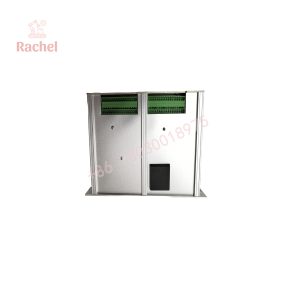
The Kollmorgen 60WKS-M240/22 is a transistorized analog servo amplifier for Kollmorgen SM-series brushless synchronous servo motors. It uses a three-phase power stage, analog differential setpoints, PI speed/current control, and motor feedback through tachometer and rotor-position inputs.
The key specification is the 22 A four-quadrant output rating. The amplifier uses a 240 VDC nominal DC link and can deliver up to 50 A peak for approximately five seconds. This makes it a substantially higher-current member of the 60WKS-M240 family than the 3 A, 6 A, or 12 A versions.
Key Technical Specifications
| Parameter | Specification |
|---|---|
| Manufacturer | Kollmorgen |
| Model | 60WKS-M240/22 |
| Product Type | Analog Servo Amplifier |
| Series | 60WKS |
| Motor Compatibility | SM-series brushless synchronous motors |
| Supply Voltage | 3 × 60–172 VAC, 50–60 Hz, +10% max. |
| Rated DC-Link Voltage | 240 VDC |
| Rated Output Current | 22 A |
| Peak Output Current | 50 A for approximately 5 seconds |
| Rated Input Power | 3.7 kVA |
| Maximum AC Fuse | 3 × 20 A |
| Ballast Pulse Power | 5.4 kW |
| Ballast Continuous Power | 135 W |
| Minimum Motor Inductance | 0.7 mH |
| Output Switching Frequency | 8.5 kHz |
| Setpoint Inputs | 2 differential inputs, ±10 V |
| Feedback | 3-phase, brushless, or DC tachometer; RLG rotor-position sensor |
| Control Logic | 24 V, optocoupler-isolated |
| Cooling | Forced ventilation |
| Protection | Short circuit, earth fault, undervoltage, overvoltage, temperature, I²t |
| Dimensions | Approximately 220 × 233.4 × 45 mm |
| Weight | Approximately 1.4 kg |
| Protection Class | IP00 |
The OEM documentation confirms that the 60WKS-M240/22-PB belongs to a family with 3, 6, 12, 22, and 26 A variants. The 22 A version has a 3.7 kVA rated load, 22 A rated four-quadrant output, and 50 A peak output.
One important distinction: 60WKS-M240/22 is commonly cross-referenced with 60WKS-M240/22-PB and 60WKSM24022PB. Do not assume that every suffix or option version is electrically identical. Verify the nameplate and installed option board before ordering.
Application Scenarios & The “Trench” Experience
A legacy servo axis starts faulting only during hard deceleration. At low speed it behaves normally. Increase the commanded speed, initiate a stop, and the amplifier trips.
That pattern matters.
With a four-quadrant 22 A servo amplifier, regenerative energy, DC-link voltage, motor inductance, feedback integrity, and ballast-circuit operation all deserve attention. Replacing the drive without checking those conditions can destroy the replacement just as quickly.
- Machine Tools — High-Dynamic Servo Axes — Provides 22 A four-quadrant output for Kollmorgen SM-series brushless motors.
- Industrial Machinery — Reversing Motion — Supports bidirectional torque and regenerative operation through its four-quadrant power stage.
- Printing Equipment — Speed-Controlled Rollers — Analog ±10 V setpoints and tachometer feedback fit legacy motion architectures.
- Packaging Machinery — Synchronized Motion — Useful where an existing controller already generates analog servo commands.
- Legacy Production Lines — Exact Drive Replacement — Maintains an existing 60WKS architecture without immediately redesigning the machine’s motion-control interface.
Field case — plausible replacement scenario:
A converting machine has several Kollmorgen 60WKS amplifiers. One axis begins tripping during rapid stops. The motor checks correctly. The tachometer signal is clean.
The maintenance team identifies the failed unit as 60WKS-M240/22.
Before installing the spare, they record the adjustment-board settings and inspect the braking/ballast circuit. They also verify that the replacement has the same 22 A configuration and compatible feedback arrangement.
The replacement passes a low-speed test first.
Then 25%.
Then 50%.
Finally, the machine is returned to its normal acceleration and deceleration profile.
That staged commissioning matters. A servo amplifier can look healthy at idle and still fail under regenerative load.
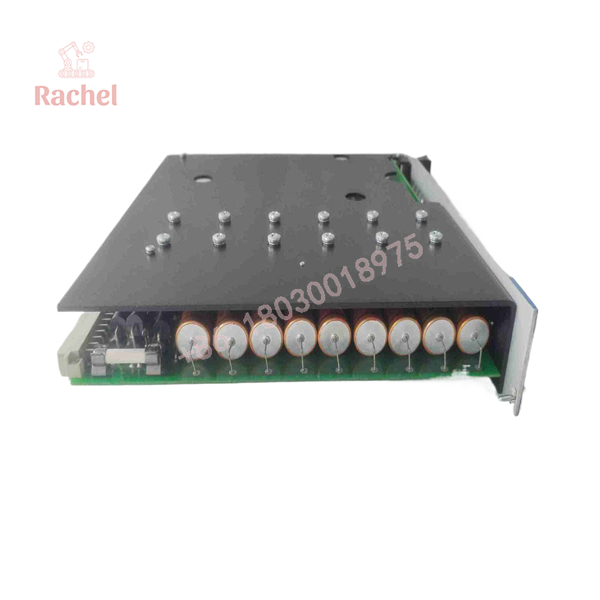
60WKS-M24022
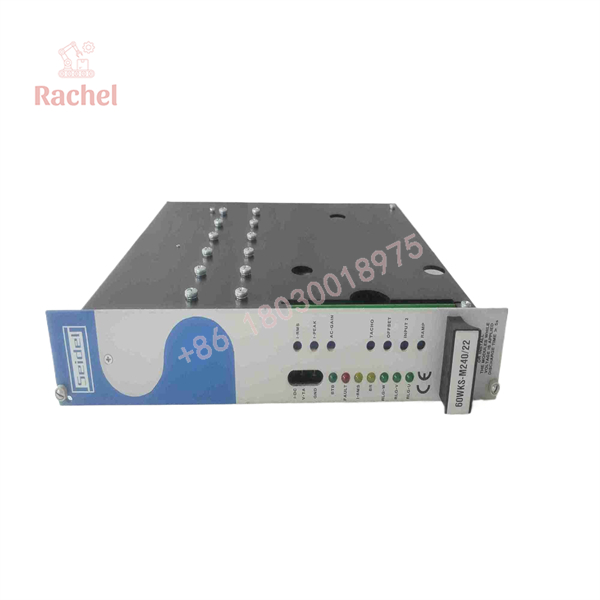
60WKS-M24022
Transparency SOP: Quality Assurance & Testing
A 60WKS-M240/22 should be tested as a power electronics assembly and as a servo-control device.
- Inbound Inspection
- Verify the complete 60WKS-M240/22 marking.
- Check the suffix, revision, option board, and serial information.
- Inspect power terminals, control connectors, Sub-D feedback connector, PCB, heat sink, and mounting hardware.
- Look for thermal damage, cracked solder joints, corrosion, or previous repair work.
- Live Rig Testing
- Install the amplifier in a compatible 60WKS test setup.
- Verify three-phase input behavior and DC-link charging.
- Confirm control-logic operation.
- Test the enable circuit.
- Apply controlled ±10 V setpoint signals.
- Verify motor feedback and closed-loop response with an appropriate test motor.
- Electrical Parameter Checks
- Verify the 240 VDC nominal DC-link condition.
- Test output current under controlled load.
- Check four-quadrant operation.
- Verify ballast-circuit behavior during controlled deceleration.
- Monitor transistor temperature and fault protection.
- Configuration Verification
- Record trimmer potentiometer settings before replacement.
- Verify the motor feedback type.
- Check the optional PCB configuration.
- Confirm the motor’s current and inductance requirements.
- Final QC & Anti-static Packaging
- Record load-test results.
- Photograph the actual unit and nameplate.
- Protect the DIN 41612 and feedback connectors.
- Use ESD-safe packaging with mechanical protection around the power terminals.
We don’t just ship boxes. A 22 A analog servo amplifier needs a controlled load test. A green LED at idle proves very little.
The Veteran’s Tech Trap Guide (Crucial Value-Add)
- ⚠️ Don’t confuse the 22 A and 26 A versions. They share the 240 VDC link architecture, but their rated output currents and power ratings differ. The 26 A version has a 4.4 kVA rated load versus 3.7 kVA for the 22 A version.
- ❗ Check the motor inductance. The OEM table gives a 0.7 mH minimum motor inductance for the 22 A version. Do not substitute a motor outside the specified electrical range without engineering verification.
- ⚠️ Inspect the ballast circuit after an overvoltage fault. The 60WKS-M240/22 has a 5.4 kW pulse ballast rating and 135 W continuous ballast rating. A machine with aggressive deceleration can expose a problem that never appears during steady-state running.
- ❗ Photograph the adjustment board. This is an analog amplifier. Setpoint scaling and controller adjustments are not stored like parameters in a modern EtherCAT servo drive. Lose the original settings and commissioning becomes much harder.
Frequently Asked Questions (FAQ for Conversion)
Q1. What is the Kollmorgen 60WKS-M240/22?
It is a 22 A analog servo amplifier in the Kollmorgen 60WKS family, designed primarily for SM-series brushless synchronous servo motors.
Q2. What is the output rating?
The rated four-quadrant output current is 22 A, with a peak output of 50 A for approximately five seconds. Its nominal DC-link voltage is 240 VDC.
Q3. Is 60WKS-M24022 the same as 60WKS-M240/22-PB?
The available documentation and industrial listings cross-reference these designations, including 60WKS-M240/22-PB and 60WKSM24022PB. Still, verify the physical nameplate and suffix before treating them as an exact replacement.
Q4. Does it use EtherNet/IP, EtherCAT, or another digital fieldbus?
No modern Ethernet fieldbus should be assumed. This is an analog servo architecture using differential setpoint inputs, 24 V control signals, tachometer/rotor-position feedback, and a transistorized power stage.
Q5. Can the 60WKS-M240/22 be hot-swapped?
No. Treat it as a high-energy servo power device. Isolate the machine, discharge the DC link, verify zero hazardous voltage, and follow the applicable lockout/tagout procedure before removal.
Q6. What should I check before replacing it?
At minimum: motor current, motor inductance, feedback type, ±10 V command wiring, enable logic, ballast/braking circuit, option PCB, adjustment settings, and exact 60WKS suffix. A replacement with the correct current rating can still be wrong for the machine.
Q7. Why is a surplus unit cheaper than direct OEM supply?
The 60WKS family is legacy hardware and is no longer a mainstream new-drive platform. Secondary-market suppliers list new-surplus, refurbished, and previously used units. That makes condition and testing more important than the advertised price.

 Start Chat


