





Description
Product Introduction & Engineering Value
The 683B-23795 is not simply a motorized vacuum valve. Its integrated electronics allow the valve to participate directly in a closed-loop pressure-control system. MKS designed the Type 683B to operate either in pressure-control mode or flapper-position mode, with configuration and diagnostic information available through the DeviceNet interface.
This architecture is particularly valuable in semiconductor process equipment because chamber pressure is a process variable, not merely a mechanical valve-position problem. The controller can use pressure feedback to adjust the exhaust throttle position and maintain the desired downstream pressure.
Technical Specifications
| Specification | 683B-23795 |
|---|---|
| Manufacturer | MKS Instruments |
| Series | Type 683B |
| Part Number | 683B-23795 |
| Valve Function | Exhaust throttling / downstream pressure control |
| Communication | DeviceNet |
| Communication Connector | 5-pin male Micro connector |
| Selectable DeviceNet Data Rates | 125, 250, or 500 kbaud |
| Control Modes | Pressure or flapper position |
| Drive | Direct gear drive |
| Valve Speed | Approximately 1.7 seconds |
| Position Resolution | 1/12,000 |
| Maximum Differential Pressure | 1 atm / 15 psig |
| Standard Valve Materials | 316 stainless steel, Viton |
| Standard Valve Operating Temperature | 0–100°C |
| Valve Motor Ambient Temperature | -20 to +40°C |
| Closed Leakage | <10⁻⁷ Torr·L/s |
| Typical Flange Family | ISO-KF / NW |
| Reported Configuration | 3 in. / NW80 |
| Lifecycle | Discontinued |
The general Type 683B specifications above come from MKS’s archived product documentation. MKS specifies a 1.7-second valve speed, 1/12,000 resolution, direct gear drive, and a maximum differential pressure of 1 atm (15 psig).
MKS also specifies DeviceNet communication with selectable 125, 250, or 500 kbaud data rates.
Important Part-Specific Qualification
Not every Type 683B configuration has the same flange, bore, sealing, or motor configuration. MKS’s ordering information shows that Type 683B valves were configurable by bore/flange size, sealing configuration, communication, and motor speed.
Therefore, the 3-inch/NW80 and F-CUP identification should be treated as the configuration associated with 683B-23795 in semiconductor-equipment listings, rather than automatically applied to every 683B valve.
For procurement, the complete part number and physical valve label should take precedence over generic Type 683B specifications.
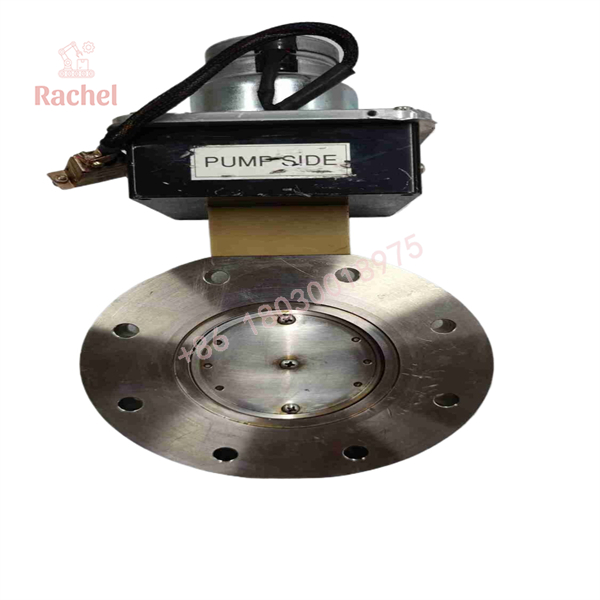
683B-23795
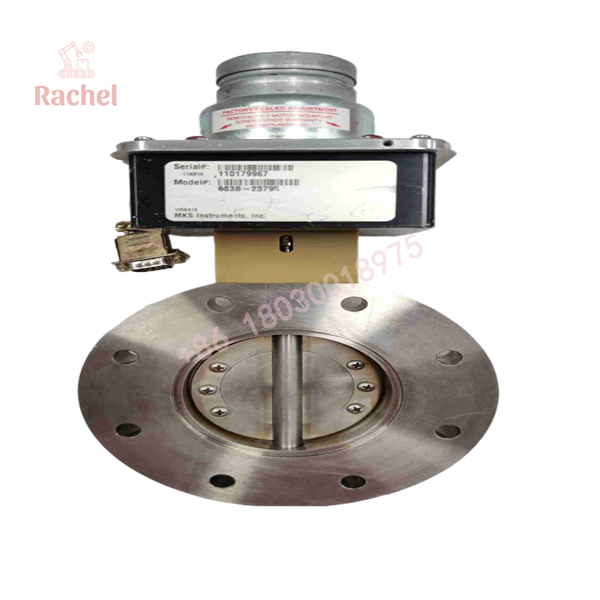
683B-23795
DeviceNet Control Architecture
One of the defining characteristics of the 683B-23795 is its DeviceNet interface.
MKS describes DeviceNet as the communication link for the Type 683B. The valve can expose operating and configuration information through the network, allowing a DeviceNet master to interact with the valve without requiring a separate analog valve controller.
The network interface provides access to functions including:
- Pressure-control set point
- Position-control set point
- Control tuning parameters
- Soft-start parameters
- Valve position
- Pressure information from the external transducer
- Alarm/trip settings
- Valve cycle count
- Operating hours
- Hardware/software revision
- Serial and model information
- Valve-drive limits
MKS specifically documents adjustable trip points for pressure, valve position, and set-point deviation.
Why This Matters During Troubleshooting
If the valve fails to respond correctly, the fault may not be mechanical.
A 683B system can have problems in several layers:
- DeviceNet network communication
- Integrated valve electronics
- Motor/drive mechanism
- Flapper or shaft assembly
- Pressure transducer
- Vacuum plumbing
- Pumping system
- Process-control configuration
A DeviceNet communication fault can therefore look like a valve failure, while a mechanical problem can appear to the control system as a position-control or pressure-control problem.
Pressure-Control Operation
The Type 683B supports two principal operating approaches:
Pressure Control
In pressure-control mode, the valve uses pressure feedback to adjust the exhaust restriction and drive the chamber toward the commanded pressure set point.
This is the important mode for semiconductor process chambers where pressure directly affects deposition, etch, or other process conditions.
Flapper Position Control
The valve can also operate as a position-controlled throttle valve.
This mode is useful when the external process-control system needs direct control of valve position rather than having the valve independently regulate pressure.
MKS explicitly documents both pressure and flapper-position control modes.
Application in Semiconductor Equipment
The 683B-23795 has a particularly strong association with Applied Materials semiconductor process equipment.
A semiconductor-equipment configuration record identifies:
- MKS 683B-23795
- Applied Materials P/N 3870-03394
- 3-inch F-CUP configuration
- DeviceNet driver
- Pressure-control function
- CVD application
The same equipment record identifies the valve as part of an Applied Materials Producer CVD configuration.
This makes the part particularly relevant to maintenance inventories supporting legacy Applied Materials CVD equipment.
Field Application & “Trench” Experience
A plausible maintenance scenario:
A CVD chamber begins showing slow pressure settling and increased process-to-process variation. The pressure controller continues reporting a valid pressure value, but the throttle position oscillates around the commanded operating point.
The first temptation is to replace the Baratron pressure sensor.
That is not necessarily the correct diagnosis.
A better sequence is to examine:
- DeviceNet communication quality
- Reported valve position
- Actual flapper movement
- Valve cycle count
- Motor response
- Pressure-controller tuning
- Vacuum-line condition
- Pump performance
- Process by-product accumulation
If the DeviceNet master reports changing valve commands but the physical valve does not follow them, the integrated actuator or mechanical assembly becomes a stronger suspect.
Conversely, if the valve position tracks commands but chamber pressure remains unstable, the pressure measurement, pumping system, process gas load, or control-loop tuning deserves attention.
This is a plausible engineering scenario, not a claim about a specific customer installation.
Niche Applications
The 683B-23795 is particularly relevant to:
Semiconductor CVD
The valve regulates downstream exhaust restriction to help maintain chamber pressure during deposition processes.
Vacuum Process Chambers
The integrated controller allows the valve to participate in automated pressure-control systems without requiring a separate analog valve controller.
Legacy Applied Materials Equipment
The 3870-03394 / 683B-23795 cross-reference is particularly important for spare-parts procurement in legacy Applied Materials equipment.
Installation and Replacement Considerations
1. Match the Physical Configuration
Do not order solely on the basis of “MKS 683B.”
Verify:
- 683B-23795 part number
- Bore size
- Flange type
- Flange orientation
- Sealing configuration
- DeviceNet interface
- Motor configuration
- Valve serial number
A Type 683B valve with a different bore or flange configuration is not necessarily a drop-in replacement.
2. Verify the DeviceNet Network
Before replacing the valve, record the existing:
- DeviceNet node address
- Network baud rate
- Master/controller configuration
- EDS/device profile information
- Network termination
- Connector wiring
- Power supply condition
A replacement valve may be mechanically correct but still fail to communicate if the network configuration does not match.
3. Verify Pressure Feedback
The Type 683B can use an external pressure measurement for closed-loop pressure control. MKS documentation states that the valve is compatible with Digital Baratron capacitance manometers and can alternatively accept a 0–10 VDC signal from a traditional analog Baratron capacitance manometer.
Therefore, a pressure-control problem should not automatically be attributed to the throttle valve itself.
Veteran’s Tech Trap Guide
⚠️ Trap #1 — Treating 683B-23795 as a Generic Butterfly Valve
It is not.
The 683B is an intelligent valve with integrated control and DeviceNet electronics. Replacing it with a mechanically similar valve without equivalent control functionality can remove the entire pressure-control interface.
PRO TIP: For an equipment replacement, match the communication architecture and control function, not just the flange dimensions.
⚠️ Trap #2 — Ignoring DeviceNet Configuration
The valve’s DeviceNet interface is an integral part of the equipment design.
Check the node address and baud rate before assuming the replacement valve is defective.
⚠️ Trap #3 — Assuming Every 683B Has the Same Mechanical Configuration
The MKS ordering table shows multiple bore/flange and sealing configurations within the Type 683B family.
PRO TIP: The full MKS part number is more useful than “Type 683B” when ordering a spare.
⚠️ Trap #4 — Confusing Valve Position With Chamber Pressure
A valve can reach its commanded position while the chamber pressure remains incorrect.
Possible causes include:
- Pressure transducer problems
- Pump degradation
- Restriction in the exhaust path
- Process-gas changes
- Contamination
- Incorrect control tuning
Do not condemn the valve solely because the pressure reading is wrong.
QA & Testing SOP
For a New Surplus or refurbished 683B-23795, inspection should go beyond visual condition.
Identification Inspection
Record:
- MKS nameplate
- Exact 683B-23795 number
- Serial number
- Hardware/software revision
- DeviceNet connector
- Valve bore/flange
- Seal configuration
Mechanical Inspection
Inspect:
- Flapper movement
- Shaft mechanism
- Motor/gear drive
- Valve body
- Flanges
- Sealing surfaces
- O-ring condition
- Evidence of process contamination
Do not cycle a vacuum valve aggressively without following the applicable MKS service procedure.
Electrical and Communications Testing
Where appropriate test equipment is available:
- Apply the correct valve power.
- Establish DeviceNet communication.
- Verify device identity.
- Confirm node address.
- Confirm communication rate.
- Exercise position commands.
- Monitor reported position.
- Verify pressure-control response where a calibrated pressure source is available.
- Check alarm/trip behavior.
- Record hardware/software revision.
Vacuum Functional Test
For a critical semiconductor spare, the preferred acceptance test should include:
- Leak verification
- Valve movement
- Position response
- DeviceNet communication
- Pressure-control response
- Repeatability
- Full-open/full-closed behavior where permitted by the test procedure
A unit that merely powers up should not be classified as fully tested.
New Surplus Authenticity
The 683B-23795 is a relatively expensive semiconductor-process component, and marketplace condition descriptions vary significantly.
One current listing identifies a used unit as “as-is” with no warranty, while another industrial supplier offers a used unit with a one-year replacement warranty.
For procurement, request:
- Actual valve photographs
- MKS nameplate
- Exact 683B-23795 marking
- Serial number
- DeviceNet connector photograph
- Flange photograph
- Flapper/valve-body condition
- Test report
- Vacuum leak-test results, if available
- Warranty terms
Supplier warranty is not equivalent to MKS factory warranty.
For refurbished semiconductor equipment valves, the most important question is not simply “Does it look new?” but “What functional tests were actually performed?”
Lifecycle and Replacement Strategy
MKS currently states that the 683B DeviceNet exhaust throttle valve family is no longer available and identifies the T2B EtherCAT exhaust throttle valve family as the recommended current replacement product family.
That does not mean a T2B valve should automatically be installed as a drop-in replacement for 683B-23795.
The current MKS T2B family has different communication options and application requirements. MKS documentation, for example, notes that the EtherCAT T2BA pressure-control system is compatible with EtherCAT manometers.
For a legacy Applied Materials tool, replacing a 683B-23795 therefore requires an engineering compatibility review covering:
- Mechanical dimensions
- Flange configuration
- Pressure range
- Valve response
- DeviceNet versus replacement communication
- Controller/software compatibility
- Pressure-transducer interface
- Tool-specific configuration
- Process qualification
For production equipment, tested original 683B-23795 surplus or professionally refurbished inventory may be preferable to an unqualified modern substitute when minimizing tool modifications is the primary objective.
FAQ
What is MKS 683B-23795?
It is an MKS Type 683B intelligent exhaust throttle valve with integrated DeviceNet control electronics, intended for downstream vacuum pressure control.
What is the Applied Materials part number?
The 683B-23795 is cross-referenced in semiconductor-equipment records to Applied Materials P/N 3870-03394. The associated configuration is described as a 3-inch F-CUP flapper DeviceNet throttle valve.
Does the 683B-23795 use DeviceNet?
Yes. The Type 683B uses DeviceNet for digital communication and control. MKS specifies selectable communication rates of 125, 250, or 500 kbaud.
Can it control pressure directly?
Yes. The Type 683B supports both pressure-control mode and flapper-position control mode. It can receive pressure information from a compatible external pressure transducer.
Is the 683B-23795 still manufactured?
MKS currently identifies the 683B DeviceNet family as no longer available. MKS recommends the T2B EtherCAT exhaust-throttle-valve family as the current replacement product family.
Is T2B a direct drop-in replacement?
Do not assume so. The current T2B family uses different communication and configuration options. Mechanical, electrical, network, pressure-transducer, and tool-control compatibility must be verified before substitution.
What should be checked on a refurbished 683B-23795?
At minimum: exact part number, serial number, flange configuration, DeviceNet communication, motor/drive operation, flapper movement, pressure-control response, and vacuum leak performance. For semiconductor production equipment, a simple power-on test is inadequate.
Procurement Description
MKS Instruments 683B-23795 Type 683B Intelligent Exhaust Throttle Valve, 3-Inch/NW80 F-CUP Flapper Configuration, Integrated DeviceNet Controller, Semiconductor Vacuum/CVD Pressure-Control Application; Applied Materials P/N 3870-03394.


 Start Chat


