





Description
Product Introduction
The NABCO PSU-24 Power Source Unit is a heavy-duty, marine-grade AC-to-DC power converter engineered by Nabtesco/NABCO. Functioning as the electrical heartbeat of shipboard propulsion control panels, this unit rectifies raw, fluctuating shipboard AC mains power into the clean, deeply regulated 24V DC power required by sensitive automation hardware.
Unlike standard commercial power supplies, the PSU-24 is housed in a ruggedized ~8.9 kg steel chassis built to dampen extreme hull vibrations. It distributes power across multiple isolated terminal rails (e.g., P1/N1, P2/N2), allowing it to independently feed engine room microprocessor boards (like the NE-133), bridge telegraph systems, and field control relays without causing cross-loop voltage drops during heavy automation demands.
Key Technical Specifications
| Parameter | Specification |
| Manufacturer | NABCO / Nabtesco Corporation |
| Model Number | PSU-24 |
| Equipment Category | Marine AC-DC Power Source Unit |
| Input Voltage Rating | AC 100V (Terminals: R – S) / Compatible ranges up to 100-240V AC (50-60Hz) |
| Output Voltage Rating | Regulated 24V DC |
| Output Distribution | Multiple Terminal Pairs: P1-N1, P1F-N1F, P2-N2, P3-N3 |
| Form Factor | Heavy-duty steel panel-mount chassis |
| Physical Weight | Approx. 8.90 kg (19.6 lbs) |
| Environmental Protection | Class-approved conformal coated internals; Marine-grade heat dissipation |
Application Scenarios & Field Case Study
The Blackout Recovery Scenario
It is 23:00 during heavy cargo loading operations while the ship is running off the harbor generator. Massive power fluctuations from deck cranes cause the auxiliary AC instrument circuit to surge and sag violently. The bridge telegraph panel suddenly goes dark, triggering a “Control Power Fail” alarm on the engine room monitoring system. The original NABCO PSU-24 unit in the main control cabinet suffered a primary rectifier failure from the severe electrical stress. A marine electrician unbolts the ~8.9 kg unit, installs a pre-tested surplus PSU-24, and wires the multi-rail terminals. Stable 24V DC is restored to the backplane instantly, rebooting the bridge maneuvering CPU and clearing all alarms before departure.
Application Scenarios
- Main Engine Remote Control (M-800 Series) Cabinets: Serves as the primary 24V DC source for the entire automation sub-rack, including CPU, interface, and signal conditioning cards.
- Bridge Maneuvering Consoles: Provides isolated DC power for bridge order telegraph handles, lever position encoders, and illumination logic.
- Electro-Pneumatic Actuator Systems: Delivers high-current 24V DC switching power to solenoid valves managing main engine starting air and fuel limiters.
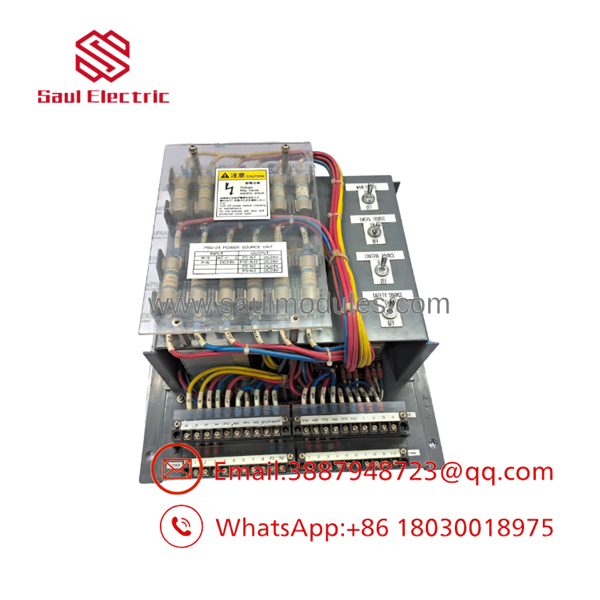
PSU-24
Transparency SOP: Quality Assurance & Testing
- Physical & Thermal Inspection: The heavy steel chassis is inspected for mounting stress, while internal switching blocks and large filter capacitors are examined for heat discoloration, bulging, or electrolyte leakage.
- High-Voltage Insulation Testing (Megger): Dielectric resistance is tested between the AC input terminals (R/S) and the chassis ground to ensure marine safety compliance and prevent electrical shock hazards.
- Loaded Thermal Burn-In: The unit is connected to an AC source and attached to a variable DC electronic load. It is run for several hours at maximum rated current to verify voltage stability and confirm the heat sinks are dissipating thermal load correctly.
- Ripple & Noise Analysis: An oscilloscope is used across the output rails (P1-N1, P2-N2) to ensure the 24V DC output is smooth and free of AC ripple spikes that could corrupt sensitive microprocessors.
- Heavy Freight Packaging: Due to the unit’s high density (8.9 kg), it is bolted or securely strapped to a custom wooden shipping plate, wrapped in ESD film, and suspended in heavy-duty export foam to prevent drop-shock damage in transit.
Maintenance & Field Guidance
- ⚠️ Mind the Unit Weight During Install: ❗ At nearly 9 kg (20 lbs), this unit is exceptionally heavy for its size. Ensure you have a secure grip and that panel-mount retaining bolts are not cross-threaded during installation inside tight ECR cabinets.
- ❗ Verify Input vs. Output Terminals: Never mix the R-S (AC Input) and P-N (DC Output) terminal blocks. Applying 100V AC to the 24V DC output terminals will instantly destroy the internal regulator and catastrophically damage downstream control cards.
- ⚠️ Check Upstream AC Quality: If your original PSU-24 failed prematurely, check the ship’s 100V AC instrument supply for continuous over-voltage conditions or excessive harmonic distortion before installing the replacement.
- ❗ Tighten Terminal Screws: Ship vibration can loosen heavy-gauge power wires. Torque all ring terminal screws firmly and re-check them after the first week of voyage.
Frequently Asked Questions (FAQ)
Q: What is the primary function of the NABCO unit?
A: It is a ruggedized power supply that steps down and converts shipboard AC mains power into highly stable, isolated 24V DC power for NABCO engine control and automation hardware.
Q: Why does the have multiple output terminals (P1, P2, P3)?
A: The multiple output rails allow the power supply to distribute 24V DC to different sub-systems (like CPU logic, alarm relays, and solenoid drivers) independently, minimizing electrical noise interference between the systems.
Q: Can this unit be repaired, or must it be replaced entirely?
A: While internal switching blocks (often TDK-Lambda modules) can sometimes be repaired in a lab, swapping the entire chassis is the standard marine procedure to guarantee immediate vessel reliability and avoid port delays.
Q: What warranty coverage applies to this surplus power supply?
A: Every unit comes backed by a full 12-month industrial replacement warranty. If voltage regulation fails or internal faults occur within 365 days of purchase, an immediate unit exchange or refund is provided.

 Start Chat


