





Description
Introduction & Engineering Value
I’ve spec’d motion hardware for twenty years, and the VigoServo line is the one nobody talks about but everyone in semiconductor tooling quietly depends on. When an ARN30 dies, wafer handling stops. Full stop.
The ARN30 exists because precision linkages — Nabtesco’s own cycloid and reduction gears among them — demand drives tuned for micro-radian positioning, not generic automation speed. It’s engineered as a matched pair with VigoServo motors, which is exactly why it’s the right replacement and not just a replacement.
Technical Specifications
| Parameter | Detail |
|---|---|
| Model Family | ARN30 (VigoServo ARN series, ARN30-A common revision) |
| Manufacturer | Nabtesco / Teijin Seiki legacy line |
| Product Class | Single-axis AC servo drive (amplifier) |
| Motor Compatibility | VigoServo AC brushless servo motors — matched pairing required |
| Control Modes | Position / velocity / torque control per system configuration |
| Feedback | Encoder-based closed-loop feedback with drive-side processing |
| Form Factor | Compact book-style amplifier for cabinet or machine-mount installation |
| Typical Duty | High-precision, low-backlash positioning axes; high duty-cycle indexing |
| Application Platforms | Semiconductor wafer handlers, die bonders, robotics, precision assembly |
| Configuration | Parameter set via drive interface / commissioning tools; settings stored in onboard memory |
| Condition Offered | New Surplus and Refurbished, both function-tested (see QA section) |
Note on numeric ratings: Published voltage/current figures vary by revision and system configuration. We verify electrical ratings against the original Teijin Seiki / Nabtesco datasheet for your exact unit revision before it ships — ask for the QA record.
Field Application & The “Trench” Experience
3 a.m. call, July. A die bonder at a packaging subcontractor drops its Z-axis mid-run — the ARN30 threw an overcurrent fault and would not clear, even after a full power cycle. The machine is a 2008-era platform; the OEM quotes six weeks on a replacement motion controller, and every day down is five figures of lost output.
We had a refurbished ARN30-A on the shelf. But here’s the part that saved them: the maintenance lead had photographed the drive’s parameter table a year earlier during a scheduled audit. New drive went in, parameters keyed over, axis homed on the second attempt (first homing routine needed the encoder offset re-zeroed — always does). Tool running by lunch. The tech’s log entry read: “Down 9 hours instead of 6 weeks. Buy spare.”
Niche application scenarios:
- Wafer pre-aligner rotation axis — continuous bidirectional indexing with sub-arcsecond settling, where the ARN30’s tuning matches Nabtesco’s precision gearheads on the same axis.
- Wire bonder bond-head servo — high-cycle torque-mode operation where thermal stability of the amplifier over 20+ million cycles matters more than peak specs.
- LCD panel transfer robot end-effector — smooth low-speed torque output for vacuum handling in cleanroom conditions, where generic VFD-based axes show visible jerk artifacts.
QA & Testing — No Hand-Waving
How a “New Surplus” ARN30 differs from a garage-sale pull, in five steps:
- 1. Identity & revision check — model markings and board revision verified against Nabtesco/Teijin Seiki documentation. Fakes and mixed-revision units get rejected here.
- 2. Deep visual inspection — magnifier pass on power stage, electrolytic capacitors, connectors, and cooling paths. Bulged caps or prior repair attempts disqualify the unit from “New Surplus” grading entirely.
- 3. Powered bench test — drive brought up on a controlled bench supply at rated input, checked for fault-free initialization and stable standby current draw.
- 4. Closed-loop motion test — paired with a VigoServo test motor, we run commanded position/velocity moves and confirm fault-free tracking and clean encoder feedback.
- 5. Load soak — a timed duty-cycle soak catches thermal faults that a five-minute bench check never will. Units that trip during soak go back to the bench, not the box.
Every shipped unit carries an inspection record with test readings. Ask for it — we keep them on file either way.
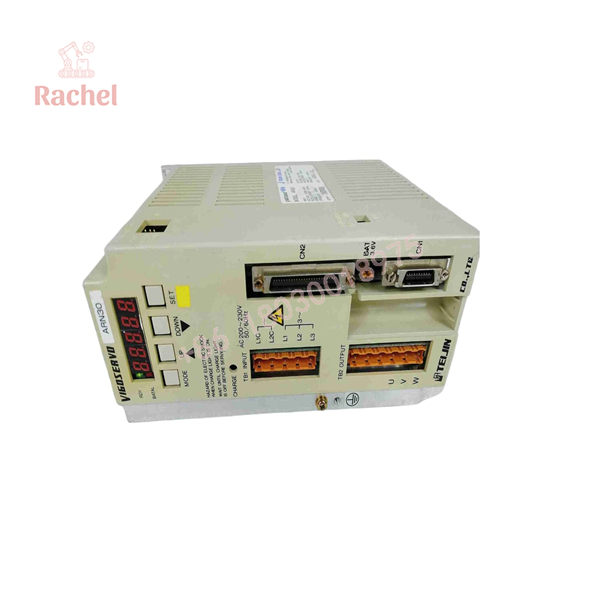
ARN30
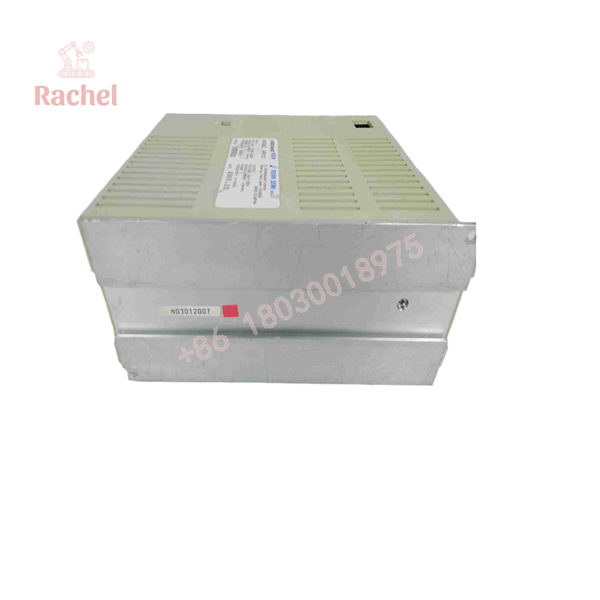
ARN30
The Veteran’s Tech Trap Guide
⚠️ Trap #1 — Parameters don’t migrate themselves. The ARN30 stores axis tuning in the drive, not the controller, in most configurations. Swap the drive without the parameter table and you get an axis that homes wrong, overshoots, or hunts at standstill. Photograph or export parameters while the drive is healthy. This is the single highest-value five minutes in this entire page.
PRO TIP: Encoder offset after a drive swap is the classic gotcha. Even with correct parameters, the homing reference can sit a fraction off. Re-zero per the platform’s commissioning procedure before you trust any positioning — especially on wafer-handling axes where a millimeter is a catastrophe.
⚠️ Trap #2 — Mismatched motor pairings. The ARN30 is tuned as a set with specific VigoServo motor/encoder variants. An ARN30 from a different machine generation may not pair cleanly with your motor’s encoder type. Confirm the motor model and encoder spec against the drive revision before ordering — send us the nameplate photos and we’ll verify the match.
PRO TIP: Check the cooling before you blame the drive. Many ARN30 “failures” in the field are thermal trips from clogged cabinet filters or a failed cabinet fan cooking the amplifier. If your replacement drive faults in the same slot, measure the cabinet intake temperature first. You might be about to buy a second dead drive.
FAQ
Q1: What’s the difference between ARN30 and ARN30-A?
The -A suffix denotes a specific revision in the VigoServo ARN line, with the usual small hardware refinements revision changes bring. Functionally they occupy the same slot in most platforms, but parameter compatibility can vary by machine generation. Give us your machine’s motion controller version and we’ll confirm which revision you need — guessing here costs downtime.
Q2: Can this drive be used with motors other than VigoServo?
It’s engineered and tuned as a matched pair with Teijin Seiki / Nabtesco VigoServo servo motors. Retrofitting other manufacturers’ motors means re-tuning from scratch and verifying encoder compatibility, which we don’t recommend as a field exercise. If you’re considering that path, we’ll be honest with you about the effort involved.
Q3: Is your stock genuine Nabtesco/Teijin Seiki, and how is it verified?
Yes. Every unit’s markings, board revisions, and internal components are checked against OEM documentation at incoming inspection, and serial/revision data is recorded on the QA sheet that ships with the drive. Counterfeits and re-badged units get caught at step one of our process or rejected outright.
Q4: What does “New Surplus” mean for this drive specifically?
Original OEM production, unused, never installed — typically from a machine builder’s spares inventory or excess stock. Shelf-aged but never powered in service. Refurbished units, by contrast, have served in machines and been fully restored, re-capped as needed, and passed the complete bench and load-soak protocol. Both carry the same functional warranty; the listing states the condition plainly.
Q5: What warranty do you offer?
12-month functional replacement warranty on both New Surplus and Refurbished units. If the drive fails in service, we cross-ship a tested replacement from stock — your axis gets moving while the failed unit comes back to us for analysis. Extended terms are available for critical-spares programs.
Q6: Do you supply pre-programmed drives with our parameter set?
In many cases, yes. Send us a parameter dump or clear photos of the original drive’s settings, and our bench team can pre-load the configuration before shipment so your swap is closer to plug-and-play. Ask the technical desk for turnaround time when you place the order.

 Start Chat


