





Description
Product Introduction
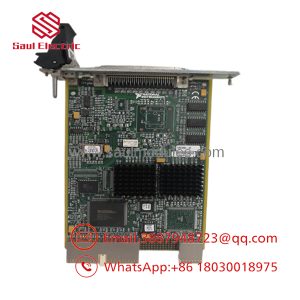
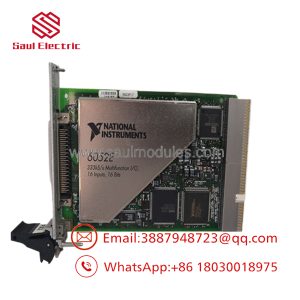
The National Instruments PXI-6025E is a classic 3U single-slot PXI multifunction data acquisition (DAQ) module built on NI’s battle-tested E Series architecture. Designed to plug directly into any standard PXI chassis or CompactPCI slot, it provides reliable analog input, analog output, digital I/O, and counter/timer capabilities controlled natively through NI-DAQmx or legacy Traditional NI-DAQ drivers.
Where lower-end USB or PCI acquisition cards suffer from bus latency and grounding issues, the PXI-6025E utilizes the PXI backplane for precise timing and hardware triggering. It features NI’s DAQ-STC timing controller, allowing independent analog and digital operations without bottlenecking system memory. This makes it an ideal drop-in replacement for legacy automated test equipment (ATE) and industrial monitoring systems that require strict hardware determinism.
Key Technical Specifications
| Parameter | Specification |
| Bus Interface | PXI 3U / CompactPCI |
| Analog Inputs | 16 single-ended or 8 differential |
| ADC Resolution | 12 bits |
| Max Sampling Rate | 200 kS/s (single channel or aggregate multi-channel) |
| Input Ranges | ±0.05 V to ±10 V (Software selectable) |
| Analog Outputs | 2 channels (12-bit resolution, up to 10 kS/s) |
| Digital I/O Lines | 32 lines (5 V TTL/CMOS compatible, 8255 PPI based) |
| Counter/Timers | 2 channels, 24-bit resolution (DAQ-STC chip) |
| Overvoltage Protection | ±40 V powered on, ±25 V powered off |
| I/O Connector | 100-pin female high-density VHDCI or 68-pin (via adapter) |
| Operating Temperature | 32°F to 131°F (0°C to 55°C) |
Application Scenarios & The “Trench” Experience
You’re running an automated test rack for aerospace actuator qualification. The line has been running the same validated LabVIEW 7.1 application code since 2004. Out of nowhere, channel 3 on your DAQ card blows an input amplifier due to a ground loop on a sensor harness. The whole station halts. Rewriting the software for a modern M-Series or X-Series DAQ card would require weeks of re-validation, sign-offs, and software refactoring. You need a direct-fit PXI-6025E card installed, calibrated, and recognized by the legacy driver within hours.
- Aerospace & Defense ATE – Functional Test Systems – Captures low-frequency transducer data and outputs control voltages for legacy test fixtures running on validated legacy PXI racks.
- Automotive R&D – End-of-Line Component Testing – Monitors 16 discrete temperature and pressure sensor channels across automotive assembly rigs with hardware-timed triggering.
- Electronics Manufacturing – Burn-In Rack Monitoring – Uses the 32 digital I/O lines alongside analog sampling to trigger power relays and read status indicators on DUT (Device Under Test) boards.
Field Case Study:
A defense contractor in Ohio faced a line shutdown when an aging PXI-6025E failed during a production run of marine radar sub-assemblies. The original test executive was locked to Traditional NI-DAQ (Driver v7.4). A modern card upgrade meant a $45,000 software re-certification effort. We dispatched a verified surplus PXI-6025E card with identical board revision specs. The test engineer swapped the card into Slot 4 of the PXI chassis, assigned the MAX (Measurement & Automation Explorer) device identifier to Dev1, and had the production rack running fully calibrated tests in under 45 minutes.
Transparency SOP: Quality Assurance & Testing
We don’t just ship boxes; we test them on actual PXI chassis hardware.
- Inbound Physical Inspection: Inspection of the front panel connector pins for bending/corrosion, verification of PCB trace integrity, and checking for damaged capacitors or burnt input protection resistors.
- Live Chassis Insertion & Bus Enumeration: Card is installed into an NI PXI-1042/1045 chassis to verify proper PCI bus enumeration and EEPROM ID recognition in MAX.
- Multi-Channel Analog I/O Verification: Using a calibrated precision voltage source, all 16 analog input channels are swept from -10 V to +10 V across multiple gain settings to ensure ADC linearity and zero crosstalk.
- Digital I/O & Counter Loopback Test: All 32 digital I/O lines are toggled in pattern modes, and internal counter/timers are frequency-tested using an external oscilloscope setup.
- Anti-Static Packaging: The card undergoes an ESD discharge check, is sealed in anti-static shielding, and is packed in custom ESD foam enclosures.
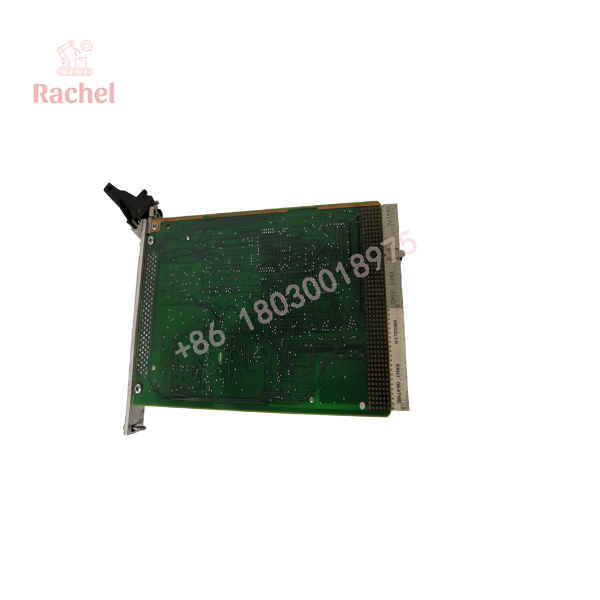
PXI-6025E
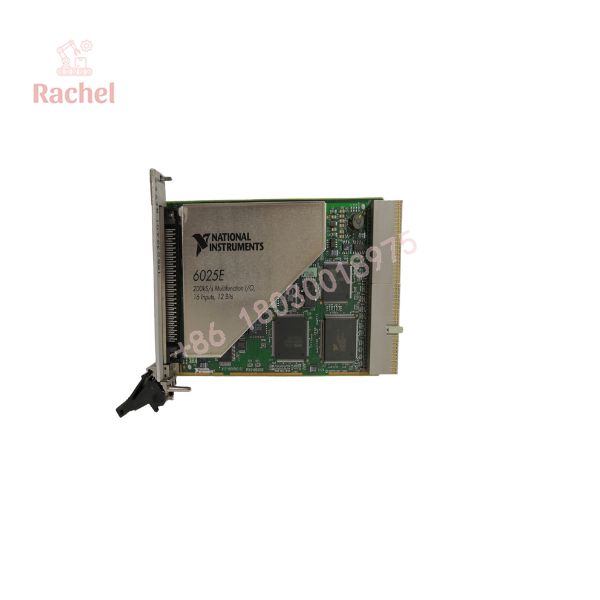
PXI-6025E
The Veteran’s Tech Trap Guide
⚠️ Driver Compatibility Nightmares (NI-DAQmx vs. Traditional NI-DAQ):
Before installing, verify what driver suite your host software expects. If your application was written 20 years ago using statdaqc.lib or Traditional NI-DAQ (Legacy), modern NI-DAQmx drivers might not expose the card to your software the same way. Check your driver version before updating anything.
❗ Mind the 100-Pin Connector Strain:
The high-density 100-pin I/O connector on the front panel can bend pins easily if the cable connector is inserted at an angle. Always hand-tighten the thumb jack-screws evenly on both sides. Don’t let a heavy cable harness hang freely off the front panel without strain relief—it will fracture the board-mount connector solder joints over time.
⚠️ Watch Out for Ground Loops on Differential Inputs:
If you configure the card for 8 Differential channels instead of 16 Single-Ended channels, ensure your signal sources share a common reference ground or use bias resistors (10 kΩ to 100 kΩ) to ground on the negative terminal. Floating signals will drift straight to the positive rail and clip your readings.
❗ Don’t Overdrive Unpowered Inputs:
Applying high-voltage signals to the analog input pins while the PXI chassis is powered off can degrade the internal multiplexer ICs. The overvoltage rating drops from ±40 V (powered on) to ±25 V (powered off).
Frequently Asked Questions
Q: Is the PXI-6025E compatible with modern Windows 10/11 64-bit operating systems?
A: It depends on your driver configuration. The PXI-6025E is supported under NI-DAQmx on 32-bit/64-bit systems up to driver versions that retain E-Series hardware support. However, if your software relies on Traditional NI-DAQ (Legacy), you must stay on Windows XP or 7 (32-bit).
Q: What is the main difference between the PXI-6025E and the PXI-6024E?
A: The PXI-6025E offers 32 Digital I/O lines (driven by an on-board 8255 PPI chip) and 2 Analog Outputs. The lower-tier PXI-6024E has only 8 Digital I/O lines and fewer custom timing options.
Q: Can I hot-swap this card out of a live PXI chassis?
A: No. Standard PXI cards (non-PXI Express hot-swap backplanes) do not support removal while the chassis power supply is running. Power down the PXI chassis before unscrewing and ejecting the card to prevent backplane bus corruption or electrical damage.
Q: Does this card come calibrated, and can I calibrate it in the field?
A: Yes. The PXI-6025E includes on-board EEPROM calibration constants. You can run self-calibration routines directly inside NI MAX software without external equipment to correct for temperature drift offsets.
Q: Why buy a surplus PXI-6025E card instead of upgrading to an X-Series DAQ card?
A: Upgrading to a modern PXIe card often forces you to replace the PXI chassis, update the controller hardware, and rewrite legacy LabVIEW/C code. Buying a direct replacement PXI-6025E keeps your verified, functional test rack running without adding engineering overhead or software validation costs.

 Start Chat


