





Description
3. Product Introduction & Engineering Value
Ask anyone who’s kept a fleet of older SEW drives running and they’ll tell you the same thing: MOVITRAC 31C units are simple, honest inverters that just don’t quit — which is exactly why so many are still in service decades after being commissioned, and why finding an exact Size 1 replacement matters more than people expect.
The 31C015-503-4-00 is a Size 1, 400/500 V basic-unit inverter rated for a recommended motor power of 1.5 kW (2.0 HP) under constant load, or 2.2 kW (3.0 HP) for variable-torque loads. It accepts input voltage across the 380–500 VAC range (with a 20% current derating at 500 VAC), and outputs 0–400 Hz with 0.05 Hz resolution. It’s compatible with the full MOVITRAC 31C option-card ecosystem — FEA31C I/O expansion, FIO31C digital I/O, FEN31C/FPI31C speed and position detection, and fieldbus interfaces including PROFIBUS and INTERBUS.
4. Technical Specifications
| Parameter | Value |
|---|---|
| Input voltage (Vin) | 3 × 380/400/415/460/480/500 VAC (permissible range 380 VAC −10% to 500 VAC +10%) |
| Input frequency (fin) | 50–60 Hz ±5% |
| Rated input current (Iin, 100% at 400 VAC) | 3.5 AAC |
| Rated output power (PN) | 2.8 kVA |
| Rated output current (IN, at 400 VAC) | 4.0 AAC |
| Continuous output current (125% IN) | 5.0 AAC |
| Recommended motor power | 1.5 kW (2.0 HP) constant load / 2.2 kW (3.0 HP) variable torque |
| Output frequency range | 0–400 Hz, fmin 0–40 Hz, fmax 5–400 Hz |
| PWM switching frequency | Adjustable: 4 / 8 / 12 / 16 kHz |
| Minimum braking resistance (4-Q operation) | 47 Ω −10% |
| Enclosure rating | IP20 (EN 60529 / NEMA1) |
| Ambient temperature | 0°C to +45°C, with 3.0% IN derating per K above 45°C up to 60°C |
| Dimensions (W × H × D) | 184 × 281 × 170 mm (7.24 × 11.06 × 6.69 in) |
| Weight | 4.5 kg (9.9 lb) |
5. Field Application & The “Trench” Experience
Illustrative scenario — general integration pattern, not a specific reported incident:
A recurring situation with older MOVITRAC 31C fleets looks like this: a facility running several Size 1 drives on conveyor or pump duty loses one to age, and the replacement gets ordered by voltage class alone — “400/500V” — without checking that the recommended motor power (1.5 kW constant / 2.2 kW variable-torque) actually matches the connected motor. The drive powers up fine, runs, but trips on Continuous Overload or runs the motor undersized relative to what the previous unit was rated for. Nothing wrong with the part — it’s a sizing mismatch that a five-minute nameplate cross-check would have caught before installation.
Specific application scenarios:
- Conveyor speed control on a packaging line, where a Size 1 drive matches smaller sub-3kW motors without the added cost of an oversized unit
- HVAC circulation pump control in a mechanical room, using the drive’s 0–400 Hz range and adjustable PWM frequency to manage motor noise versus switching losses
- Small material-handling hoist retrofits, where the 4-Q braking chopper option and hoist-function parameters (P710) support controlled lowering with a counterweight
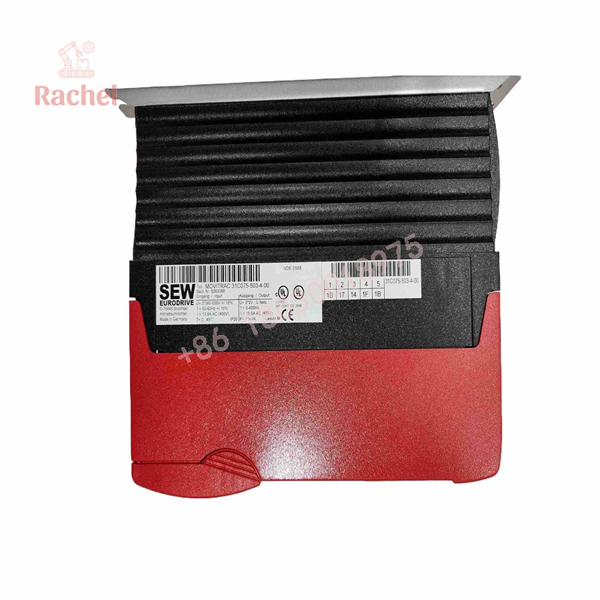
31C015-503-4-00
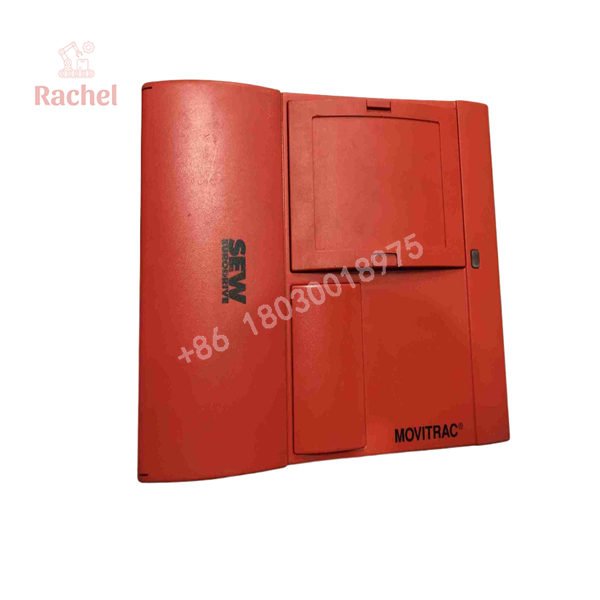
31C015-503-4-00
6. Transparency SOP: QA & Testing
For a used or refurbished SEW MOVITRAC 31C unit, here’s the general verification framework:
Step 1 — Nameplate and part number verification. Confirm the exact type designation (e.g., 31C015-503-4-00) and manufacturer part number (826 333 7) match the listing before it ships.
Step 2 — Visual inspection. Check for capacitor bulging, connector corrosion, and heat-related discoloration on the power section.
Step 3 — Power-up and self-test. SEW units run an internal self-test on power-up (indicated by the yellow-flashing LED V1); confirm this completes cleanly and the unit reaches the ready state (steady yellow LED).
Step 4 — Functional test under load, where test-bench facilities allow — motor start/stop via the CW/stop and Enable terminals, checking rotation direction and basic ramp behavior.
(General framework — swap in your actual documented QA process if it differs.)
7. The Veteran’s Tech Trap Guide
⚠️ Voltage derating at 500V is real, not a footnote. At Vmains = 3 × 500 VAC, permissible input and output currents drop by 20% compared to rated values. If someone specs a replacement purely off the “500V” label without checking this derating against the actual motor load, they’ll get nuisance overload trips.
⚠️ Don’t skip the FBG31C keypad if you’re moving parameter sets between units. The keypad can upload/download complete parameter sets between MOVITRAC 31C drives (P820/P822) — a huge time-saver on a like-for-like swap, but only if you actually use it instead of manually re-entering every parameter from scratch.
PRO TIP: Before re-enabling the drive after any parameter reset, check P862 (pushbutton reset) and the auto-reset settings (P860/P861) deliberately. Auto-reset performs up to three automatic restart attempts — SEW’s own documentation flags this as not recommended for any drive where an unexpected restart could injure someone or damage equipment.
⚠️ Braking resistor value matters, not just “any resistor will do.” The minimum braking resistance for 4-Q operation on this size is 47 Ω. Using an undersized resistor value risks nuisance brake-chopper faults or worse.
8. Dynamic FAQ
Q: What’s the recommended motor size for this drive?
1.5 kW (2.0 HP) for constant-load applications, or 2.2 kW (3.0 HP) for variable-torque loads like fans and pumps.
Q: Can this unit run on a 230V supply instead?
No — this is the -503 (400/500V) variant. The 230V equivalent in this size class is the 31C015-233-4-00, a separate part number.
Q: Does it support fieldbus communication?
Not natively on the basic unit — PROFIBUS, INTERBUS, and DeviceNet require the FFP31C, FFI31C, or FFD31C option cards installed in the X20 slot.
Q: Is a “New Surplus” 31C015-503-4-00 the same electrically as new stock?
Functionally identical if the unit tests clean — SEW didn’t revise the -4-00 basic unit’s core electrical spec across its production life, but always confirm condition and test results at time of purchase.
Q: What warranty applies to used/refurbished stock?
[Insert your actual warranty terms — don’t assume a standard duration for legacy drive hardware.]
Q: What’s the maximum PWM switching frequency, and does it matter which one I pick?
Adjustable to 4, 8, 12, or 16 kHz (parameter P325). Higher frequencies reduce motor audible noise but increase switching losses and heat in the inverter — pick based on your noise tolerance and thermal margin, not just the highest setting available.

 Start Chat


