





Description
Product Introduction
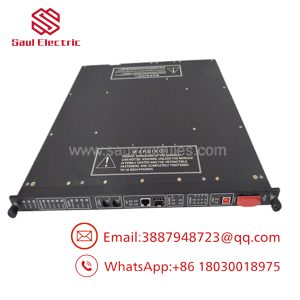
The Triconex 3511 is an 8-channel pulse input (PI) module designed for high-availability Tricon Triple Modular Redundant (TMR) safety Instrumented Systems (SIS). Operating within the Tricon v9 and v10 chassis architectures, the 3511 converts frequency and pulse signals from magnetic pickups, proximity probes, and digital flowmeters into high-precision rotational speed or volumetric flow rate data.
Engineered for safety-critical turbomachinery protection (ESD) and emergency shutdown systems, the 3511 utilizes three independent input channels across its TMR architecture. Each channel processes incoming pulse trains concurrently, executing 2-out-of-3 (2oo3) voting at the main processor level to guarantee maximum fault tolerance, zero false trips, and SIL 3 safety integrity.
Key Technical Specifications
| Parameter | Value |
|---|---|
| Manufacturer & Line | Triconex / Invensys (Schneider Electric) |
| Module Type | Pulse Input (PI) Module |
| System Compatibility | Tricon v9.x, v10.x TMR Main Racks & Expansion Chassis |
| Number of Channels | 8 Non-isolated input channels |
| Input Frequency Range | 1 Hz to 50 kHz |
| Input Signal Types | Magnetic Pickups (VR), Active Proximity Switches, Optical Sensors |
| Minimum Input Voltage | 100 mV peak-to-peak @ 10 Hz; 200 mV peak-to-peak @ 50 kHz |
| Maximum Input Voltage | 120 V AC RMS peak |
| Accuracy | ±0.01% of reading (1 Hz to 50 kHz) |
| Power Consumption | <10 Watts from backplane power rails |
| Safety Integrity Rating | IEC 61508 SIL 3 Capable |
| Weight | Approx. 4.5 lbs (2.04 kg) |
Application Scenarios & The “Trench” Experience
Picture a steam turbine driving a primary synthesis gas compressor in an ammonia plant. A sudden load rejection causes the turbine shaft to accelerate rapidly toward its mechanical trip limit. Standard analog 4–20 mA transmitters or PLC cards update too slowly (>100 ms scan delays) to catch transient overspeed events, risking catastrophic rotor destruction. The Triconex 3511 pulse input module reads raw magnetic pickup signals directly at up to 50 kHz, executing sub-millisecond hardware acceleration calculations. When overspeed thresholds are breached, the 3511 initiates 2oo3 voting across its TMR channels to trip the main trip valve (MTV) in under 15 milliseconds—safeguarding multi-million dollar equipment.
- Steam & Gas Turbine Overspeed Protection: Measures turbine shaft RPM directly from magnetic pickups or proximity probes to trigger electronic overspeed trip trips.
- High-Accuracy Gas & Liquid Flow Totalization: Reads pulse outputs from positive displacement, turbine, or Coriolis flow meters for custody transfer loops.
- Compressor & Expander Monitoring: Tracks rotational speed profiles, anti-surge feedback, and ramp rates on critical process gas machinery.
- Rotational Machinery Safety Instrumented Systems (SIS): Integrates high-speed pulse inputs into SIL 3 emergency shutdown logic.
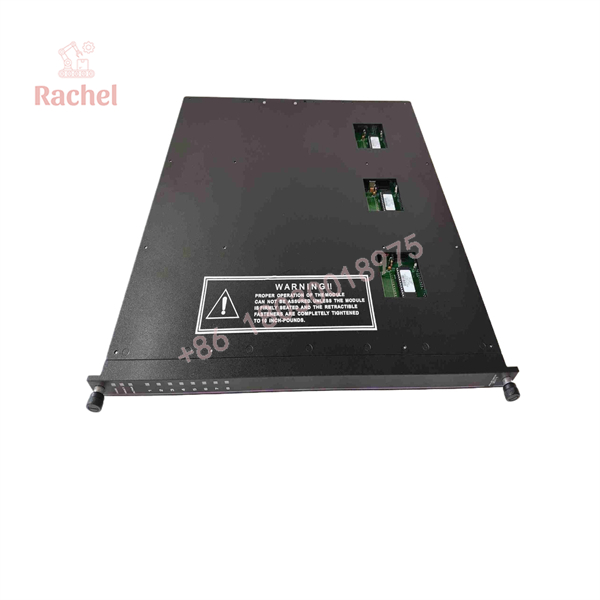
3511
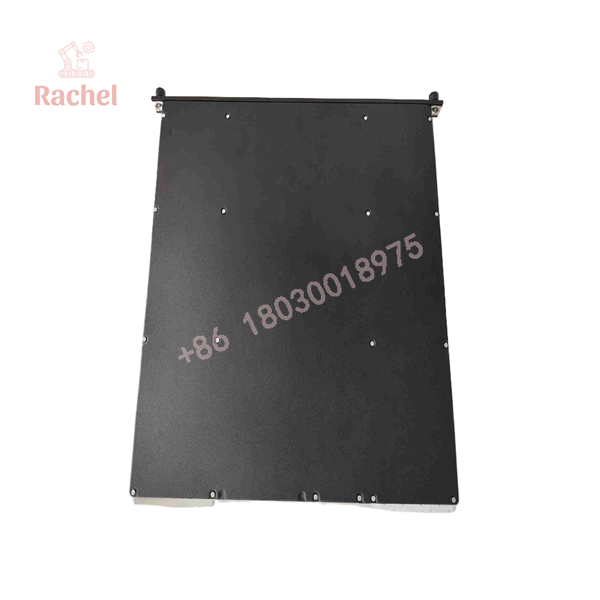
3511
Transparency SOP: Quality Assurance & Testing
Every Triconex 3511 module undergoes extensive testing prior to dispatch:
- Inbound Visual & Mechanical Audit: Inspection of backplane DIN connectors, faceplate ejector levers, status LEDs, and component solder joints for thermal discoloration or mechanical stress.
- Backplane TMR Power-On Test: Module is seated in a live Tricon test rack to verify triple-redundant power rail stabilization and initial self-test boot routines.
- Multi-Channel Frequency Sweep Verification: Precision signal generators feed sine and square wave test signals (1 Hz to 50 kHz) across all 8 input channels to verify sensitivity thresholds and pulse counting accuracy.
- Fault Injection & 2oo3 Voting Validation: Channel fault simulation is performed on individual legs to confirm the TMR system correctly flags channel diagnostic alarms without causing false trips.
- Burn-In & Thermal Stress Run: Module undergoes extended thermal chamber testing under full channel load to rule out latent semiconductor defects.
- ESD & Shielding Packaging: Unit is vacuum-sealed in anti-static ESD shielding bags and packed in heavy-duty foam crates to withstand shipping transit.
The Veteran’s Tech Trap Guide (Crucial Value-Add)
In our field experience, commissioning high-speed pulse modules on turbomachinery involves several critical wiring and noise traps:
- ⚠️ Sensor Signal Amplitude vs. Frequency: Passive magnetic pickups generate lower peak-to-peak voltages at low shaft speeds (1 Hz to 50 Hz). Ensure the air gap between the pickup probe and target gear teeth is adjusted precisely according to OEM specs; otherwise, the 3511 channel will fail to detect pulse crossings during slow turbine roll-up.
- ❗ Shield Grounding Discipline: High-frequency pulse lines are susceptible to electromagnetic interference (EMI) from nearby VFD cables or high-voltage igniters. Always use twisted shielded pair (STP) cables and connect the cable shield at the Triconex termination panel end only to eliminate ground loop noise.
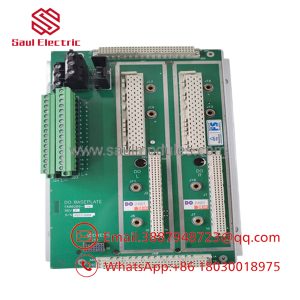
- ⚠️ Matching External Termination Panels (ETP): The 3511 pulse module requires specific companion External Termination Panels (such as the Triconex 9563-810 or 9561-810) equipped with correct pulse-conditioning circuitry. Interfacing the 3511 with standard analog voltage or digital input termination panels will result in signal degradation or hardware faults.
- ❗ Hot-Swapping Precaution: While Triconex TMR modules support online hot-replacement, ensure the replacement module’s firmware revision matches the running redundant pair in the slot before inserting it into a live safety chassis.
Frequently Asked Questions (FAQ)
Q: What is the main difference between the Triconex 3511 Pulse Input Module and standard Digital Input (DI) modules?
A: Standard DI modules process low-speed discrete state changes (on/off signals up to a few hundred Hertz), whereas the 3511 is a specialized high-speed counter board capable of processing complex AC sine waves and square pulses up to 50 kHz for real-time speed calculation.
Q: Can the Triconex 3511 accept signals directly from passive magnetic pickups without external signal conditioners?
A: Yes. The 3511 features built-in threshold detection circuits that process low-voltage AC sine wave outputs from passive variable reluctance (VR) magnetic pickups directly.
Q: What programming tool is used to configure the Triconex 3511 pulse module?
A: The 3511 is configured using Invensys/Schneider Electric TriStation 1131 software, where channels are assigned specific frequency ranges, conversion factors (e.g., pulses per revolution), and filtering constants.
Q: How does the 3511 module handle a single channel hardware failure?
A: Because of the Triple Modular Redundant (TMR) design, if one processing leg inside the 3511 fails, the remaining two legs maintain correct 2oo3 voting decisions while illuminating the module’s FAULT LED and reporting a diagnostic alert to the main processor.
Q: What warranty coverage is provided with this unit?
A: We supply this module with a full 12-month operational warranty. If the unit experiences hardware defects or channel failures under standard operating conditions within one year, we provide an immediate replacement or repair.

 Start Chat


