





Description
Key Technical Specifications
| Parameter | Value |
|---|---|
| Manufacturer | ABB |
| Product Family | CC-E Signal Converters |
| Model | CC-E I/I |
| Order Number | 1SVR011718R2500 |
| Function | Analog Current-to-Current Converter |
| Input Signal | 4–20 mA |
| Output Signal | 4–20 mA |
| Supply Voltage | 24 V DC |
| Electrical Isolation | 3-way Isolation (Input / Output / Supply) |
| Mounting | 35 mm DIN Rail |
| Housing Width | 22.5 mm |
| Protection Rating | IP20 |
| Operating Temperature | 0 °C to +60 °C |
| Net Weight | Approximately 0.085 kg |
The CC-E I/I is a single-function analog signal converter designed for 4–20 mA process signals with 24 V DC power and galvanic isolation between the input, output, and supply circuits.
Product Introduction
The ABB 1SVR011718R2500 CC-E I/I is a DIN rail-mounted analog signal converter used to isolate and transfer standard 4–20 mA process signals in industrial automation systems. It is commonly installed between field instruments and PLC, DCS, or SCADA systems to eliminate ground loops and improve signal integrity.
Its compact 22.5 mm housing, three-way electrical isolation, and simple fixed-function design make it suitable for process industries including power generation, chemical processing, water treatment, and factory automation.
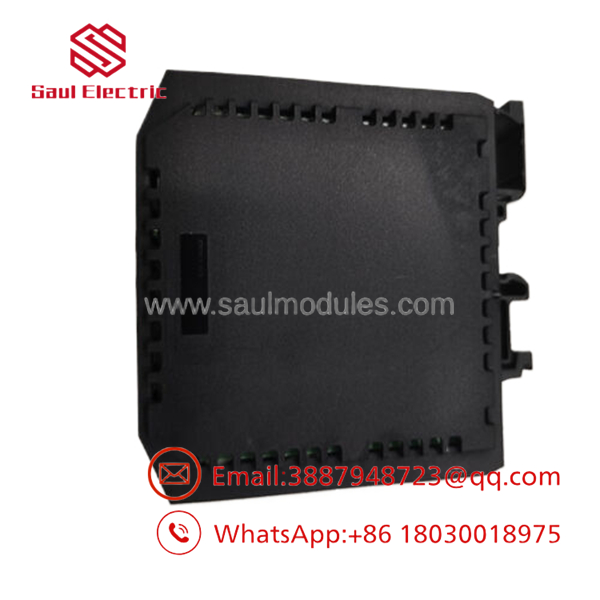
- 1SVR011718R2500
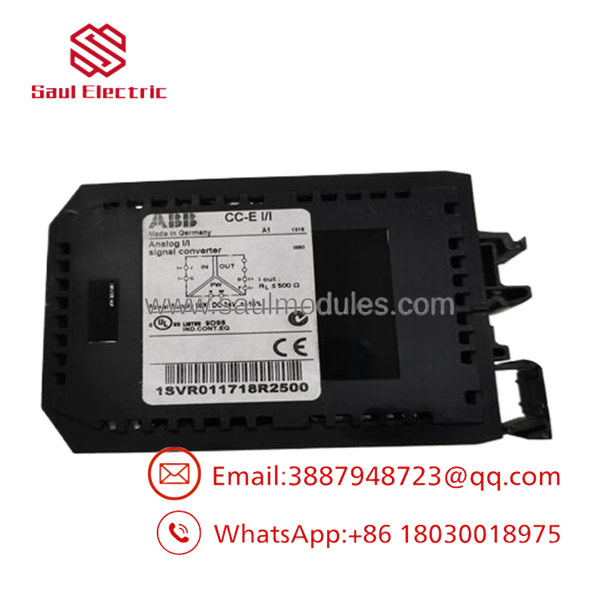
- 1SVR011718R2500
Troubleshooting Quick Reference
| Symptom | Possible Cause | Relevance to this Part | Quick Check Method | Recommendation |
|---|---|---|---|---|
| No output current | No 24 V DC supply | ✅ High | Measure supply voltage at power terminals | Restore power before replacing converter |
| Output fixed at 4 mA | Open input loop | ✅ High | Measure loop current with a calibrated milliamp meter | Check transmitter wiring |
| Output unstable | Electrical noise or poor grounding | ⚠️ Medium | Inspect shield grounding and cable routing | Separate signal cables from power cables |
| PLC reads incorrect value | Incorrect scaling | ⚠️ Medium | Compare PLC analog scaling with transmitter range | Correct engineering unit configuration |
| No isolation effect | Incorrect wiring | ✅ High | Verify input and output are wired independently | Follow ABB wiring diagram |
| Signal offset | Sensor calibration issue | ❌ Low | Inject a calibrated 4–20 mA source | Verify field transmitter before replacing converter |
| Complete communication loss | Internal hardware fault | ✅ High | Inject a known-good 4–20 mA test signal | Replace converter only after wiring verification |
Technical Note: In practice, these converters rarely fail. Wiring mistakes, failed transmitters, and missing loop power account for most reported faults. Always inject a calibrated 4–20 mA signal before concluding that the converter is defective.
Frequently Asked Questions (FAQ)
Q1. What does the ABB CC-E I/I converter do?
It provides galvanic isolation while converting a 4–20 mA input directly into a 4–20 mA output, helping eliminate ground loops and electrical interference.
Q2. Is this converter configurable?
No. The 1SVR011718R2500 is a fixed-function model specifically designed for 4–20 mA to 4–20 mA conversion. Other ABB CC-E models support different signal ranges.
Q3. Does it provide electrical isolation?
Yes. It features three-way electrical isolation between the input, output, and power supply circuits, improving measurement reliability and protecting connected equipment.
Q4. Can it be installed directly in a PLC cabinet?
Yes. It is designed for 35 mm DIN rail mounting and requires a 24 V DC power supply, making it suitable for standard industrial control panels.
Q5. Is this model still in production?
Although some distributors still list the part, ABB’s lifecycle documentation identifies this CC-E series model as part of a discontinued product line with limited availability through surplus inventory and remaining stock.
Q6. What should I verify before ordering?
Confirm:
- Exact part number (1SVR011718R2500)
- Input signal (4–20 mA)
- Output signal (4–20 mA)
- Supply voltage (24 V DC)
- DIN rail mounting requirements
- Available cabinet space (22.5 mm width)
A quick loop-current measurement before replacement often identifies whether the issue is in the field transmitter, wiring, or the signal converter itself.

 Start Chat


