





Description
Key Technical Specifications
| Parameter | Value |
| Brand | ABB |
| Part Number | 3BHL000734P0003 |
| Legacy / Cross Ref Part ID | HL000734P0003 |
| Type Designation | SL0V4.6/53 (AQ Trafo No. 1IT478245S8) |
| Inductance | 0.0046 mH (4.3 µH) |
| Rated Current | 806 A continuous |
| Cooling Type | Air-cooled (Natural or forced air dependent on cabinet footprint) |
| Function Type | Line / Load Reactor (di/dt limiting) |
| Customs Tariff Number | 85045095 |
| Country of Origin | Finland / Sweden |
Product Introduction
The ABB 3BHL000734P0003, designated as type SL0V4.6/53, is a heavy-duty, high-current air core reactor engineered for medium-voltage frequency converters and marine electrical drive panels. Manufactured in coordination with AQ Trafo AB, this 806 A inductor provides a precise 0.0046 mH inductance to limit the rate of current rise (di/dt), protecting fast-switching semiconductor components like IGCTs or IGBTs from catastrophic overcurrent failures.
By utilizing an air core design instead of an iron core, this reactor entirely eliminates magnetic saturation risks at high currents. It is heavily utilized in high-power industrial inverter assemblies, marine propulsion drives, and dynamic excitation power systems where continuous load regulation and robust harmonic dampening are mandatory.
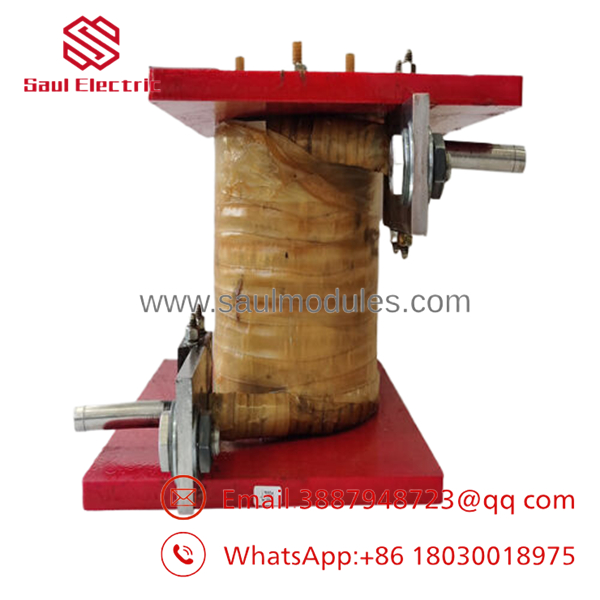
- 3BHL000734P0003
Installation & Configuration Guide
1.Pre-Installation Preparation:Estimated time: 15 mins.
Ensure complete isolation. Because this component acts on the high-current bus lines of a medium-voltage frequency converter or drive panel, coordinate with the substation operator to lock out and tag out the primary input feeder breaker.
⚠️ Lethal Stored Energy Warning: Medium-voltage converters contain massive DC link capacitor groups. Do not open the enclosure door or touch internal buswork for at least 5 to 10 minutes following isolation. Use a certified high-voltage detective probe to confirm zero energy exists between phase lines and ground.
Prepare essential tools: a calibrated torque wrench with metric sockets, clean rags, an electrical contact cleaning solvent, a micro-ohmmeter or digital insulation resistance tester (Megger), and your smartphone.
2.Removing the Old Reactor:Estimated time: 15 mins.
Take a high-resolution smartphone photo of the copper busbar configuration, hardware stack sequence (bolt, flat washer, Belleville spring washer, nut), and grounding connections.
Unbolt the flexible or solid copper busbars from the reactor terminals. Do not let the heavy copper lines twist or warp the remaining terminal mounts on neighboring parts. Unfasten the primary heavy-duty structural chassis bolts anchoring the reactor base to the cabinet frame.
⚠️ Heavy Handling Hazard: Due to the physical bulk of high-current reactors, utilize a mechanical hoist or secure two-person lift to draw the module straight out from the cubicle without scarring the chassis insulation walls.
3.Installing the New Module:Estimated time: 15 mins.
Inspect the new 3BHL000734P0003 unit for any physical deformations or debris in the air paths. Clean the bright copper connection pads using a lint-free rag and industrial contact cleaner to remove protective storage films.
Position the new air reactor onto the cabinet mounting channels. Align the base holes and thread the structural fasteners. Before tightening, line up the system’s main copper busbars with the reactor terminals.
Hardware Stack Sequence (Critical): Thread the bolt through, ensuring you place the Belleville spring washer correctly to maintain continuous tension under high-temperature cycles. Torque every electrical terminal bolt to the exact industrial specifications required for high-power connections to avert hotspot generation.
Self-Checklist:
- [ ] Busbar connections are clean, flush, and torqued to design specifications.
- [ ] Belleville washers are loaded in the correct structural direction.
- [ ] The reactor frame is bonded securely to the cabinet master earth ground.
4.Testing & Commissioning:Estimated time: 20 mins.
Execute a 500 V insulation resistance test using your Megger tool from the main coils to the chassis ground frame to guarantee no internal isolation paths were compromised during mechanical handling. Conduct a low-resistance digital micro-ohm test across the terminal joints to confirm your torque values created a solid electrical connection.
Remove all tools from the enclosure and seal the access doors. Restore line power to the auxiliary systems and the converter drive logic first. Run the integrated drive platform self-diagnostic routine. If the hardware checks out without triggering line phase or imbalance faults, slowly run the system up under load while executing thermal imaging scans on the connection points to rule out hotspots.
Frequently Asked Questions (FAQ)
Q: Why does the 3BHL000734P0003 use an air core design rather than an iron core?
A: In high-power medium-voltage drives, current peaks can surge instantly during fast semiconductor switching. An iron-core inductor risks magnetic saturation under these sharp overcurrent spikes, causing its inductance to plunge and exposing components like IGBTs to failure. The air-core construction ensures the 0.0046 mH inductance value remains perfectly linear, providing steady di/dt protection even at maximum peak current loads.
Q: Can I use this reactor as a generic substitute for other 3BHL series inductors?
A: Absolutely not. Every reactor in the 3BHL family is custom engineered around a specific inductance level, continuous current carrying capacity (806 A in this instance), thermal dissipation rate, and frame footprint. Attempting to sub-in a unit with a lower current rating or different inductance profile will alter the filter’s tuning frequency, likely triggering drive errors or causing the choke to overheat and burn out under standard operating loads.
Q: What is the significance of the AQ Trafo type SL0V4.6/53 code on the nameplate?
A: AQ Trafo AB is the specialized sub-contracted manufacturer that builds these inductive assemblies according to ABB’s precise engineering designs. The SL0V4.6/53 designation represents the core physical frame size, insulation matrix, and mechanical build variables. The internal ABB factory database catalogs this part under number 3BHL000734P0003 or legacy item code HL000734P0003; both parts represent identical electrical components.
Q: How do I know if an existing 3BHL000734P0003 unit in my drive cabinet is failing?
A: Look for visible discoloration or dark blistering on the winding insulation, which indicates structural hotspots or localized overheating. You may also hear anomalous humming or buzzing noises under load if the internal mechanical bindings loosen over time. The most reliable diagnostic method is to isolate the component and use a micro-ohmmeter to measure coil resistance, comparing it directly across phases to detect shorted turns.
Q: Are these surplus reactors tested, and how do you protect them during shipment?
A: Yes, every unit undergoes careful visual tracking and structural validation before it is added to our inventory. Because these high-power air reactors are heavy and have open structures, they are prone to impact damage if dropped. We pack them inside heavy-walled corrugated boxing or wooden crates, isolating them with high-density foam padding to ensure the copper terminal pads and winding alignments remain secure during transit.

 Start Chat


