





Description
Key Technical Specifications
| Parameter | Specification / Value |
| Number of Channels | 16 (configured as 2 isolated groups of 8 channels) |
| Input Type | 24 VDC current sinking, groupwise isolated from ground |
| Input Voltage Range, “1” | 13 to 30 VDC |
| Input Voltage Range, “0” | -30 to +5 VDC |
| Input Impedance | 3.2 kΩ |
| Nominal Input Current | 6 mA @ 24 VDC |
| Event Recording Resolution | 0.4 ms |
| Event Recording Accuracy | -0.3 ms to +0.7 ms |
| Selectable Digital Filter | 0 to 100 ms software-programmable shutter filter |
| Isolation Barrier | Groupwise isolation; Rated insulation: 50 V; Dielectric test: 500 VAC |
| Power Dissipation | 2.3 W typical |
| Modulebus Current Draw | 100 mA typical / 120 mA maximum @ +5 VDC (0 mA @ +24 VDC) |
| Onboard Diagnostic Checks | Process power supply supervision, Event queue full, Time sync missing |
| Compatible MTUs | TU810, TU812, TU814, TU818, TU830, TU833, TU838, TU850 |
| Dimensions & Weight | Width: 45 mm (1.77″), Depth: 102 mm (4.01″), Height: 119 mm (4.7″); Weight: 0.22 kg |
Product Introduction
The ABB DI830 (3BSE013210R1) is a highly specialized 16-channel, 24 VDC digital input module designed for the S800 I/O system, optimizing operations that require precise millisecond-level signal tracking. Unlike standard digital input modules, the DI830 features dedicated Sequence of Events (SOE) logic, capturing transient state changes with an exceptional 0.4 ms resolution.
Organized into two isolated groups of eight channels, the module registers fast process transitions directly at the I/O tier, bypassing controller program scan latency. This board features internal current-limiting protection, individual status LEDs, and cyclic self-diagnostics that actively monitor process voltage presence, synchronization health, and event queue capacity. It is primarily selected for power generation, petrochemical safety trip networks, and high-speed turbine monitoring systems running ABB AC 800M processors.
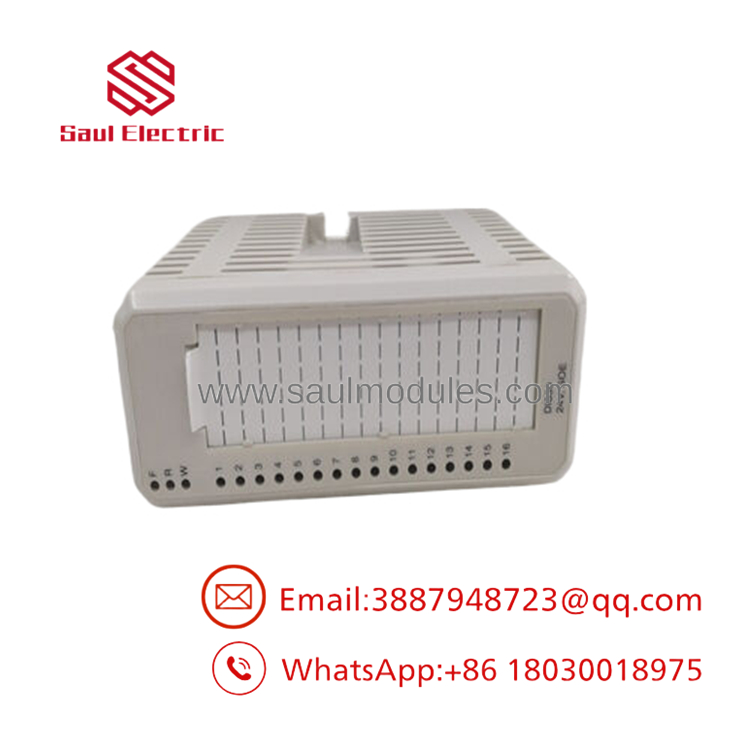
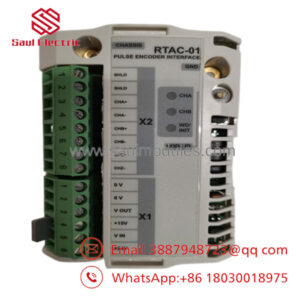
- DI830
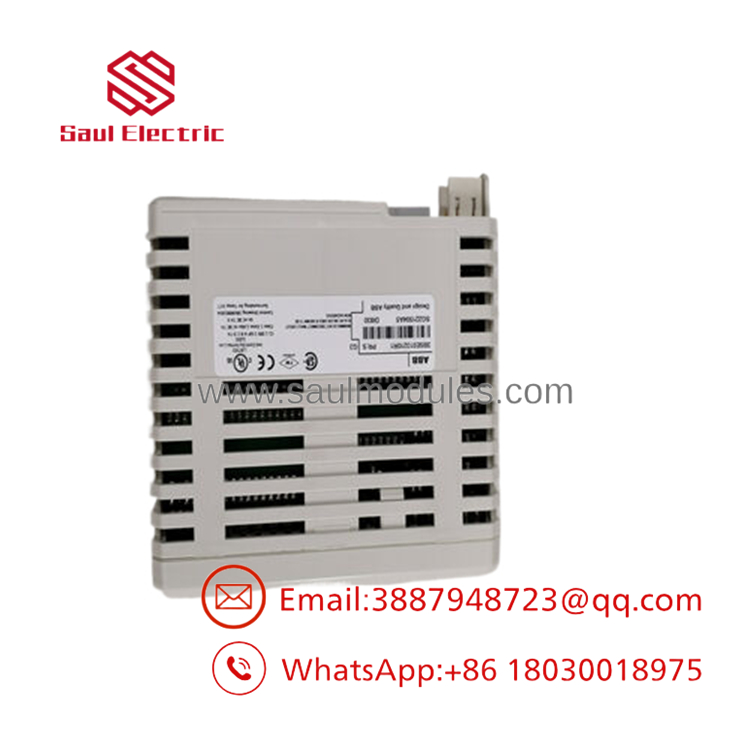
- DI830
Troubleshooting Quick Reference
| Symptom | Possible Cause | Relevance to this Part | Quick Check Method | Recommendation |
| Front panel W (Warning) LED is solid or flashing yellow | Missing process power supply to one/both channel groups or time sync loss | ✅ High | Check the 24 VDC external loop supply connected to the corresponding MTU terminals. Check controller sync status. | Restore field power to the terminal blocks. If time synchronization is missing, verify the master clock link to the AC 800M processor. |
| Front panel F (Fault) LED is solid red | Internal self-diagnostic failure or event queue memory overflow | ✅ High | Read the module’s diagnostic buffer via ABB Control Builder. Power-cycle the module to reset the memory space. | If the fault persists after a modulebus power cycle or if the event buffer keeps crashing under no load, the internal ASIC is bad; replace module. |
| Incoming event timestamps are inconsistent or drifting | Time synchronization link to the S800 I/O cluster has failed | ✅ High | Check diagnostic registers for “Time synchronization missing” flag. Verify the sync cable configuration. | Ensure your S800 Modulebus transceiver or communication interface (e.g., CI801/CI840) is actively broadcasting time sync packets. |
| Input state changes register in software but fail to generate SOE alarms | Software filter time (shutter filter) configured too high | ✅ High | Verify the configured “Filter Time” in the module’s parameter properties within the controller configuration. | If set to 50 ms, events shorter than 50 ms are ignored. Adjust the shutter filter setting down toward 2 ms to capture ultra-fast transitions. |
Note: For deep system timing anomalies or complex SOE configuration errors, please extract your Control Builder project hardware tree settings and diagnostic logs, then contact our technical support engineers.
Frequently Asked Questions (FAQ)
Q: What is the benefit of using the DI830 over a standard digital input module like the DI810?
A: Standard input modules like the DI810 are polled cyclically by the PLC processor, meaning their resolution is limited by the task scan time (typically 10 ms to 100 ms). If multiple fast events occur within one scan cycle, the controller cannot determine the true sequence of events. The DI830 captures changes directly inside its own hardware buffer with 0.4 ms resolution, attaching an accurate timestamp at the exact instant the field contact changes state. This is critical for determining the root cause of high-speed industrial trips.
Q: Do I need a specific Module Termination Unit (MTU) to run the ?
A: The uses the standard S800 compact and extended terminal bases. You can mount it on the TU810, TU812, TU814, or TU818 Compact MTUs, as well as the TU830, TU833, or TU838 Extended MTUs. Because it is a 24 VDC low-voltage module, standard keying code AA must be set on the MTU to prevent higher-voltage modules from being mistakenly plugged into its slot.
A: No. The is strictly a current-sinking input module. This means your external 24 VDC power supply must feed the field switch contacts, and the contacts must return positive voltage into the input terminals. The common reference point inside the module is tied to ground (0 VDC).
Q: What happens if the communication to the controller drops? Are my recorded events lost?
A: To be honest, yes, if the link remains down long enough to exceed the storage buffer. The features an internal event queue to store timestamps until the controller can retrieve them. However, if the Modulebus network connection remains severed and the on-board queue fills completely, the module will raise an “Event queue full” warning flag, and any subsequent real-time transitions will be lost. Re-establishing communication should be prioritized immediately if a network warning triggers.
A: We use a specialized, time-calibrated test rig to verify these boards. We slot the into a live S800 rack with an active AC 800M controller and a master clock source. We use a high-frequency function generator to inject sub-millisecond pulses simultaneously across all 16 channels. We then verify that the controller registers each transition within the specified -0.3 ms to +0.7 ms accuracy window, test the process voltage monitoring loops, and confirm the shutter filter parameters. The card only receives its dated QC Passed sticker after completing a 12-hour error-free communication log.

 Start Chat


