





Description
Key Technical Specifications
| Parameter | Value |
|---|---|
| Manufacturer | ABB |
| Model | DO802 (3BSE022364R1) |
| Product Type | Digital Relay Output Module |
| Series | S800 I/O |
| Number of Outputs | 8 Individually Isolated Relay Outputs |
| Output Type | Normally Open (NO) Relay |
| Output Voltage | 24–110 V DC / 250 V AC Maximum |
| Maximum Output Current | 2 A per Channel |
| Isolation | Channel-to-Channel and Channel-to-System Isolation |
| Maximum Field Cable Length | 600 m |
| ModuleBus Current (+5 V) | 70 mA |
| ModuleBus Current (+24 V) | 80 mA |
| Typical Power Dissipation | 2.2 W |
| Diagnostics | Status LED, Module Error, Module Warning, Channel Error |
| Operating Temperature | 0 to +55 °C |
| Protection Rating | IP20 |
| Compatible System | ABB S800 I/O Platform |
Product Introduction & Supply Chain Strategy
The ABB DO802 is an 8-channel relay digital output module for the S800 I/O platform. It controls AC and DC field devices including contactors, solenoid valves, alarms, motor starters, and auxiliary relays through individually isolated relay contacts while providing continuous diagnostic monitoring through the ModuleBus.
This product is a Brand New Surplus unit. It is not used, not pulled from a decommissioned plant, and not refurbished. All modules undergo rigorous quality verification to ensure OEM-level reliability. Maintaining 1–2 spare DO802 modules as buffer stock reduces lead time variability and lowers Total Cost of Ownership (TCO). Genuine New Surplus inventory also avoids the hidden reliability risks commonly associated with refurbished relay modules.
Installation & Configuration Guide
Stage 1: Pre-Installation (Prep & Safety)
- Apply Lock-Out/Tag-Out (LOTO).
- Isolate both control power and field power.
- Wear a grounded ESD wrist strap.
- Photograph:
- MTU wiring
- Output assignments
- Cabinet layout
- Existing module position
- Verify the replacement module part number and MTU compatibility.
Stage 2: Removal
- Disconnect field wiring if required by the installed MTU.
- Release the module locking mechanism.
- Pull the module straight from the MTU without twisting.
- Inspect connectors for contamination or damage.
Stage 3: Installation (Clone & Seat)
- Verify the correct MTU model.
- Insert the replacement module completely until locked.
- Confirm secure mechanical engagement.
- Restore field wiring.
- Verify all output channel assignments before energizing.
Stage 4: Power-On & Testing
- Restore control power.
- Confirm the Status LED indicates normal operation.
- Verify no Module Error or Module Warning indicators are active.
- Test each relay output individually.
- Confirm correct operation of connected field devices.
- Validate communication with the controller before returning the process to service.
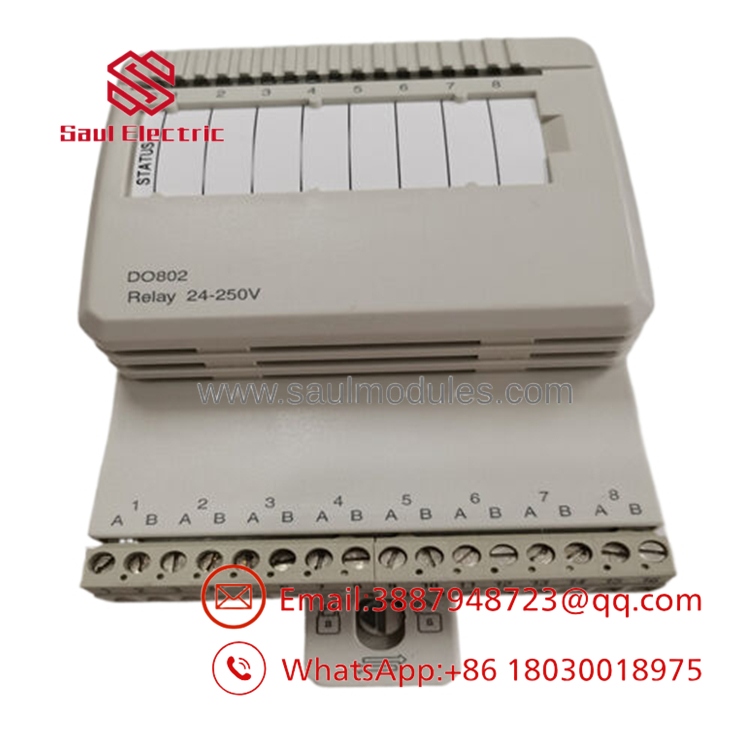
- DO802
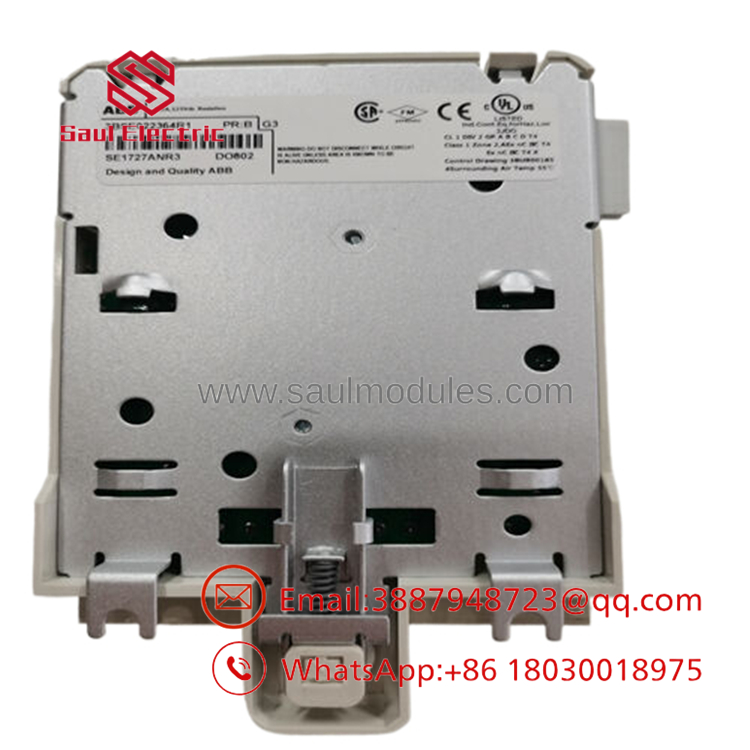
- DO802
Firmware/Software Versions & Upgrade Notes
- The DO802 contains minimal embedded firmware and normally does not require firmware updates.
- Verify compatibility between the controller firmware, Control Builder libraries, and the installed S800 I/O hardware revision.
- The relay power supervision function can be enabled or disabled through configuration parameters.
- Avoid controller firmware upgrades during emergency module replacement unless the complete system has been validated.
- Back up controller configuration, I/O database, and engineering project files before maintenance.
- Verify MTU compatibility whenever replacing modules of different hardware revisions.
Frequently Asked Questions (FAQ)
Q1. Is this module genuinely new?
Yes. This is a New Original / New Surplus ABB module. It is not used, repaired, or refurbished. Every unit undergoes OEM serial verification, functional testing, electrical inspection, relay output verification, and ESD-safe packaging before shipment.
Q2. Why is New Surplus priced below OEM factory supply but above refurbished modules?
New Surplus inventory comes from genuine OEM distribution channels and retains original component integrity. Although it generally costs more than refurbished equipment, it avoids hidden relay contact wear, uncertain repair history, and premature failures that can result in costly production downtime.
Q3. Should the be stocked as a critical spare?
Yes. Because relay output modules directly control production equipment, the should be classified as an A-Class critical spare. Maintain 1–2 on-site units as buffer stock to reduce stock-out risk and compensate for lead time variability.
Q4. Can the be hot-swapped?
Hot-swapping depends on the specific ABB controller architecture, MTU configuration, and plant maintenance procedures. Follow ABB system documentation and site operating procedures before replacing the module in an energized system.
Q5. Will replacing the require application changes?
Normally, no. When the replacement module matches the original hardware revision and I/O configuration, the existing PLC or DCS application remains unchanged.
Q6. What quality verification is completed before shipment?
Each New Surplus follows a documented quality process including:
- OEM serial number verification
- Anti-counterfeit inspection
- Visual inspection
- Relay output functional testing
- ModuleBus communication verification
- LED diagnostic verification
- Electrical insulation and continuity testing
- QC inspector approval
- ESD-safe packaging
- Heavy-duty export shipping preparation
Q7. What inventory strategy provides the lowest Total Cost of Ownership (TCO)?
For plants operating ABB S800 I/O systems, maintain as buffer stock for critical production lines. Combine lifecycle monitoring, vendor consolidation, cross-site inventory sharing, and scheduled inventory reviews to reduce lead time variability, prevent emergency procurement, minimize carrying costs, and achieve a lower Total Cost of Ownership (TCO).

 Start Chat


