





Description
Key Technical Specifications
| Parameter | Value |
|---|---|
| Core Control Platform | Direct Torque Control (DTC) Application Processing Network |
| Base Internal Circuit Board 1 | NAMC-21 (Application & Motor Control Processing Board) |
| Base Internal Circuit Board 2 | NIOC-01 (Analog/Digital Standard I/O Termination Card) |
| System Communication Link | Onboard DDCS optical fiber transceiver channels |
| Analog Inputs | 3 channels (Programmable differential, ±10V or 0/4 to 20mA) |
| Analog Outputs | 2 channels (0/4 to 20mA current loop configuration) |
| Digital Inputs | 6 programmable isolation channels (24V DC logic base) |
| Relay / Digital Outputs | 3 programmable relay contacts (Max 250V AC / 30V DC, 2A) |
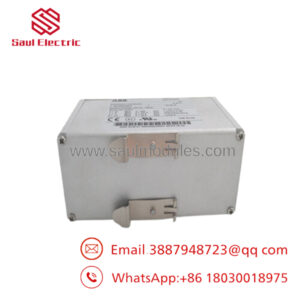
| Housing Configuration | Metal chassis enclosure protective frame shield |
| Net Weight | Approximately 1.40 kg (3.09 lbs) |
| Factory Assembly Origin | Finland (FI) |
Product Introduction
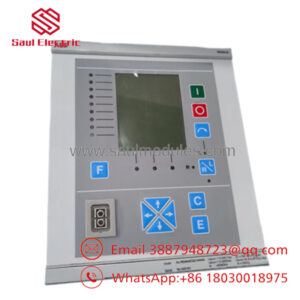
The ABB NDCU-21C (Product ID: 42000652) is an integrated, dual-card Drive Control Unit assembly engineered for high-demand industrial VFD systems, serving primarily as the central intelligence node for the legacy ACS600 MultiDrive series. Contained within a heavy-duty protective metal enclosure, the NDCU-21C functions as a unified controller package by physically and electronically combining two critical sub-boards: the NAMC-21 board, which executes complex Direct Torque Control (DTC) math and system application macros, and the NIOC-01 standard input/output card, which directly handles the local analog and digital field instruments tracking the motor’s operation.
By handling processing locally inside the NDCU package, the unit processes real-time speed, torque, and position regulation without placing excess traffic demands on upstream plant networks. Data and gate-firing commands travel to the power semiconductor blocks over high-speed DDCS (Distributed Drives Communication System) fiber optic links, providing absolute galvanic isolation between the low-voltage processing circuitry and noisy high-current inverter fields. The combination of flexible analog current inputs, high-isolation digital points, and durable onboard relay channels makes the NDCU-21C an essential module for massive coordinated web lines, paper mills, heavy conveyors, and multi-motor manufacturing trains.
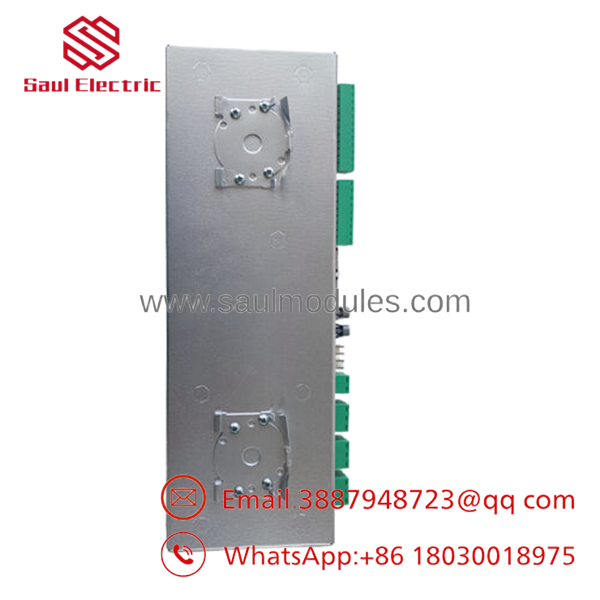
- NDCU-21C
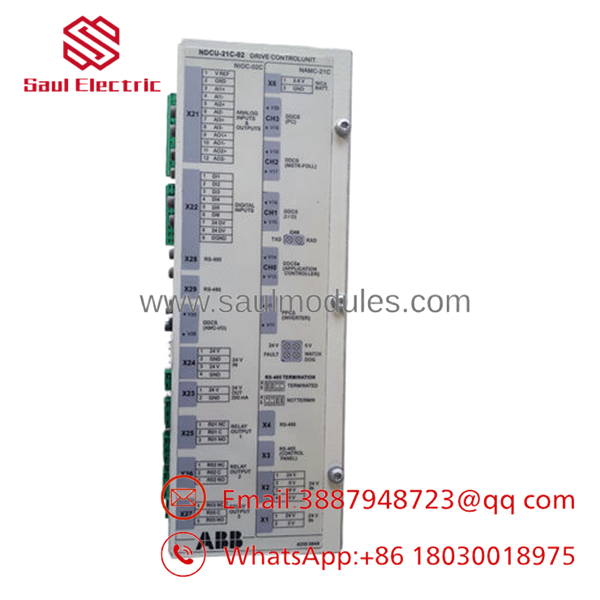
- NDCU-21C
Technical Pitfall & Survival Guide
- The Blank Flash Firmware Lockout
❗ Risk: Ordering and installing an NDCU-21C-02 that is coded “W/O SW” (Without Software). Sourcing a generic, un-flashed New Surplus unit means the internal EEPROM chip lacks your specific motor-drive parameters and system macro profiles. Sliding this raw assembly into your rack frame will result in a hard initialization fault code, completely disabling the drive configuration.
- Avoidance: Before powering down your system, back up your active application profiles using a field service tool (like DriveWindow or standard keypad download steps). Alternatively, if the original processor is completely dead, extract the memory/application daughter-card from the old NAMC-21 board and transfer it to the replacement unit’s socket before sliding the enclosure back into position.
- Fiber Optic Light Over-Saturation / Attenuation Gaps
❗ Risk: Mishandling the delicate fiber optic lines connected to the DDCS transceiver ports. If the fiber endings are contaminated with dust or finger grease, light signal loss (attenuation) occurs, causing random “PPCS Link” or “Short Circuit Fault” trips. Conversely, over-tightening plastic zip-ties can pinch the fiber cladding, causing internal fracturing and intermittent communication dropouts.
- Avoidance: Always clean the optical cable tips with lint-free wipes and 99% isopropyl alcohol before snapping them into place. Ensure cables maintain a minimum gentle bend radius of 30 mm, and secure them using loose velcro ties rather than high-tension plastic ties.
- Analog Common Mode Ground Floats
❗ Risk: Connecting unshielded external 0-10V or 4-20mA monitoring lines back to the NIOC-01 section without referencing a true common potential. If the reference points float apart under high-current motor fields, high common-mode voltages can leak across the analog input channels, throwing off your speed feedback loops or destroying the input op-amps.
- Avoidance: Always land the cable shielding jackets at a single, solid instrumentation ground bar. Check that the hardware input selector jumpers on the NIOC board (current vs. voltage mode) perfectly match the physical signals arriving from your PLC or field transmitter to avoid over-current damage to the tracking ports.
Troubleshooting Quick Reference
| Symptom | Possible Cause | Relevance to this Part | Quick Check Method | Recommendation |
|---|---|---|---|---|
| Drive display reads “COMM LOSS” or “DDCS LINK FAULT” | Damaged fiber strand, unseated connector, or a blown optical transceiver on the NAMC-21 board. | ✅ High | Inspect the optical ports on the face of the unit. Confirm a visible red light pulse is emitting from the Tx line during system boot. | If the port remains dark while power is present, or if swapping the fiber cable does not resolve the alarm, the optical interface stage is failed. Replace the NDCU assembly. |
| All local analog and digital inputs read dead values | Internal ribbon cable separating the NAMC and NIOC boards has worked loose, or loss of 24V DC auxiliary supply. | ✅ High | Measure the 24V DC test points on the NIOC terminal block. Check that the internal board interconnect pins are firmly seated. | If 24V input power is verified but the processing logic fails to read any physical I/O states, the intermediate connection bridge or the NIOC card’s digital logic stage is damaged. |
| Drive faults on “System Config Error” immediately on boot | Missing application software macro layer or mismatched firmware revisions. | ✅ High | Use DriveWindow software to query the assembly’s system configuration properties and verify the software version. | Migrate the original parameter chip onto the replacement unit, or reload the exact drive application firmware image matching your motor profile via the download port. |
Frequently Asked Questions (FAQ)
What is the relationship between the model number and the NAMC-21 / NIOC-01 components?
The is the complete factory assembly number for the entire metal control enclosure package. Inside this single assembly box, ABB integrates the NAMC-21 (the main controller board handling processor math) and the NIOC-01 (the interface board containing screw terminals for field signals). Sourcing the NDCU gives you both matched cards pre-assembled in a unified package.
Can I hot-swap the control module while the main DC bus of the drive is active?
No. Attempting to pull the control unit or disconnect its power harnesses while the drive’s intermediate DC bus is charged can cause major electrical arcs across the logic pins, risking permanent destruction of the processor circuitry and triggering upstream inverter fault trips. Always isolate all primary and auxiliary AC/DC sources before maintenance.
Does the New Surplus come pre-loaded with standard motor parameters?
New Surplus units typically ship with default factory testing firmware or come “W/O SW” (Without Software) to allow for flexible deployment. Because industrial motor specifications vary widely based on frame size, torque requirements, and voltage classes, you must load your specific site backup profiles onto the unit using ABB software before connecting it to a live motor.
Why should our engineering team buy a New Surplus assembly rather than individual sub-boards?
Buying individual NAMC or NIOC boards requires manual assembly, board alignment, and internal ribbon connection handling inside an open, ESD-sensitive environment. Sourcing the complete New Surplus gives you a pre-assembled, factory-sealed control unit that reduces field errors and speeds up replacement during a critical shutdown.
What is the primary benefit of the DDCS optical interface on this specific drive control module?
The optical interface isolates the sensitive 32-bit computing blocks on the NAMC card from the high-voltage electrical fields of the inverter semiconductors. By using light signals instead of copper wire to transmit gate commands, the drive layout eliminates electromagnetic interference (EMI) and prevents high-voltage ground faults from frying the core control logic.

 Start Chat


