





Description
Key Technical Specifications
| Parameter | Value |
|---|---|
| Manufacturer | ABB |
| Model | REJ601 BD446NN1XG |
| Product Series | Relion® 605 |
| Product Type | Numerical Feeder Protection Relay |
| Primary Application | Medium-voltage feeder protection |
| Protection Functions | Three-stage Overcurrent, Two-stage Earth Fault, Thermal Overload, Phase Discontinuity, Negative Sequence |
| Inrush Detection | Transformer inrush stabilization |
| CT Input | Selectable 1 A / 5 A |
| Auxiliary Supply | Universal 24–265 V AC/DC |
| Communication Protocols | Modbus RTU, IEC 60870-5-103 (configuration dependent) |
| Binary I/O | Configurable binary inputs and relay outputs |
| Event Recording | 100 time-stamped events, fault and disturbance records |
| Configuration | Local HMI or communication interface |
| Mounting | Press-fit panel mounting |
| Operating Temperature | -25 °C to +70 °C |
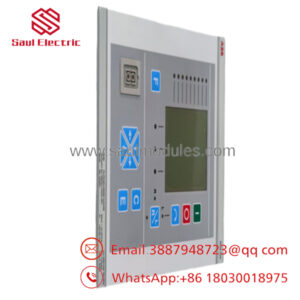
The REJ601 BD446NN1XG is a Relion® 605 Series feeder protection relay intended for utility and industrial distribution systems. It combines feeder protection, monitoring, and event recording in a compact numerical relay with universal auxiliary power and configurable I/O.
Product Introduction
The ABB REJ601 BD446NN1XG is a dedicated feeder protection relay designed for primary and secondary medium-voltage distribution networks. It provides dependable protection for overhead lines, underground cable feeders, and distribution transformers by integrating overcurrent, earth-fault, thermal overload, and phase monitoring functions into a single compact relay.
Its compact press-fit design, universal power supply, configurable binary I/O, and support for Modbus RTU and IEC 60870-5-103 communication make it well suited for utility substations, industrial switchgear, water treatment facilities, mining operations, and power distribution upgrade projects.
Troubleshooting Quick Reference
| Symptom | Possible Cause | Relevance to this Part | Quick Check Method | Recommendation |
|---|---|---|---|---|
| Relay remains off | Auxiliary power missing | ❌ Low | Measure auxiliary voltage at supply terminals | Verify station power before replacing relay |
| Relay self-supervision alarm | Internal electronics fault | ✅ High | Check relay diagnostics via HMI | Hardware repair or replacement may be required |
| Unexpected feeder trip | Incorrect CT ratio or protection settings | ❌ Low | Compare CT wiring and relay settings with drawings | Correct configuration before replacing relay |
| Earth-fault protection fails | Incorrect earth-fault parameters | ⚠️ Medium | Secondary injection test | Verify settings and CT polarity |
| Communication failure | RS-485 wiring or protocol mismatch | ❌ Low | Verify Modbus/IEC-103 settings and cable continuity | Check communication network first |
| Frequent relay reset | Unstable auxiliary supply | ⚠️ Medium | Monitor supply voltage during operation | Inspect DC battery or control PSU |
| Transformer energization causes nuisance trip | Inrush detection disabled | ❌ Low | Review inrush blocking parameters | Enable or adjust transformer energization settings |
Technical Note
From practical field experience, REJ601 relays rarely fail internally. Most commissioning issues result from CT polarity errors, incorrect protection settings, communication wiring problems, or unstable auxiliary power. Before replacing the relay, export the event logs, disturbance records, and configuration parameters. Those records usually identify the actual fault much faster than replacing hardware.
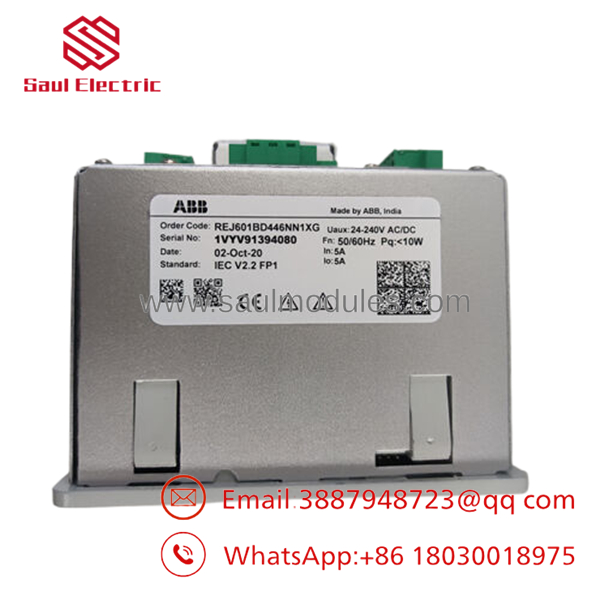
- REJ601 BD446NN1XG
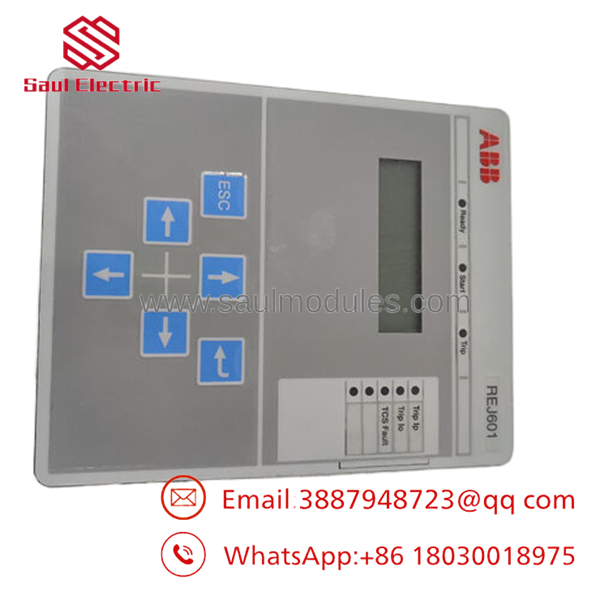
- REJ601 BD446NN1XG
Frequently Asked Questions (FAQ)
Q1. What is the BD446NN1XG primarily used for?
It is designed for feeder protection in medium-voltage distribution systems. Typical applications include utility substations, industrial distribution panels, cable feeders, overhead lines, and distribution transformers.
Q2. Does this relay include circuit breaker control?
No. The is an overcurrent protection relay without integrated breaker control. If breaker control is required, the ABB REF601 provides both protection and control functions.
Q3. Can I replace the relay without restoring the settings?
No. Always back up the protection settings, communication parameters, CT selection, and event records before replacement. Installing a factory-default relay without restoring the configuration can leave the feeder improperly protected.
Q4. Why won’t the replacement relay communicate with my SCADA system?
The most common causes are incorrect Modbus address settings, baud rate mismatches, RS-485 wiring faults, or communication protocol configuration. I’ve seen technicians replace perfectly good relays only to discover the serial communication settings had never been restored after installation.
Q5. Why is New Surplus inventory less expensive than buying directly from ABB?
New Surplus units generally originate from canceled utility projects, unused maintenance inventory, or excess warehouse stock. They have never been commissioned in service but are supplied through secondary industrial distribution channels, reducing procurement costs while maintaining original ABB manufacturing quality.
Q6. What should I verify before installing the replacement relay?
Before installation:
- Record all protection settings.
- Export event and fault records.
- Verify CT ratio selection (1 A or 5 A).
- Photograph every terminal connection.
- Check RS-485 communication wiring.
- Confirm auxiliary supply voltage.
- Wear a grounded ESD wrist strap during installation.
A few minutes spent documenting the original configuration can prevent hours of recommissioning work.
Q7. How is each BD446NN1XG inspected before shipment?
A professional inspection process typically includes:
- ABB model and serial number verification
- Visual inspection for connector damage, corrosion, and repair marks
- Relay self-diagnostic verification
- Secondary injection testing of protection functions
- Binary input/output functional testing
- Communication port verification
- Event recording and firmware verification
- ESD-safe anti-static packaging
- Final QC inspection before shipment
Functional test reports, communication test records, relay self-test results, and inspection photographs should be available upon request from the supplier.

 Start Chat


