





Description
Key Technical Specifications
| Parameter | Value |
|---|---|
| Manufacturer | ABB |
| Model | RET543AM243AAAB |
| Product Series | RET543 |
| Product Type | Transformer Protection Terminal |
| Primary Application | Two-winding power transformer protection |
| Main Protection | Three-phase current differential (87T) with harmonic restraint |
| Additional Protection | Overcurrent, Restricted Earth Fault, Thermal Overload, Over/Undervoltage, Frequency, Phase Unbalance |
| Analog Inputs | 6 Current Inputs, 4 Voltage Inputs |
| Digital Inputs | 16 Configurable |
| Relay Outputs | 10 Programmable |
| Communication Protocols | IEC 61850, Modbus, DNP3 (configuration dependent) |
| Rated Current Input | 1 A / 5 A (configuration dependent) |
| Auxiliary Supply | Model-dependent AC/DC supply |
| Event Recording | Disturbance recorder, SOE event log, self-diagnostics |
| Operating Environment | Utility and industrial substations |
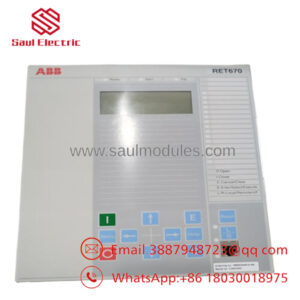
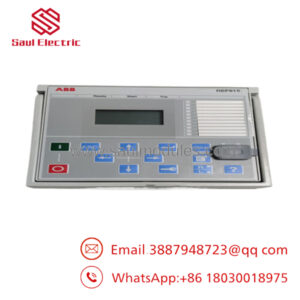
The RET543AM243AAAB belongs to ABB’s RET543 transformer protection terminal family and is designed for transformer protection, control, monitoring, and substation automation in utility and industrial power systems.
Product Introduction
The ABB RET543AM243AAAB is a multifunction numerical transformer protection relay developed for medium- and high-voltage substations. It combines transformer differential protection, backup protection, measurement, breaker control, disturbance recording, and equipment supervision into a single intelligent terminal for power transformer applications.
Designed for critical power infrastructure, the RET543 supports transformer differential protection with second- and fifth-harmonic restraint, allowing secure operation during transformer energization while maintaining fast fault clearance. Optional communication interfaces enable integration into modern digital substations and SCADA systems.
Troubleshooting Quick Reference
| Symptom | Possible Cause | Relevance to this Part | Quick Check Method | Recommendation |
|---|---|---|---|---|
| Relay does not power up | Auxiliary supply missing | ❌ Low | Measure auxiliary supply voltage at power terminals | Verify station DC/AC supply before replacing relay |
| Differential protection blocked | CT circuit or parameter mismatch | ❌ Low | Verify CT ratio, polarity, and vector group settings | Correct configuration before replacing relay |
| Unexpected differential trip | CT saturation or wiring error | ❌ Low | Compare oscillography and disturbance records | Inspect CT wiring before replacing relay |
| Self-supervision alarm | Internal hardware fault | ✅ High | Review relay diagnostics and self-test status | Hardware repair or replacement may be required |
| Communication with SCADA lost | Ethernet/serial configuration issue | ⚠️ Medium | Verify communication parameters and network status | Check network before replacing relay |
| Breaker does not trip | Output relay or trip circuit failure | ❌ Low | Inject trip command and verify output contacts | Test trip circuit first |
| Frequent relay restart | Auxiliary voltage instability | ⚠️ Medium | Monitor control voltage during operation | Inspect station battery and power supply |
Technical Note
In commissioning work, RET543 hardware failures are uncommon. Most transformer protection problems result from CT polarity mistakes, incorrect vector group compensation, transformer ratio configuration errors, or communication settings. Before replacing the relay, export disturbance records, event logs, parameter files, and self-diagnostic reports. These records usually identify the root cause much faster than replacing the hardware.
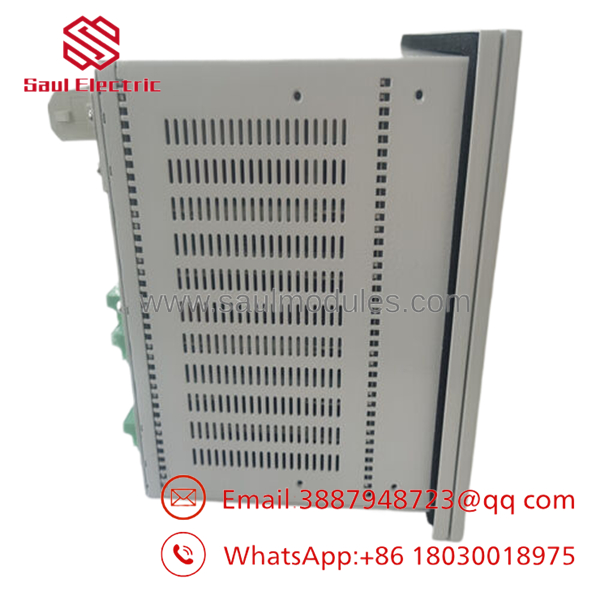
- RET543AM243AAAB
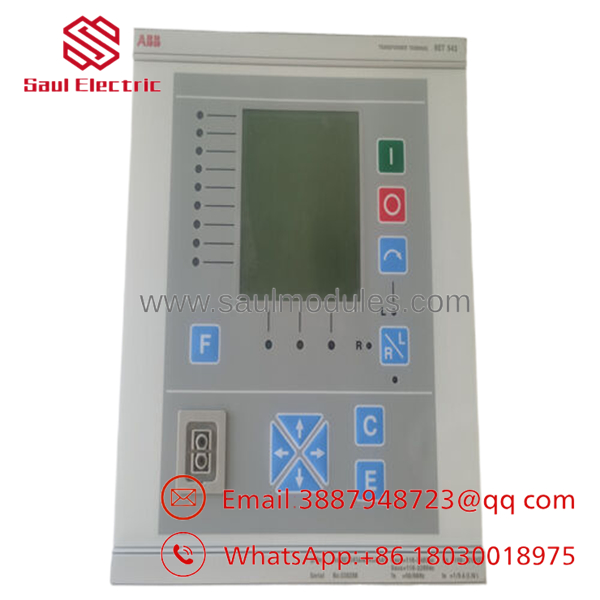
- RET543AM243AAAB
Frequently Asked Questions (FAQ)
Q1. What is the RET543AM243AAAB primarily used for?
It is designed to protect two-winding power transformers and generator-transformer blocks in utility substations, industrial power systems, and power generation facilities. Besides transformer differential protection, it also provides measurement, monitoring, and control functions.
Q2. What protection functions are included?
Depending on the hardware configuration, the relay supports:
- Transformer differential protection (87T)
- Harmonic restraint for inrush current
- Restricted earth fault (REF)
- Phase overcurrent
- Earth-fault protection
- Thermal overload protection
- Over/undervoltage protection
- Frequency protection
- Phase unbalance detection
These functions allow one relay to perform the duties that previously required several individual protection devices.
Q3. Can I replace the relay without restoring the configuration?
No. Always back up the complete protection settings, transformer vector group configuration, CT ratios, communication parameters, and event records before removing the relay. Installing a factory-default RET543 without restoring its configuration can leave the transformer improperly protected.
Q4. Why won’t the replacement relay operate correctly after installation?
The most common causes are incorrect CT polarity, transformer vector group settings, or differential compensation parameters. I’ve seen engineers spend an entire day troubleshooting what appeared to be defective hardware, only to discover one CT secondary had been reversed during installation. Always verify the wiring before suspecting the relay itself.
Q5. Why is New Surplus inventory less expensive than buying directly from ABB?
New Surplus units usually originate from canceled substation projects, unused utility spare inventories, or excess procurement stock. They have never been commissioned in service but are supplied through secondary industrial channels, reducing procurement costs while preserving original ABB manufacturing quality.
Q6. What should I verify before replacing the relay?
Before installation:
- Export the complete engineering file.
- Save all protection settings.
- Record the firmware version.
- Photograph every terminal connection.
- Verify transformer vector group settings.
- Confirm CT polarity and CT ratios.
- Label all communication cables.
- Wear a grounded ESD wrist strap throughout installation.
One reversed CT or an incorrect vector group setting can immediately produce false differential current calculations. Spending a few minutes documenting the existing installation can prevent hours of recommissioning.
Q7. How is each inspected before shipment?
A professional inspection process typically includes:
- ABB model and serial number verification
- PCB inspection for corrosion, connector wear, and repair marks
- Relay self-diagnostic verification
- Secondary injection testing of protection functions
- Binary input/output functional testing
- Communication interface verification
- Firmware version documentation
- ESD-safe anti-static packaging
- Final QC inspection before shipment
Functional test reports, disturbance recorder verification, communication test records, and inspection photographs should be available upon request from the supplier.

 Start Chat


