





Description
Product Introduction & Engineering Value
When several actuators, indicator lamps, or relay coils stop responding simultaneously, technicians often suspect the PLC processor first. In practice, the output module deserves equal attention. A damaged transistor channel, overloaded output, or wiring fault can disable multiple field devices while the controller itself continues operating normally.
The Allen-Bradley 1769-OB16 is intended for applications requiring fast and reliable DC output switching. Unlike relay output modules, its solid-state design offers rapid response with no mechanical contact wear, making it well suited for machines with frequent switching cycles.
Technical Specifications
| Specification | Value |
|---|---|
| Manufacturer | Allen-Bradley / Rockwell Automation |
| Catalog Number | 1769-OB16 |
| Product Family | 1769 Compact I/O |
| Module Type | Digital Solid-State Output Module |
| Number of Outputs | 16 |
| Output Type | 24V DC Sourcing |
| Operating Voltage | 20.4…26.4V DC |
| Nominal Voltage | 24V DC |
| Isolation Voltage | 1200V AC for 1 second (1697V DC equivalent) |
| Bus Current Draw | 200 mA @ 5V DC |
| Maximum Current per Point | 1.0 A @ 30°C (0.5 A @ 60°C) |
| Maximum Current per Module | 8.0 A @ 30°C (4.0 A @ 60°C) |
| Output Delay | 0.1 ms ON / 1.0 ms OFF (maximum, resistive load) |
| Mounting | DIN Rail or Panel |
| Approximate Dimensions | 118 × 35 × 87 mm |
| Approximate Weight | 280 g (0.61 lb) |
Technical specifications are based on Rockwell Automation technical publications.
Field Application & The “Trench” Experience
A beverage bottling facility experienced repeated production stops after several pneumatic cylinders failed to actuate during the filling sequence. Initial diagnostics focused on the air supply and valve manifold, but both checked out within specification.
The maintenance team eventually isolated the issue to an overloaded output channel on the existing 1769-OB16. After installing a tested replacement and adding interposing relays for the higher-current solenoid valves, the machine completed an entire production shift without a single output fault.
Typical applications include:
- High-speed packaging machines controlling pneumatic valve manifolds.
- Automated conveyor systems driving indicator lamps, relays, and diverter solenoids.
- Assembly workstations operating contactors and small DC actuators.
Transparency SOP: QA & Testing
Every 1769-OB16 module undergoes a documented verification procedure before shipment.
- Verify the catalog number, revision, and manufacturer identification.
- Inspect the enclosure, terminal block, and backplane connector for wear or physical damage.
- Install the module in a CompactLogix test chassis.
- Test all sixteen output channels using calibrated DC loads.
- Verify output voltage, channel response time, and communication with the controller.
- Record inspection data before classifying the module as New Surplus or Refurbished.
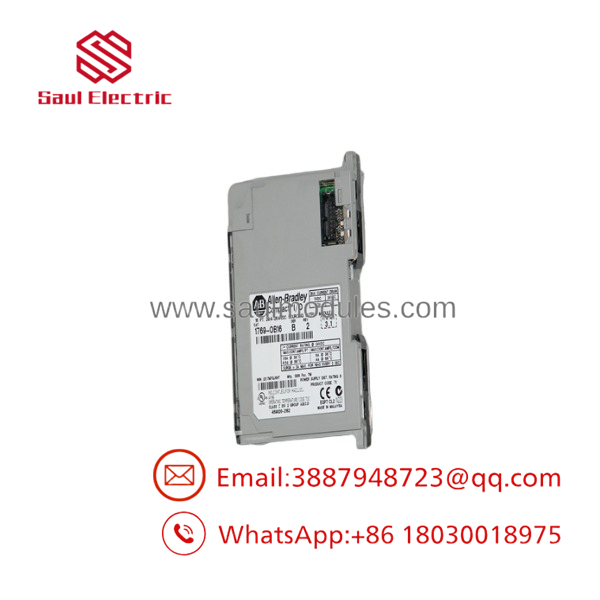
- 1769-OB16
The Veteran’s Tech Trap Guide
⚠️ Don’t Drive Large Inductive Loads Directly
Although each output channel has a defined current rating, repeatedly switching solenoid valves or contactor coils without suppression devices can shorten the service life of the output circuitry.
⚠️ Watch the Module Current Rating
The module current limit applies to the entire output group as well as individual channels. A design that is acceptable at room temperature may exceed the allowable current when the control cabinet operates at higher ambient temperatures.
PRO TIP: If a single output appears permanently energized, don’t immediately replace the module. Experienced technicians often find that a damaged field device or wiring fault is feeding voltage back into the output circuit. Testing with an interposing relay or disconnecting the field load can help isolate the root cause before replacing hardware.
Dynamic FAQ
Q1. What is the primary function of the 1769-?
The 1769- provides 16 solid-state 24V DC sourcing outputs for controlling relays, solenoids, indicator lights, and other DC field devices in CompactLogix and Compact I/O systems.
Q2. Is the 1769- a relay output module?
No. It uses solid-state transistor outputs, which provide faster switching than mechanical relays and eliminate contact wear.
Q3. What controllers are compatible with the 1769-?
The module is designed for the 1769 Compact I/O platform, commonly used with CompactLogix controllers and supported legacy Compact I/O architectures.
Q4. Can I replace a failed 1769- without modifying the PLC program?
In most cases, yes. If the replacement module uses the same catalog number and occupies the same slot, the existing controller project generally does not require logic modifications. Always verify the hardware configuration before startup.
Q5. How is New Surplus inventory authenticated?
Each module is inspected for original manufacturer labeling, connector condition, successful communication with a compatible controller, and verified operation of all sixteen output channels before shipment.
Q6. What is the most common cause of premature output failure?
Repeated switching of inductive loads without proper suppression, excessive output current, wiring faults, or back-fed voltage from field devices are among the most common causes of output module damage. These conditions should be investigated before replacing the module.

 Start Chat


