





Description
Product Introduction
The Autronica KMC-210-09 is a ruggedized Eurocard analog conditioning and measuring module built specifically for Autronica’s legacy KD series main engine temperature monitoring racks. Installed directly into central engine room alarm frames, it processes resistance signals from Pt100 RTD sensors attached to critical propulsion components, including main journal bearings, crossheads, cylinder liners, and exhaust manifolds.
Going far beyond a simple signal transmitter, the KMC-210-09 contains precision onboard comparator circuits and precision adjustment potentiometers. It evaluates raw thermal data in real-time, driving local LED indicators and dropping output alarm relays instantly if temperatures cross critical thresholds. For marine engineers battling thermal drift or component aging on legacy 2-stroke or 4-stroke engine safety racks, swapping in a tested KMC-210-09 board guarantees continuous protection against catastrophic mechanical seizures without needing a multi-million-dollar automation overhaul.
Key Technical Specifications
| Parameter | Specification |
| Manufacturer & Part No. | Autronica / Kongsberg Maritime KMC-210-09 (116-KMC-210-09) |
| System Compatibility | Autronica KD-10, KD-20 Central Temperature Systems |
| Measuring Channels | Dual-channel Pt100 RTD inputs (3-wire compensation) |
| Standard Temperature Range | 0°C to +160°C or 0°C to +600°C (Suffix variant dependent) |
| Operating Voltage | 24 VDC (Internal backplane rack powered) |
| Onboard Adjustments | Precision multi-turn potentiometers for Zero, Span, and Alarm Limits |
| Output Interfaces | Analog telemetry output (0-10V / 4-20mA) + Dry Contact Alarm Relays |
| Visual Indicators | Front-panel/Card-edge red LED trip status indicators |
| Form Factor | Standard Eurocard PCB format with DIN 41612 edge connector |
| Conformal Coating | Marine-grade protective varnish against moisture, oil mist, and salt spray |
Application Scenarios & The “Trench” Experience
The Chief Engineer’s 2 AM Emergency
You are chief engineer on a 20-year-old bulk carrier navigating the Malacca Strait at 02:00. The ECR alarm console triggers a severe “Main Bearing No. 4 Temp High” alarm, instantly commanding a main engine slowdown to 40 RPM. You rush down to the engine room, run a local manual pyrometer check on Bearing 4, and find it running completely cool at 48°C. Channel 2 on the aging KMC-210 card drifted due to a failed operational amplifier, reading a false 110°C and locking the engine in a forced slowdown state. You cannot navigate tight sea lanes at half-power. You need to pull the faulty card, match the calibration pots on a spare -09 module, slide it into the rack slot, and restore full propulsion authority immediately.
Key Field Applications
- Main Engine Bearing Monitoring: Real-time temperature acquisition across main journal bearings, crankpin bearings, and thrust pads.
- Exhaust Gas Temperature Monitoring: Measuring individual cylinder exhaust outlets on 2-stroke diesel engines.
- Generators & Auxiliary Plant Safety: High-temperature trip protection on lube oil coolers, scavenge air boxes, and stern tube bearings.
- Retrofit Maintenance: Direct replacement module for aging marine alarm cabinets on vessels subject to strict DNV, ABS, or ClassNK inspections.

KMC-210-09
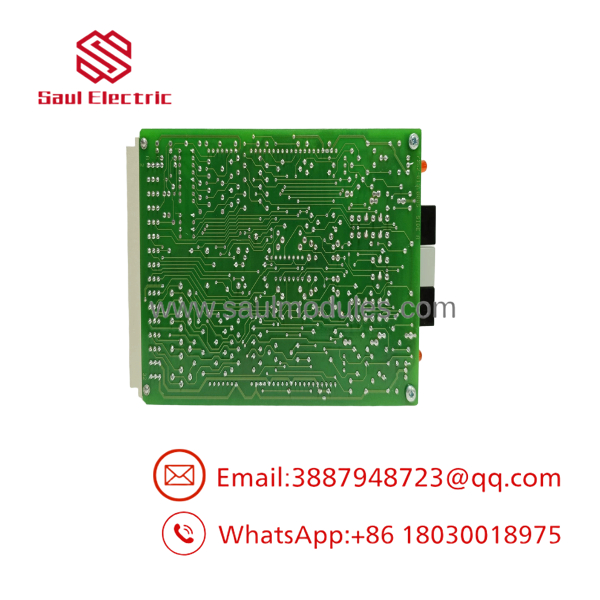
KMC-210-09
Transparency SOP: Quality Assurance & Testing
Engine safety conditioning boards require absolute precision—a false temperature reading can trip an engine in open water or let a bearing melt without warning. We don’t just ship boxes; we test them on actual Autronica test rigs.
- Inbound Visual & PCB Audit: Thorough inspection of edge connector gold plating, multi-turn potentiometers, onboard tantalum capacitors, and trace integrity.
- Backplane Power Rail Test: The card is installed in an active test frame to verify internal voltage regulator stability and zero current overdraw.
- Pt100 Decade Box Calibration: Precision decade resistance boxes are connected to both channels, simulating exact thermal values (e.g., 100.0 Ω at 0°C, 138.5 Ω at 100°C) to verify analog scaling linearity.
- Trip Threshold Verification: Temperature setpoints are elevated past limit levels to confirm rapid, crisp relay dropouts and immediate front LED actuation.
- Anti-Static Sealing & Marine-Grade Packaging: Boards are cleared, vacuum-sealed in ESD shielding bags, and encapsulated in thick industrial foam to survive sea freight conditions.
The Veteran’s Tech Trap Guide (Crucial Value-Add)
⚠️ DO NOT Touch Potentiometers Without a Calibrated Decade Box
The multi-turn potentiometehe set the zero offset, scale span, and trip points for two independent channels. Trying to “eyeball” or field-adjust these pots while the card is plugged into a warm engine room rack without a precise Pt100 simulator will completely ruin channel calibration and cause false engine trips.
❗ Verify the Temperature Suffix on the Front/Side Label
Autronica manufactured cards tuned for specific thermal windows (e.g.,
2x20 160°Cfor bearings vs600°Cfor exhaust gas). Check the hand-written or stamped scale designation on the edge connector handle before installing. Placing an exhaust-range card on a low-temperature bearing circuit will make normal bearing temperatures register as zero.
⚠️ Clean the Gold Backplane Edge Pins Before Insertion
Engine rooms are notorious for airborne oil mist settling inside panel racks over decades. Before seating the rent card into the card cage, wipe down the PCB edge connector pins with isopropyl alcohol and clean the female rack receptacle with electrical contact spray to avoid intermittent sensor-break alarms caused by contact resistance.
Frequently Asked Questions (FAQ for Conversion)
he hot-swappable in a live KD-10 rack? A: No. While it is a slide-in Eurocard format, pulling or inserting the card with backplane power active can cause momentary voltage spikes on adjacent signal channels or trip common alarm relays. Always pull the designated rack slot supply fuse before swapping boards.
Q: Can he with 2-wire Pt100 sensors instead of 3-wire sensors? A: Yes, but you must bridge the lead-compensation terminals directly at the board’s terminal connector block. However, 3-wire connections are strongly recommended over long marine cable runs to eliminate cable resistance measurement errors.
Q: How do I know if my issuead card or a broken field Pt100 sensor? A: Disconnect the field wires for the faulty channel at the back of the rack terminal strip and connect a fixed 100-ohm resistor directly across the input terminals. If the channel reading drops to a rock-solid 0°C on the display console, the card is working fine and your field sensor or cable is open-circuit.
Q: Why choose refurbished ous stock over upgrading the alarm panel? A: The KD-10/KD-20 system architecture is legacy technology. Upgrading an entire engine room temperature monitoring panel requires replacing dozens of sensor runs, rewiring control cabinets, and undergoing re-certification by class societies—a process costing tens of thousands of dollars. Installing a pre-calibrateus keeps your vessel 100% compliant at a fraction of the cost.
Q: What warranty coverage comes with your surplus or reed modules?ry board we supply—whether new surplus or fully bench-refurbished—is backed by our full 12-month replacement warranty.



 Start Chat


