





Description
Product Introduction
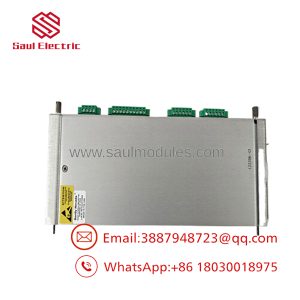
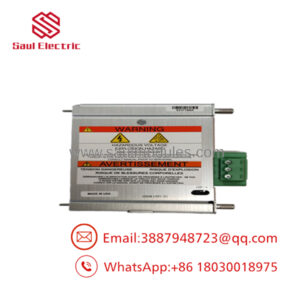
The Bently Nevada 3500/45-01-00 is a dedicated 4-channel position monitor card designed for critical steam turbine protection and process valve position feedback. The -01-00 ordering code defines the complete assembly configuration: the front main processing module paired with a standard Rear I/O module equipped with removable Euro-style screw terminal connectors.
Unlike standard vibration cards, the 3500/45 accepts signals from Linear Variable Differential Transformers (LVDTs), Rotary Variable Differential Transformers (RVDTs), and eddy current proximity probes. It continuously measures macro-mechanical shifts on turbomachinery trains—including Axial Position (Thrust), Differential Expansion, Case Expansion, Complementary Differential Expansion, and Control Valve Position—providing hardware trip outputs to prevent internal rotor-to-stator rubbing during thermal ramps.
Key Technical Specifications
| Parameter | Specification Value |
| Ordering Code | 3500/45-01-00 (01 = Standard I/O Module, 00 = Standard Agency Approvals) |
| Main Card / Rear I/O Assembly | 176449-01 / 140471-01 (Front Board) + 128229-01 (Rear I/O) |
| Channel Capacity | 4 fully independent, software-configurable position channels |
| Supported Transducers | AC LVDTs, DC LVDTs, RVDTs, 3300 XL Proximitors (8mm, 11mm, 16mm, 25mm, 50mm) |
| Measurement Modes | Axial Position, Differential Expansion, Case Expansion, Valve Position |
| Field Wiring Connection | Removable Euro-Style screw terminal connectors |
| Transducer Excitation | Internal AC/DC excitation voltage supply for external LVDT/RVDT sensors |
| Buffered Signal Outputs | 4 Front-Panel coaxial BNC outputs (100 Ω output impedance) |
| Power Consumption | 7.7 Watts typical |
| Operating Temperature | -30°C to +65°C (-22°F to +149°F) |
Application Scenarios & The “Trench” Experience
During cold roll and thermal startup of a 300 MW utility steam turbine, the high-pressure rotor heats up and expands far faster than the heavy cast steel outer casing. If the rotor expansion outpaces casing expansion past allowable tolerances (Differential Expansion), the rotating turbine blades will contact the stationary diaphragm seals—causing massive mechanical destruction, shed metal, and months of forced outage.
The 3500/45-01-00 exists to monitor these slow-moving physical clearances with extreme DC voltage precision, tripping the turbine trip throttle valve before physical interference occurs.
- Power Generation – Utility Steam Turbines: Measuring rotor-to-casing Differential Expansion using long-range 25mm or 50mm Proximitor probes.
- Refineries – Governor & Stop Valve Monitoring: Tracking actual steam control valve stem position via AC LVDTs to verify valve linearity and fast-closure response.
- Petrochemical – Large Turbo-Compressor Packages: Monitoring main shaft Axial Displacement (Thrust) and Case Expansion on heavy foundation skid plates.
Field Case Scenario: During a cold startup at a combined heat and power station, an operator noticed channel 3 on a legacy position card was displaying erratic Differential Expansion values, jumping between 150 mils and open-circuit “Not OK” status. To be honest, the plant was minutes away from aborting the startup due to false trip alarms. We verified that the LVDT field excitation rail on the old card had failed due to thermal fatigue on an internal DC-DC converter. We pulled a pre-tested 3500/45-01-00 module from surplus stock, loaded the stored configuration, verified LVDT zero-span voltages, and allowed the plant to finish thermal warming safely on schedule.
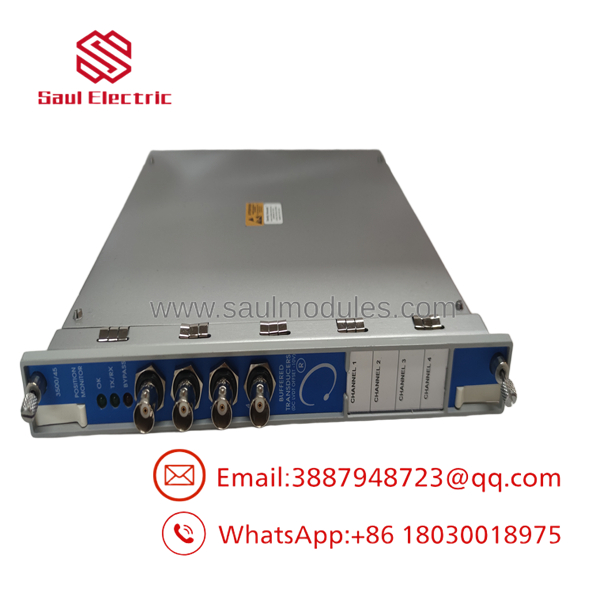
3500/45-01-00
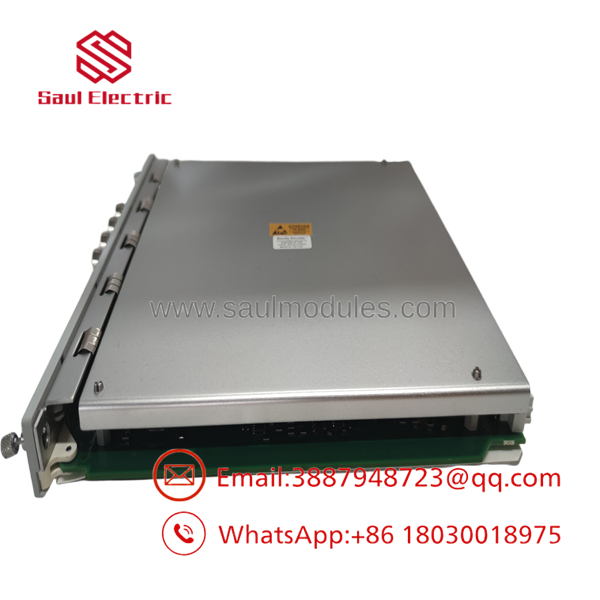
3500/45-01-00
Transparency SOP: Quality Assurance & Testing
We don’t just ship boxes; we test them on actual Bently Nevada 3500 racks.
- Inbound Visual & Pin Inspection: We inspect board traces under magnification, test backplane connector gold fingers, and verify that the Euro-block terminal headers on the rear I/O module are clean and free of corrosion.
- Backplane Handshake & POST: The front processing card and rear I/O module are seated in a powered 3500 chassis. We run Power-On Self-Tests (POST) to confirm communication with the 3500/22M System Interface without rack fault errors.
- LVDT/Proximitor Signal Simulator Injection: Using precision DC voltage sources and AC LVDT signal simulators, we sweep input voltages across all four channels to verify zero-point offset, full-scale stroke linearity, and Alert/Danger relay actuation levels.
- Buffered BNC Output Check: Every front-panel BNC output is tested on an oscilloscope to ensure clean, unattenuated DC voltage signal pass-through for diagnostic software.
- Anti-Static Sealing: Verified assemblies are packed directly into conductive Faraday ESD bags with custom protective foam.
The Veteran’s Tech Trap Guide (Crucial Value-Add)
- ⚠️ Mismatched LVDT Excitation Frequency & Voltage: AC LVDTs require precise excitation frequency and voltage drive settings. If the excitation configuration in 3500 Rack Configuration Software does not match the physical LVDT vendor specification (e.g., 3 kHz vs 5 kHz excitation), the 3500/45 card will fail to balance the sensor, leading to severe measurement drift and constant “Not OK” channel warnings.
- ❗ Never Short the LVDT Excitation Lines: The rear terminal block supplies AC excitation voltage to field LVDTs. Accidentally shorting the excitation terminals during field wiring troubleshooting will blow internal solid-state fuses on the card, requiring board-level repair. Always disconnect power to the rack or pull the Euro connector plug before adjusting field wiring terminations.
- ⚠️ Re-Zeroing Requirements After Replacement: Position channels (especially Differential Expansion and Valve Position) require physical zero-referencing. When swapping out a 3500/45 card, you MUST perform a digital zero-calibration in 3500 Rack Configurator while the machine is cold/rest position, or your mechanical baseline offset will be inaccurate.
Frequently Asked Questions (FAQ for Conversion)
Q: What is the difference between the Bently Nevada 3500/42M and 3500/45?
A: The 3500/42M is optimized for dynamic dynamic vibration (radial shaft vibration, casing velocity, acceleration). The 3500/45 is optimized for slow-moving DC position measurements (Differential Expansion, Case Expansion, Valve Position, Thrust) using LVDT, RVDT, and Proximitor inputs.
Q: What does the suffix “-01-00” signify on the 3500/45?
A: The -01 suffix designates the Standard Rear I/O Module equipped with Euro-style screw terminals. The -00 suffix specifies Standard Agency Approvals (CSA, CE, UL).
Q: Is the 3500/45-01-00 position monitor hot-swappable?
A: Yes, the front main module can be hot-swapped while the rack is powered. However, to be honest, replacing a card wired to active steam turbine Danger trip relays carries risk—always inhibit connected relay channels in software before removing the card.
Q: Does the 3500/45 support both AC LVDTs and DC LVDTs?
A: Yes. The 3500/45 supports both 3-wire/4-wire AC LVDTs (utilizing the card’s internal AC excitation supply) and self-powered DC LVDTs, selectable via software configuration per channel.
Q: What warranty is included with this module assembly?
A: All our Bently Nevada 3500/45-01-00 assemblies—whether factory-sealed new surplus or fully rig-tested units—are covered by our full 12-month replacement warranty.

 Start Chat


