





Description
Product Introduction
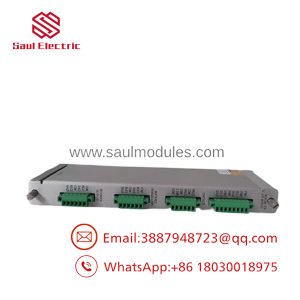
The Bently Nevada 3500/54 133396-01 is a Turbine Supervisory Instrumentation (TSI) Monitor designed for the 3500 Machinery Protection System. It continuously monitors critical turbine operating parameters such as shaft position, differential expansion, eccentricity, and other supervisory measurements required for large steam and gas turbines. The module integrates with the modular 3500 platform to provide continuous protection for rotating equipment operating under demanding industrial conditions.
In our field experience, the 3500/54 is frequently confused with standard vibration monitors. It serves a different purpose. While vibration modules focus on shaft dynamic behavior, the 3500/54 concentrates on turbine supervisory measurements that operators rely on during startup, shutdown, thermal expansion, and load changes. Verify both the monitor configuration and its matching rear I/O module before installation.
Key Technical Specifications
| Parameter | Value |
|---|---|
| Manufacturer | Bently Nevada |
| Model | 3500/54 |
| Part Number | 133396-01 |
| Product Type | Turbine Supervisory Instrumentation (TSI) Monitor |
| System Platform | 3500 Machinery Protection System |
| Monitoring Channels | 4 |
| Installation | 3500 Rack |
| Primary Measurements | Shaft Position, Differential Expansion, Eccentricity, Supervisory Parameters |
| System Integration | 3500 Rack Interface Module (RIM) / 3500/22M TDI |
| Standard Compliance | Designed for API 670 machinery protection systems |
| Application | Steam Turbines, Gas Turbines, Turbo-Compressors |
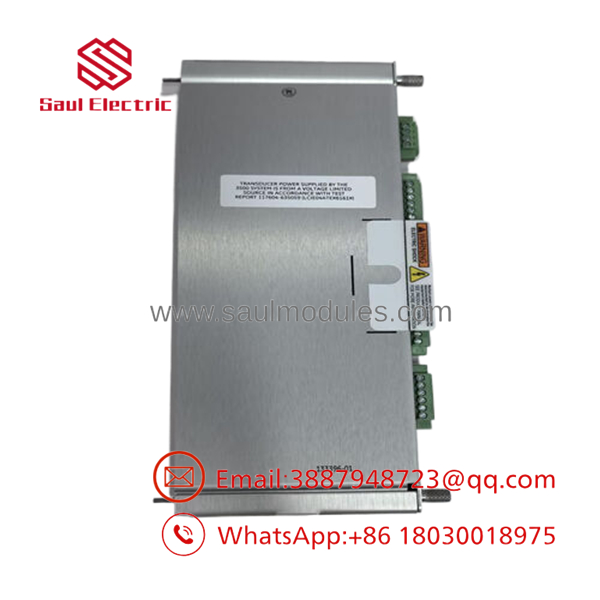
- 3500/54 133396-01
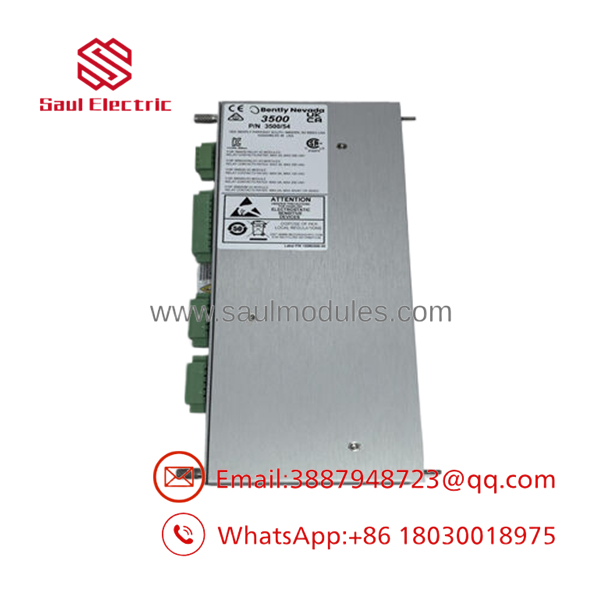
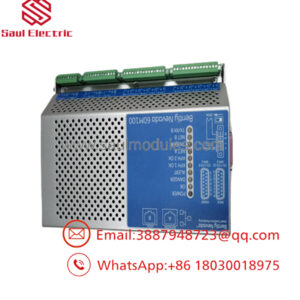
- 3500/54 133396-01
Application Scenarios & The “Trench” Experience
Everything looked normal during startup.
Bearing temperatures were stable.
Vibration stayed well below alarm limits.
Yet the turbine refused to reach full load because differential expansion exceeded the configured limit.
The problem wasn’t mechanical.
A failed supervisory input channel inside the 3500/54 was reporting incorrect expansion data. After replacing the monitor and validating the transducer calibration, the turbine completed startup without additional delays.
Typical Applications
Power Generation – Steam Turbine Supervision –
Monitors shaft position, differential expansion, and rotor movement required for safe turbine startup and operation.
Combined Cycle Plants – Gas Turbine Protection –
Provides supervisory measurements used together with vibration monitoring during load changes.
Oil & Gas – Process Turbines –
Tracks shaft movement and thermal expansion on compressor drive turbines.
Petrochemical Plants – Critical Rotating Equipment –
Supplies supervisory measurements required by API 670 protection systems.
Industrial Cogeneration – Turbine Monitoring –
Supports continuous monitoring of mechanical position parameters throughout the operating cycle.
Field Replacement Example
During a scheduled outage, maintenance personnel replaced several proximity probes on a steam turbine.
After startup, the turbine repeatedly generated differential expansion alarms.
Probe voltages measured correctly.
Further investigation revealed a failed input channel on the 3500/54 133396-01. Installing a tested replacement module restored accurate measurements and allowed the unit to synchronize with the grid without additional troubleshooting.
Transparency SOP: Quality Assurance & Testing
We don’t just ship boxes; we test them on actual Bently Nevada 3500 racks.
1. Inbound Inspection
- Verify OEM labels, serial numbers, and hardware revisions.
- Inspect connectors, PCB assemblies, and edge contacts.
- Check for corrosion, overheating, or unauthorized repairs.
2. Live Rig Testing
- Install the module in a compatible 3500 rack.
- Simulate supervisory transducer inputs.
- Verify alarm processing and channel response.
3. Electrical Parameter Checks
- Verify input channel accuracy.
- Confirm communication with the rack interface.
- Test analog processing stability.
4. Hardware Verification
- Record hardware revision.
- Verify compatibility with the installed rear I/O module.
- Archive complete functional test records.
5. Final QC & Anti-Static Packaging
- Complete operational testing.
- Package using ESD-safe materials.
- Protect module connectors during shipment.
- Maintain full traceability documentation.
The Veteran’s Tech Trap Guide
⚠️ Don’t assume every TSI configuration is identical.
The 3500/54 can be configured for different supervisory measurements. Verify the configuration file before replacing the module, or you may restore power only to discover incorrect engineering units or alarm logic.
❗ Calibrate the transducers before blaming the monitor.
Many apparent module failures are actually caused by improperly adjusted proximity probes or damaged extension cables.
⚠️ Always match the monitor with its correct rear I/O module.
The front monitor and rear I/O are designed to operate as a compatible pair. Ordering only one component without verifying the complete assembly can extend an outage unnecessarily.
❗ Back up the rack configuration first. Trust me.
Replacing hardware is easy. Rebuilding custom alarm setpoints, relay assignments, and scaling during an outage is not.
Frequently Asked Questions (FAQ)
Q1: What does the 3500/54 monitor?
A: It monitors turbine supervisory parameters such as shaft position, differential expansion, eccentricity, and related measurements used to protect critical rotating equipment.
Q2: Is the 3500/54 a vibration monitor?
A: No. Although it operates within the 3500 Machinery Protection System, the 3500/54 is dedicated to turbine supervisory measurements, while other 3500 monitor families handle vibration, speed, temperature, or process variables.
Q3: Can this module be replaced while the rack is energized?
A: A planned maintenance outage is recommended. Replacing machinery protection modules during operation can interrupt supervisory measurements and may require system reinitialization.
Q4: Does the module require a dedicated rear I/O module?
A: Yes. Like other 3500 monitor modules, the 3500/54 must be installed with the correct matching rear I/O assembly specified for its application and wiring configuration.
Q5: Is the 3500/54 suitable for API 670 applications?
A: Yes. When properly configured within a complete 3500 Machinery Protection System, it supports turbine supervisory functions commonly implemented in systems designed to meet API 670 requirements.
Q6: Why are surplus modules less expensive than buying directly from the OEM?
A: Most surplus inventory comes from modernization projects, unused maintenance stock, or plant decommissioning. The lower cost reflects inventory sourcing rather than reduced capability. Ask for documented rack testing, traceability, and hardware revision records before purchasing.
Q7: What warranty is typically available?
A: Most established industrial automation suppliers provide a 12-month warranty on professionally tested surplus or refurbished Bently Nevada 3500/54 133396-01 modules. Before purchasing, request documentation covering channel simulation tests, hardware revision verification, and complete rack compatibility testing.

 Start Chat


