





Description
Core Product Summary
The FMS EMGZ306A is a compact analogue tension-measuring amplifier designed to process signals from compatible force sensors used in material tension measurement. It converts sensor signals into standardized analogue outputs for integration with PLCs, feedback displays, and other compatible control equipment.
The amplifier provides a ±10 V voltage output and a selectable 0–20 mA or 4–20 mA current output. Gain and offset are adjusted using front-accessible multi-turn trimmers, while the low-pass filter can be configured to suit the measurement application. The unit operates from a 24 VDC supply within an 18–36 VDC input range and provides 5 VDC sensor excitation as standard, with a 10 VDC option available for applicable versions. DIN-rail mounting supports installation inside an electrical control cabinet.
Key Technical Specifications
| Parameter | Specification |
|---|---|
| Manufacturer | FMS |
| Model | EMGZ306A |
| Product type | Analogue tension-measuring amplifier |
| Measurement channel | Single channel |
| Sensor connection | Compatible strain-gauge force sensors; supports connection of two sensors |
| Standard sensor excitation | 5 VDC, 30 mA |
| Optional sensor excitation | 10 VDC |
| Gain factor range | 500–5000 |
| Offset adjustment range | ±9 mV |
| Linearity error | Less than 0.1% |
| Offset temperature drift | Less than 0.01%/K |
| Voltage output | ±10 V, minimum load resistance 1 kΩ |
| Current output | 0–20 mA or 4–20 mA, maximum load resistance 500 Ω |
| Low-pass filter cutoff | Adjustable, approximately 1–1000 Hz |
| Power supply | 24 VDC nominal, 18–36 VDC |
| Maximum supply current | 0.1 A |
| Maximum power consumption | 2.5 W |
| Operating temperature | −10 to +60°C |
| Protection rating | IP20 |
| Mounting | DIN rail |
Engineering Selection Highlights
- Single-channel tension measurement: Processes signals from compatible force sensors for one measurement channel.
- Two-sensor connection capability: Supports connection of two force sensors; verify the sensor arrangement and wiring against the installation manual.
- Adjustable gain and offset: Allows the measurement signal to be calibrated to the required tension range and zero point.
- Selectable analogue outputs: Provides ±10 V voltage output and 0–20 mA or 4–20 mA current output, allowing selection according to the receiving device.
- Configurable signal filtering: The adjustable low-pass filter helps limit unwanted signal fluctuations within the selected measurement bandwidth.
- 24 VDC control-panel supply: The 18–36 VDC operating range provides a clear power-supply selection criterion.
- DIN-rail installation: The compact housing is designed for mounting on a DIN rail within a suitable enclosure.
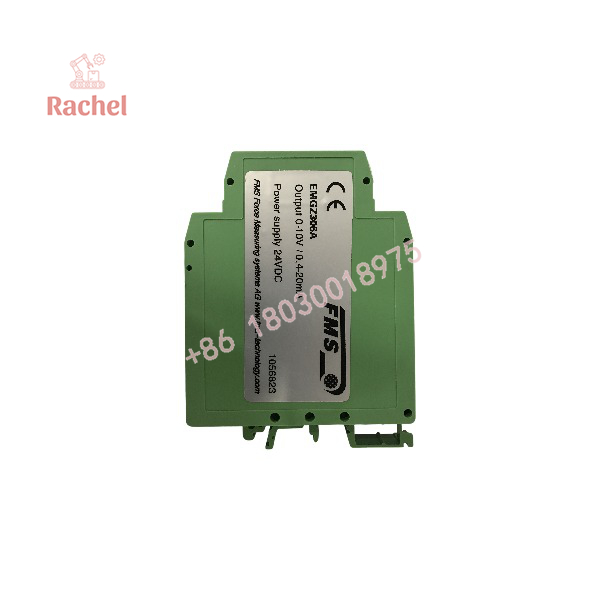
EMGZ306A
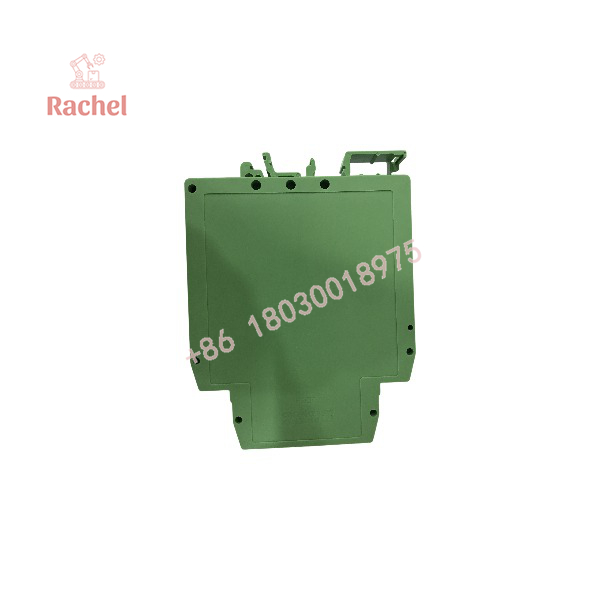
EMGZ306A
System Compatibility & Integration Requirements
| Item / Dependency | Requirement | Practical Note |
|---|---|---|
| Force sensors | Compatible FMS strain-gauge force sensors | Confirm sensor electrical characteristics and connection arrangement. |
| Sensor excitation | 5 VDC standard; 10 VDC option | Match the excitation voltage to the sensor and amplifier variant. |
| PLC or analogue input | ±10 V, 0–20 mA, or 4–20 mA as configured | Select the output mode to match the receiving input type and range. |
| Current-output load | Maximum 500 Ω | Include the receiving input and wiring resistance in the load calculation. |
| Voltage-output load | Minimum 1 kΩ | Confirm the connected input impedance. |
| Power supply | 24 VDC nominal, 18–36 VDC operating range | Provide a suitable DC supply and protective wiring. |
| Mounting | DIN rail | Install within an enclosure suitable for the operating environment. |
| Signal conditioning | Adjustable gain, offset, and low-pass filtering | Calibrate and configure the amplifier for the actual sensor and process conditions. |
Dimensions, Mounting & Connection Notes
- Mounting method: DIN rail.
- Enclosure protection: IP20.
- Power connection: 24 VDC nominal supply.
- Sensor interface: Strain-gauge force sensor connection with excitation supply.
- Analogue interfaces: Voltage and current outputs.
- Adjustment controls: Multi-turn gain and offset trimmers accessible from the front.
- Signal filtering: Configurable low-pass filter.
- Installation temperature: −10 to +60°C.
Refer to the applicable installation manual for exact terminal assignments, sensor wiring, grounding, jumper positions, and calibration procedures.
Detailed Product Overview
Sensor signal conditioning
The FMS EMGZ306A is designed to convert low-level signals from compatible strain-gauge force sensors into analogue outputs suitable for industrial control equipment. In a tension-measurement arrangement, the force sensor responds to the mechanical load, and the amplifier conditions the resulting electrical signal for monitoring or further processing.
The standard 5 VDC sensor excitation supplies the connected sensor within the specified excitation limits. An optional 10 VDC excitation configuration is available for applicable versions. Sensor selection and wiring must therefore be checked against the exact amplifier configuration.
Gain and offset adjustment
The amplifier provides independent gain and offset adjustments through multi-turn trimmers. Gain determines the relationship between the sensor signal and the output range, while offset adjustment compensates for the zero-point difference.
These adjustments are important when commissioning a tension-measurement system. The output must correspond to the intended measurement range, and the zero point must be set according to the sensor installation and calibration procedure.
Analogue output integration
The EMGZ306A provides a ±10 V voltage output and a current output selectable between 0–20 mA and 4–20 mA. This allows the amplifier to interface with compatible analogue-input modules and display equipment.
The receiving device must support the selected signal type and electrical range. For current output, the total connected load must not exceed 500 Ω; for voltage output, the load resistance must be at least 1 kΩ.
Filtering and installation
The adjustable low-pass filter has an approximate cutoff range of 1–1000 Hz. The selected setting affects how quickly the measurement output follows changes in force and how much higher-frequency variation is retained. The appropriate setting depends on the dynamics of the application and the measurement requirements.
The compact housing mounts directly on a DIN rail and has an IP20 protection rating. Installation should therefore provide an appropriate enclosure and environmental conditions within the specified −10 to +60°C operating range.
Applications & System Role
The FMS EMGZ306A serves as a signal-conditioning interface between force sensors and a machine’s control or monitoring equipment. In web-processing systems, force sensors measure the mechanical force associated with material tension, and the amplifier converts their signals into a standardized analogue representation.
Typical engineering fit scenarios include:
- Web tension monitoring: Provides an analogue measurement signal for a compatible PLC or tension-monitoring display.
- Converting and winding equipment: Supplies conditioned tension feedback for compatible machine-control architectures.
- Force measurement integration: Interfaces compatible strain-gauge force sensors with analogue-input equipment.
- Control-panel installations: Provides a DIN-rail-mounted measurement amplifier for integration into an electrical cabinet.
The EMGZ306A is a measuring amplifier rather than a complete tension-control system. Automatic tension regulation depends on the connected controller, drive or actuator, feedback configuration, and the overall machine design.
FAQ
What is the FMS EMGZ306A?
The FMS EMGZ306A is a single-channel analogue tension-measuring amplifier that converts compatible force-sensor signals into standardized voltage or current outputs.
What output signals does the EMGZ306A provide?
It provides a ±10 V voltage output and a selectable 0–20 mA or 4–20 mA current output.
What power supply does the EMGZ306A require?
It operates from a nominal 24 VDC supply, with an input range of 18–36 VDC and a maximum power consumption of 2.5 W.
Can the EMGZ306A connect to two force sensors?
Yes. The EMGZ306A supports connection of two force sensors. The actual sensor arrangement and wiring should follow the applicable installation documentation.
How is the measurement signal calibrated?
Gain and offset are adjusted using front-accessible multi-turn trimmers. Calibration should follow the prescribed procedure for the connected sensor and intended measurement range.
What is the low-pass filter range?
The cutoff frequency is adjustable over an approximate range of 1–1000 Hz, allowing the measurement response to be configured for the application.
What are the mounting and environmental requirements?
The amplifier is designed for DIN-rail mounting, has an IP20 protection rating, and is specified for operation between −10 and +60°C.

 Start Chat


