





Description
Product Introduction
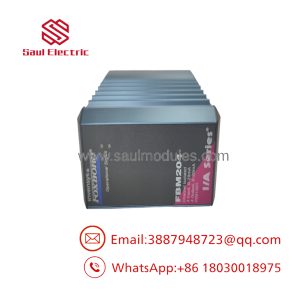
The Foxboro FBM202 (Part Number P0926EQ) is an 8-channel specialized analog input Fieldbus Module engineered for precise temperature measurement within the Foxboro I/A Series and EcoStruxure DCS platforms. Supporting direct connections to millivolt sources, thermocouples, and Resistance Temperature Detectors (RTDs), the FBM202 eliminates the need for external signal transmitters in high-density process monitoring applications.
Designed for demanding thermal process loops, the FBM202 features high-accuracy delta-sigma A/D converters, software-configurable linearization curves, and onboard Cold Junction Compensation (CJC). It isolates and conditions low-level millivolt signals directly at the rack level, delivering exceptional noise rejection and preventing measurement drift in electrically noisy plant environments.
Key Technical Specifications
| Parameter | Value |
| Manufacturer | Foxboro (Invensys / Schneider Electric) |
| Part Number | FBM202 / P0926EQ |
| Series | Foxboro 200 Series Subsystem |
| Input Channels | 8 isolated millivolt / TC / RTD inputs |
| Supported Sensor Types | Thermocouples (J, K, T, E, R, S, B, N), RTDs (Pt100, Pt200, Pt500, Pt1000, Ni120, Cu10), mV (-10 to +100 mV) |
| Resolution | 15-bit A/D conversion |
| Cold Junction Comp | Automatic onboard CJC via Termination Assembly |
| Galvanic Isolation | Channel-to-bus galvanic isolation |
| Power Consumption | 3W maximum from baseplate power rails |
| Operating Temp Range | -20°C to +70°C (-4°F to +158°F) |
Application Scenarios & The “Trench” Experience
The Trench Story
It is 03:30 AM on a freezing winter night at a continuous chemical synthesis plant. A reactor vessel’s exothermic runaway alarm goes off—not because the vessel is overheating, but because all eight thermocouple readings on an FBM202 card suddenly spiked to maximum off-scale values. The culprit isn’t eight burned-out sensors; the front-end cold-junction compensation circuitry on an aging P0926EQ module failed, causing wild temperature measurement swings. Safety logic threatens an emergency plant trip, risking hundreds of thousands in ruined product. Swapping in a pre-tested FBM202 module instantly restores accurate temperature tracking and clears the trip condition.
Target Application Scenarios
- Chemical Reactors & Distillation Columns: Directly measures multi-point internal bed temperatures using Type J/K thermocouples.
- Power Generation Turbines: Monitors bearing, stator, and exhaust temperatures using 3-wire Pt100 RTD sensors.
- Industrial Kilns & Furnaces: Reads high-temperature thermal profiles via platinum-element (R/S/B) thermocouples.
Field Case Study
A glass manufacturing facility in Ohio experienced severe signal noise and temperature drift on a furnace zone controlled by a Foxboro 200 Series DIN-rail rack. Diagnostics pinpointed a degraded analog front-end on the installed card. We dispatched a bench-tested P0926EQ module via morning courier. The instrument technician set the affected loops to manual, swapped the card on the live DIN-rail baseplate, and restored stable temperature control in under 15 minutes without interrupting the production melt.
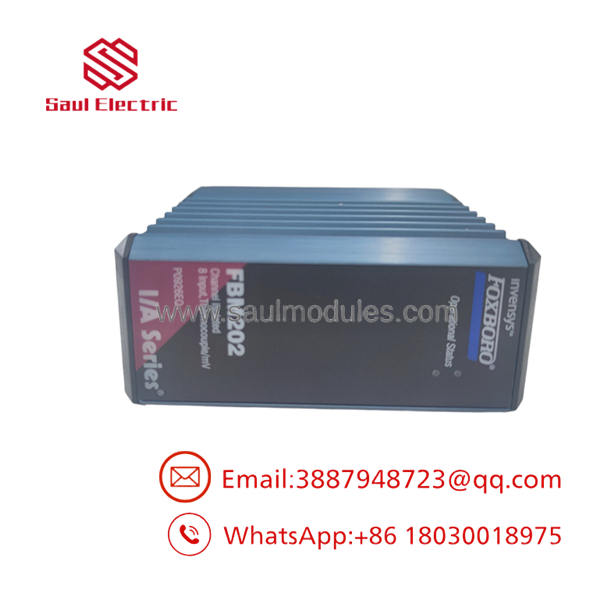
FBM202 P0926EQ
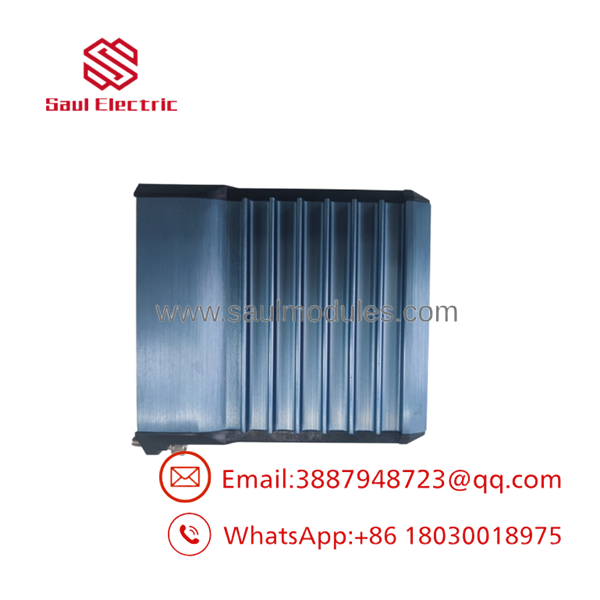
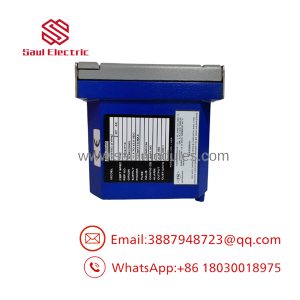
FBM202 P0926EQ
Transparency SOP: Quality Assurance & Testing
We don’t just ship boxes; we test them on actual Foxboro 200 Series racks. Every / P0926EQ module undergoes a strict 5-point workbench validation prior to shipment:
- Inbound Visual & Pin Inspection: High-magnification check for PCB thermal stress, component aging, edge connector plating integrity, and enclosure latch condition.
- Cold Power Rail Diagnostics: Resistance checks across internal power buses and input channels to rule out short circuits caused by field overvoltage events.
- Live Baseplate Bus Handshake: Module is mounted on a live Foxboro 200 Series baseplate tied to a Control Processor to verify bus communications, module identification, and LED diagnostic status.
- 8-Channel TC & RTD Calibration: Precision calibrators simulate mV inputs, Type K thermocouple curves, and Pt100 RTD resistance steps across all 8 channels to verify CJC compensation and A/D converter linearity.
- Anti-Static ESD Packaging: Cleared modules undergo contact cleaning, solvent drying, and are sealed in anti-static ESD bags before custom foam packaging.
The Veteran’s Tech Trap Guide
- ⚠️ Check Your Termination Assembly (TA) and CJC Sensors!
Thermocouple compensation relies on built-in thermistors or RTDs located on the external Termination Assembly (TA). If you swap an module and see uniform temperature offsets across all channels, verify that the CJC sensor on the TA block is securely connected and functioning.
- ❗ Never Run Unshielded Extension Wire to TC Inputs.
Low-level millivolt signals from thermocouples are extremely susceptible to EMI/RFI noise. Ensure twisted-pair shielded extension wire is used and grounded at a single point (typically the cabinet ground bus, not at the field sensor head).
- ⚠️ Match Your Software Configuration to Sensor Hardware.
The supports multiple sensor types (TC, RTD, mV). If your DCS block is configured for a Type K thermocouple but a Pt100 RTD is wired to the TA, the module will flag open-circuit errors or read erratic values. Verify software block settings before declaring a new module defective.
- ❗ Bypass Active Control Loops Before Hot-Swapping.
While 200 Series baseplates support live module replacement, pulling an will drive all 8 connected temperature loops to “BAD” status, which can trigger automatic safety interlocks or trips if control blocks aren’t bypassed first.
Frequently Asked Questions (FAQ)
Q: Can I hot-swap the Foxboro P0926EQ module while powered?
A: Yes, Foxboro 200 Series baseplates support Hot Swap (Live Insertion and Removal). However, ensure all 8 connected control loops are placed in Manual mode or bypassed in the DCS software prior to extraction.
Q: What is the difference between part numbers and ?
A: “” is the functional model designation used in system documentation, while “” is the exact hardware part number stamped on the module’s enclosure and PCB assembly. They refer to the exact same physical product.
Q: Does the require external transmitters for thermocouples or RTDs?
A: No. The directly accepts thermocouple extension wire and RTD lead wires at the external Termination Assembly, handling signal conditioning, linearization, and cold-junction compensation internally.
Q: What warranty covers these pre-tested modules?
A: Every / sold includes a full 12-Month Functional Warranty. If the card experiences hardware failure under normal operating conditions within 365 days, we provide an immediate unit replacement or full credit.
Q: Why buy surplus or pre-tested stock instead of ordering direct from the OEM?
A: Factory lead times for replacement DCS hardware can stretch into weeks or months, and direct OEM pricing for mature platform hardware is often extremely high. Sourcing pre-tested surplus allows you to restore critical process lines immediately at a significantly reduced cost.

 Start Chat


