





Description
Core Product Summary
The FOXBORO FBM207b P0914WH is a 16-channel contact-sense Fieldbus Module designed to acquire discrete contact states in compatible Foxboro distributed control systems. The FBM207b variant provides 24 VDC contact excitation, allowing the control system to monitor field contacts and switches without requiring a separate excitation source for each supported contact circuit.
Each input channel is galvanically isolated from the other channels and from ground. This isolation helps reduce the impact of electrical differences between field circuits and supports reliable signal acquisition in industrial control cabinets.
The module communicates with an associated Fieldbus Communication Module (FCM) or Field Control Processor (FCP) over the redundant 2 Mbps module Fieldbus. It can be installed in a supported 200 Series modular baseplate, subject to the system configuration and applicable termination hardware.
Model identification
- Manufacturer: Foxboro, Schneider Electric
- Model: FBM207b
- Part number: P0914WH
- Product category: Discrete contact-sense input Fieldbus Module
- Input channels: 16
- Contact excitation: 24 VDC
- System family: Foxboro I/A Series / supported Foxboro DCS installations
Key Technical Specifications
| Parameter | Specification |
|---|---|
| Product model | FBM207b |
| Part number | P0914WH |
| Module type | Contact-sense input module |
| Number of input channels | 16 |
| Input signal | Discrete contact open/closed |
| Contact excitation voltage | 24 VDC ±15% |
| Typical short-circuit current | 3.2 mA |
| Maximum logic-one on-state resistance | 1 kΩ |
| Minimum logic-zero off-state resistance | 100 kΩ |
| Input filtering | Configurable: none, 4, 8, 16, or 32 ms, where supported |
| Channel isolation | Galvanic isolation between channels and ground |
| Module Fieldbus | Redundant 2 Mbps |
| Communication partner | Associated FCM or FCP |
| Redundant supply voltage | 24 VDC, +5% / −10% |
| Maximum power consumption | 4 W |
| Maximum heat dissipation | 4 W |
| Operating temperature | −20 to +70°C |
| Storage temperature | −40 to +70°C |
| Relative humidity | 5–95%, non-condensing |
| Environmental classification | ISA S71.04 Class G3 |
| Approximate module dimensions | 102 × 45 × 104 mm |
| Height including mounting lugs | Approximately 114 mm |
| Mounting | Compatible 200 Series modular baseplate |
| Module calibration | Not required under the manufacturer’s specified configuration |
Specification note: Electrical, environmental, and mechanical details should be confirmed against the applicable hardware revision and installation documentation before commissioning. The 600 VAC isolation withstand figure specified for this module family is a test rating, not a permissible continuous input voltage.
Engineering Selection Highlights
independent contact inputs
Sixteen input channels allow multiple discrete field states to be acquired through one module. Typical signals include equipment status contacts, limit switches, auxiliary contacts, and process interlocks when their electrical characteristics meet the module requirements.
Dedicated 24 VDC contact sensing
The FBM207b is the 24 VDC contact-sense version of the FBM207/b/c family. This distinction matters when replacing a module: the FBM207 voltage-monitor version and the FBM207c 48 VDC contact-sense version do not provide the same field interface.
Channel-to-channel isolation
Galvanic isolation between input channels and ground helps separate individual field circuits electrically. This is useful where discrete signals originate from different devices or circuits, although the module’s isolation does not replace appropriate field wiring protection and grounding practices.
Configurable input filtering
Supported filtering settings can help suppress short disturbances or contact bounce. The selected filter should be appropriate for the signal characteristics and the response time required by the control application. Excessive filtering can delay the recognition of a legitimate state change.
Redundant Fieldbus communication
The module communicates through the Foxboro redundant 2 Mbps module Fieldbus with an associated FCM or FCP. System-level redundancy depends on the supported hardware arrangement, controller configuration, and correct installation; it should not be assumed from the module model alone.
Modular cabinet integration
The FBM207b is designed for installation on a compatible modular baseplate. Appropriate termination assemblies and cables provide the interface between the field wiring and the module.
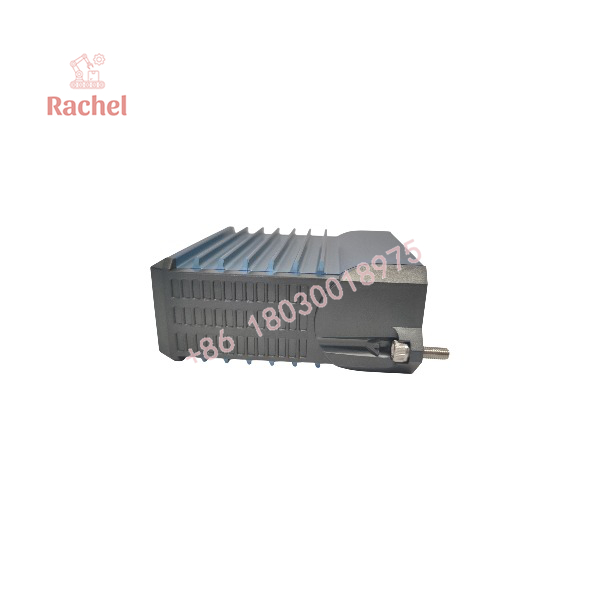
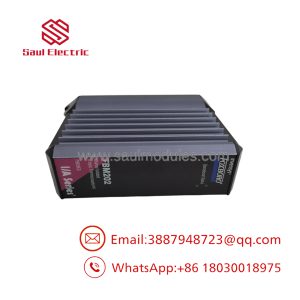
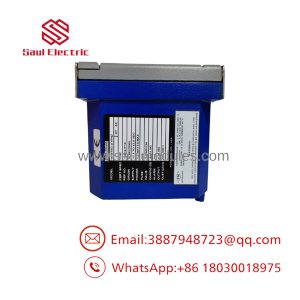
FBM207B P0914WH
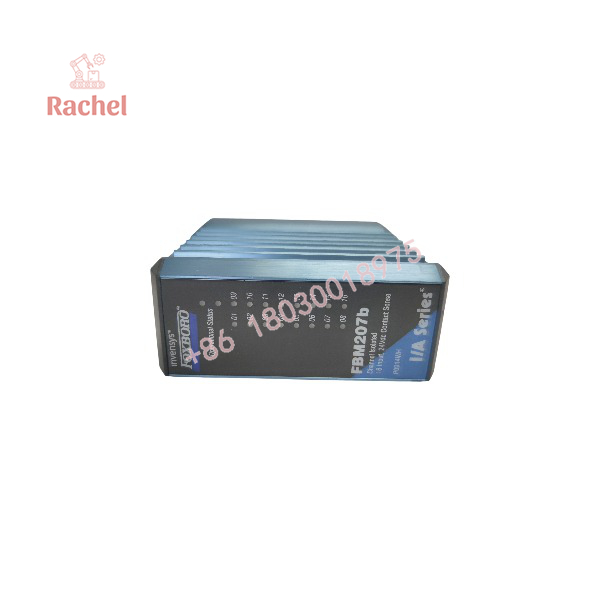
FBM207B P0914WH
System Compatibility and Integration Requirements
Before installing P0914WH, verify the following items against the existing control-system documentation.
DCS and communication architecture
- Confirm that the installed Foxboro system supports the FBM207b and its hardware revision.
- Verify the associated FCM or FCP and the applicable module Fieldbus configuration.
- Confirm the correct baseplate type, slot arrangement, and any required redundancy adapter.
- Check the system configuration and software definitions for the intended input channels.
Field signal requirements
- Use the FBM207b for compatible 24 VDC contact-sense circuits.
- Confirm the contact circuit’s electrical characteristics and the expected open/closed state.
- Do not assume that a module configured for contact sensing is interchangeable with a voltage-monitor module or a different contact-excitation variant.
- Verify input filtering and application logic where short-duration pulses or rapid state changes are important.
Termination hardware
The termination assembly is part of the field electrical interface, not merely a mechanical accessory. The manufacturer lists compatible termination arrangements for the FBM207b family, including the RH916XT compression-type assembly and P0917MJ ring-lug option in the applicable configuration. Confirm the exact part number, cable type, and certification requirements before ordering or wiring.
Redundancy
If the application requires redundant modules, verify the approved baseplate positions and redundant adapter arrangement in the Foxboro installation documentation. A redundant module installation must follow the designated adjacent-slot arrangement; the hardware should not be placed arbitrarily.
Dimensions, Mounting, and Connection Notes
Mechanical information
| Item | Specification |
|---|---|
| Module height | Approximately 102 mm |
| Height with mounting lugs | Approximately 114 mm |
| Module width | Approximately 45 mm |
| Module depth | Approximately 104 mm |
| Mounting method | Modular baseplate |
| Baseplate mounting options | DIN rail or supported 19-inch rack arrangement |
| Field wiring | Through the compatible termination assembly and termination cable |
The module and termination assembly are separate components. Confirm the space required for both, including cable routing, wiring access, and cabinet service clearance.
Installation considerations
- Verify the part number and module variant before removing or installing hardware.
- Follow the plant’s approved isolation, lockout, and electrical safety procedures.
- Confirm the baseplate slot, fieldbus connection, and any required redundant configuration.
- Check that the termination assembly and cable are approved for the FBM207b and the intended field circuits.
- Label field wiring clearly and verify the expected contact state before returning the loop to service.
- Apply power and perform channel-level functional checks in accordance with site commissioning procedures.
Do not connect a field circuit solely on the basis of the module’s isolation withstand rating. The field circuit must comply with the actual input and termination specifications.
Detailed Product Overview
How the FBM207b works
The FBM207b interfaces compatible field contacts with the Foxboro DCS input architecture. Its contact-sense circuitry provides 24 VDC contact excitation, allowing the module to distinguish between open and closed contact conditions within the specified electrical limits.
The module presents the resulting discrete states to the control system through the module Fieldbus. The associated FCM or FCP provides the communication path into the wider control architecture. Once acquired, the input states can be used by configured control logic, operator displays, alarms, interlocks, and event-processing functions.
Because each input channel is galvanically isolated from the other channels and ground, the module is designed to handle multiple independent field-contact circuits while limiting direct electrical interaction between them. Correct field wiring, suitable termination hardware, and compliance with the manufacturer’s electrical limits remain essential.
FBM207b versus related variants
| Model | Primary function | Contact or input interface |
|---|---|---|
| FBM207 | DC voltage-monitor input | Voltage-monitoring configuration; requires the appropriate termination arrangement |
| FBM207b — P0914WH | Contact-sense input | 24 VDC contact excitation |
| FBM207c — P0917GY | Contact-sense input | 48 VDC contact excitation |
These variants share the same general module family but are not interchangeable solely because their channel counts are similar. Select the module and termination assembly according to the actual field-circuit voltage and the control-system design.
Replacement and procurement checks
When sourcing P0914WH as a spare, verify the complete part number, physical condition, hardware identification, and any revision information available on the unit. Confirm whether the requirement is for the module alone or a complete assembly with the correct termination hardware and cable.
For a replacement in an operating DCS, also verify the existing module configuration and the intended field voltage. A matching model number is an important first check, but it does not replace a compatibility review of the installed baseplate, termination arrangement, controller configuration, and application logic.
Applications and System Role
The FBM207b is intended for discrete contact-state acquisition in compatible industrial control systems. Potential applications include:
- Equipment status monitoring: Acquire run, stopped, available, or fault-contact states from supported equipment interfaces.
- Valve and actuator feedback: Monitor limit-switch contacts indicating open or closed position.
- Interlock circuits: Bring compatible permissive and interlock contact states into the DCS.
- Motor control interfaces: Monitor auxiliary contacts and equipment status signals.
- Process skid integration: Collect discrete signals from packaged equipment using supported 24 VDC contact circuits.
- Alarm and event acquisition: Provide input states for control-system logic, alarms, and event handling where the configured system supports these functions.
The module acquires the electrical state of a contact circuit. The meaning of that state—such as an equipment fault, valve position, or process permissive—is determined by the field wiring, channel configuration, and control application.
Frequently Asked Questions
What is the FOXBORO FBM207B P0914WH?
It is a 16-channel contact-sense input Fieldbus Module for compatible Foxboro DCS installations. The FBM207b variant is designed for 24 VDC contact sensing.
How many inputs does the FBM207b provide?
It provides 16 independent discrete input channels.
What is the difference between FBM207 and FBM207b?
The FBM207 is the voltage-monitoring variant, while the FBM207b is designed for 24 VDC contact sensing. Their field interfaces and termination requirements differ, so confirm the exact application before substituting one for the other.
Can FBM207b replace FBM207c?
Not as a direct substitution without checking the field circuit. FBM207b uses 24 VDC contact excitation, while FBM207c is the 48 VDC contact-sense variant. The installed termination hardware and field voltage must be reviewed.
Does the FBM207b support input filtering?
The FBM207 family documentation specifies configurable filtering options of no filtering, 4 ms, 8 ms, 16 ms, or 32 ms where supported by the applicable module firmware and configuration. Confirm support in the installed system before relying on a particular setting.
Does P0914WH support redundant operation?
The FBM207 family supports redundant arrangements when the required hardware and system configuration are provided. Confirm the approved baseplate positions, adapter requirements, and controller configuration for the specific installation.
Which termination assembly should be used?
Use a termination assembly explicitly listed as compatible with the FBM207b P0914WH in the applicable Foxboro documentation. The required choice depends on the terminal style, cable arrangement, and installation requirements. Do not select a termination assembly based only on physical fit.
Does the module require calibration?
The manufacturer specifies that calibration of the module and termination assembly is not required. Commissioning should still include the functional checks required by the site’s maintenance and validation procedures.
What should be checked before installing a replacement?
Confirm the full model and part number, DCS compatibility, baseplate position, Fieldbus configuration, termination assembly, cable, field-circuit voltage, and channel configuration. After installation, verify that each relevant contact transition is correctly reflected in the control system.
Is FOXBORO FBM207B P0914WH suitable for every digital-input application?
No. It is specifically a 24 VDC contact-sense module. Applications using other voltage levels or different input interfaces require a suitable module and termination configuration verified against the manufacturer’s specifications.
Product identification: FOXBORO FBM207b P0914WH
Product type: 16-channel 24 VDC contact-sense input module
Primary selection criterion: Compatibility with the installed Foxboro DCS architecture and the actual field-contact circuit
Before ordering: Verify module revision, termination assembly, cable, and system configuration.

 Start Chat


