





Description
Product Introduction & Engineering Value
A common procurement mistake with legacy Foxboro hardware is treating the termination assembly part number and the FBM part number as interchangeable. P0916JQ is associated with the FBM206 eight-channel pulse-input configuration. It provides the field termination interface rather than performing the pulse-processing function itself.
That distinction becomes important during cabinet replacement. If the failed item is the field termination assembly, ordering an FBM206 electronics module alone will not solve the wiring problem. Conversely, if the FBM electronics are defective, replacing only P0916JQ will not restore the I/O channel.
Technical Specifications
| Parameter | Specification |
|---|---|
| Manufacturer | Foxboro |
| Part Number | P0916JQ |
| Associated FBM | FBM206 |
| System | Foxboro I/A Series 200 |
| Function | Pulse-input field termination |
| Number of Pulse Inputs | 8 |
| Input Signal | Pulse |
| Maximum Pulse Rate | Up to 25 kHz |
| Termination Type | Compression terminal assembly |
| Mounting | DIN rail |
| TA Certification Options | Type 1 / Type 2 configurations are documented |
| Modern Replacement Reference | RH916XM; P0917JQ is listed for a ring-lug configuration |
The Foxboro functional specification identifies P0916JQ with FBM206, eight pulse inputs, passive feedthrough, and FBM206 channel isolation. The same document states that RH916XM supersedes P0916JQ for the compression-terminal arrangement, while P0917JQ supersedes P0916PG for the ring-lug arrangement.
The documented P0916JQ dimensional drawing gives approximately 4.93 in. overall width, 3.13 in. maximum height, and 2.83 in. height above the DIN rail for the compression termination assembly.
Signal Application
The associated FBM206 accepts pulse signals from field devices such as vortex and turbine flow meters, solid-state or electromechanical contacts, and other pulse-output sensors. The processes up to eight pulse inputs and communicates the resulting values through the redundant 2 Mbps module fieldbus.
Field Application & the “Trench” Experience
Consider a flow-measurement cabinet in an older process unit. Eight turbine-meter signals terminate at an installation. During a maintenance inspection, one field termination point begins showing intermittent pulse-count errors. The engineering team initially suspects the transmitter because the DCS value periodically drops.
A loop check tells a different story. The sensor continues generating pulses, while movement at the termination wiring changes the measured behavior. The practical replacement is therefore the termination assembly, provided the existing configuration and termination arrangement are verified first.
That is the sort of failure where correct part identification saves hours.
Specific applications
- Turbine flow-meter pulse acquisition in utility and process measurement systems.
- Vortex flow measurement where the field instrument supplies a pulse output.
- Rotating-equipment speed measurement, including tachometer-type pulse signals.
- Legacy I/A Series 200 pulse-input cabinets undergoing maintenance or selective hardware replacement.
The documentation specifically describes high-speed pulse acquisition and applications involving rotational-speed measurement and flow meters.
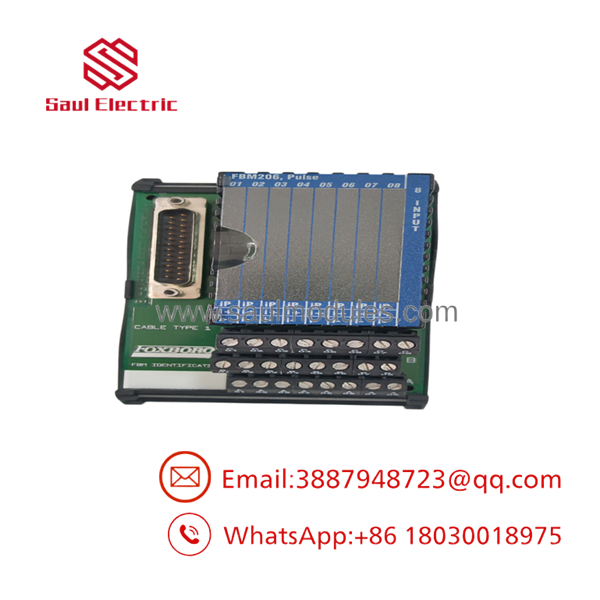
P0916JQ
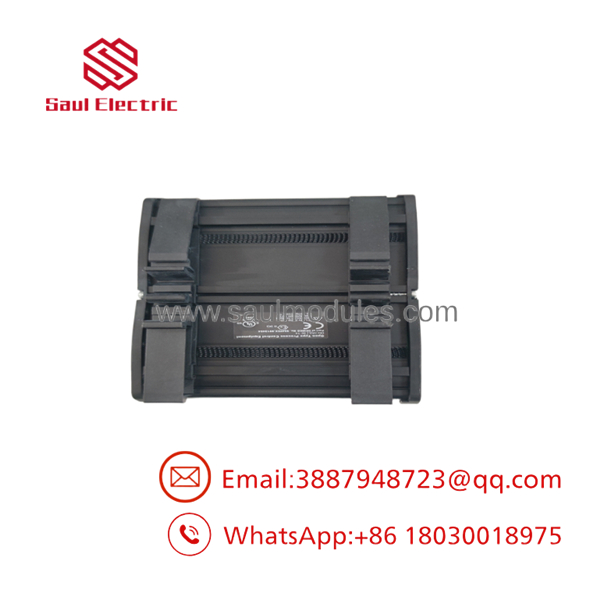
P0916JQ
Transparency SOP: QA & Testing
For new-surplus inventory, inspection should begin with the physical hardware, not the seller’s product title.
- Part-number verification — confirm the assembly is physically marked or otherwise traceable as .
- Terminal inspection — check compression terminals for deformation, corrosion, contamination, or damaged hardware.
- Mechanical inspection — inspect the DIN-rail mounting mechanism and enclosure for cracks or distortion.
- Connector inspection — verify the termination-cable interface is clean and mechanically intact.
- Configuration verification — confirm that the intended installation uses an eight-channel pulse-input configuration.
- Documentation comparison — compare the assembly against the applicable Foxboro drawing and revision before installation.
For refurbished stock, additional electrical continuity and interface testing should be documented before shipment.
Important: do not describe a termination assembly as the processor/electronics module. They are related components with different functions.
The Veteran’s Tech Trap Guide
⚠️ Trap #1 — Confusing with
This is the biggest one. is the I/O module; is its associated termination assembly. Foxboro documentation explicitly pairs the two.
⚠️ Trap #2 — Ignoring the successor part number
If you are maintaining an existing installation, don’t automatically assume that every modern replacement must carry the same number. Foxboro documentation states that RH916XM supersedes for the applicable compression-terminal arrangement.
PRO TIP: When replacing legacy hardware, record both the installed part number and termination style. A part-number-only comparison can miss an important compression-terminal versus ring-lug distinction.
⚠️ Trap #3 — Treating pulse inputs like ordinary discrete inputs
An pulse channel is intended for pulse measurement, including high-speed signals. The documented supports pulse rates up to 25 kHz. Don’t substitute a conventional contact-input termination arrangement simply because the field device uses a two-wire connection.
Dynamic FAQ
Is the same thing as an ?
No. is the termination assembly associated with . The is the I/O module that processes the eight pulse-input channels.
How many pulse channels are supported?
The / arrangement is documented for eight pulse inputs. The can accept pulse signals at rates up to approximately 25 kHz.
What type of field devices can be connected?
Typical applications include turbine flow meters, vortex meters, tachometers, solid-state contacts, electromechanical contacts, and other pulse-producing devices.
Can still be used in an existing Foxboro I/A Series installation?
It can be appropriate for an existing compatible installation, but the exact cabinet configuration and hardware revision should be checked. Foxboro’s newer documentation identifies RH916XM as superseding for the applicable compression-terminal configuration.
Is a good candidate for legacy-system spare inventory?
Yes, particularly when the installed plant still uses hardware and the existing termination assemblies are . For a critical process, however, inventory planning should account for the documented successor hardware rather than relying indefinitely on an obsolete part number.
What should I verify when purchasing New Surplus ?
Verify part number, physical condition, termination type, packaging/traceability, compatibility with , and warranty terms. New-surplus status should be supported by inspection and traceability rather than assumed solely from an online listing.

 Start Chat


