





Description
Product Introduction
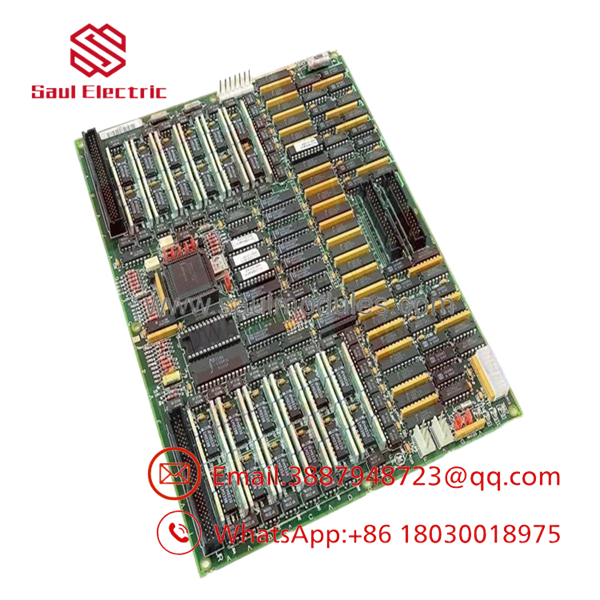
The GE DS200TCDAG2BBA is a high-density Digital I/O Processor Board (TCDA) designed specifically for GE Speedtronic Mark V turbine control systems. Operating within the main processor cores (<R>, <S>, and <T>) or expansion cores (<C>), it acts as the primary digital interface between field contact devices and the central Mark V architecture.
Unlike analog signal cards that handle variable voltages or 4-20mA loops, the TCDA board conditions, filters, and processes discrete binary signals—such as trip contacts, limit switches, pressure switches, and breaker status feedbacks. Driven by high-speed onboard logic, the board handles opto-isolation and digital state decoding before passing clean binary data across the 3PL backplane to the Stage One processor for real-time turbine protection and sequence execution.
Key Technical Specifications
| Parameter | Specification / Value |
| Manufacturer | General Electric (GE) |
| System Architecture | Speedtronic Mark V Gas/Steam Turbine Control |
| Board Functional Acronym | TCDA (Digital I/O Processor Board) |
| Digital Contact Capacity | Up to 128 discrete contact inputs / relay output drivers |
| Isolation Architecture | Onboard optocouplers for noise suppression and channel isolation |
| Primary Interfaces | Multiple 50-pin ribbon headers (JCA, JCB, JCC, JCD) & 3PL backplane connector |
| Hardware Configuration | Onboard DIP switches and BERG jumpers for contact debounce & power routing |
| Diagnostic Indication | Edge-mounted status LEDs (Power, Communications, Board Fault) |
| Firmware Execution | Socketed EPROM/PROM chips carrying core execution code |
| Physical Dimensions | Standard Mark V full-size PCB (~21.2 cm x 15 cm) |
Application Scenarios & The “Trench” Experience
The Trench Story
It’s 1:30 AM during a peak summer heatwave. A 7FA gas turbine unexpectedly trips on an unverified “Low Lube Oil Pressure” fault. Upon inspecting the control cabinet, the field tech finds that half the digital status LEDs on the Mark V <R> core are flicking erratically—optocouplers on the old TCDA board failed due to years of continuous ambient heat, injecting false contact bounces into the trip matrix. The OEM lead time for a replacement card is weeks. Swapping in a pre-tested DS200TCDAG2BBA board from emergency surplus clears the false trips, stabilizes the contact inputs, and gets the unit back online before morning demand ramps up.
Industrial Applications
- Gas Turbine Trip Matrices: Monitoring mechanical safety switches, flame detector status, and emergency stop pushbuttons on GE Frame 6, 7, and 9 units.
- Steam Turbine Valve Logic: Processing discrete limit switch feedbacks from main stop, control, and intercept valves.
- Balance of Plant (BOP) Monitoring: Handling high-density contact alarm inputs from auxiliary pumps, oil skids, and transformer trip relays.
- Combined-Cycle Synchronizers: Reading generator breaker auxiliary contacts for precise breaker close command timing.
DS200TCDAG2BBA
Transparency SOP: Quality Assurance & Testing
We don’t just pull legacy boards out of a warehouse box and throw them into a crate; we validate them on live GE Mark V rack setups.
- Inbound Physical Inspection: Complete visual audit under magnification. Inspection for trace corrosion, bulging electrolytic capacitors, damaged ribbon pins, and verification of genuine OEM solder profiles.
- Anti-Static ESD Cleaning: Ultrasonic aqueous bath to remove industrial carbon dust and airborne oil film, followed by thermal drying.
- Optocoupler & Isolation Checks: Individual channel testing across input optocouplers to ensure strict signal isolation and zero cross-talk between high-density contact channels.
- Live Mark V Core Testing: Board installation into a live Speedtronic Mark V test rig (
<R>,<S>, or<T>core). Verification of green LED self-test, boot cycle, and communication via the 3PL backplane connector. - Digital Signal Injection: Toggling digital inputs and relay driver outputs across all channels to verify real-time state changes and debounce filter timing.
- Firmware Version Logging & Anti-Static Packaging: Documenting all socketed EPROM revision tags before vacuum-sealing the board in anti-static ESD shielding.
The Veteran’s Tech Trap Guide (Crucial Value-Add)
⚠️ 1. The Revision Suffix Trap (G2BBA)
The G2BBA suffix denotes specific functional circuit revisions over older G1 or G2A variants. Installing a lower-revision card into a system engineered for a G2BBA can result in missing contact debounce filters or mismatched jumper maps.
Fix: Always verify the exact full part number—including revision letters—on both the board’s white silk screen and the barcode sticker before installing.
❗ 2. Moving the Socketed EPROMs
The DS200TCDAG2BBA relies on socketed PROM chips to store site-specific hardware definitions and firmware parameters. If you install a replacement board without transferring these PROMs, the Mark V HMI will throw a major I/O configuration mismatch fault upon boot.
Fix: Use an IC extractor tool to carefully move the original socketed EPROMs from your failed card to the replacement card. Make sure the notch on the IC chip aligns correctly with the socket notch—inserting it backward will permanently fry the chip upon power-up.
⚠️ 3. Ribbon Cable Alignment & Pin Bending
The 50-pin ribbon cable headers (JCA, JCB, JCC, etc.) on vintage Mark V boards become brittle over time. Off-angle insertion can easily push a pin out of alignment or bend it flat against the header base without tripping a visible mechanical fault.
Fix: Inspect all pin arrays with a flashlight before connecting cables. Seat ribbon connectors straight down with even thumb pressure on both ends of the housing.
Frequently Asked Questions (FAQ)
Q: Can I hot-swap the DS200TCDAG2BBA card while the Mark V panel is running?
A: No. Pulling a digital processor card live disrupts the 3PL backplane, breaks contact sensing loops, and will instantly trigger a system trip or drop a control core offline. Always de-energize the specific core power supply before pulling or inserting the card.
Q: What is the main functional difference between a TCDA and a TCDA-derived extension board?
A: The TCDA (DS200TCDAG2BBA) acts as the primary digital processor board in the main core, handling the high-speed opto-isolation and digital bus routing. Extension boards (like the TCDTB terminal boards) serve primarily as field wiring termination points without onboard microprocessor capabilities.
Q: What does the ‘BBA’ suffix at the end of the part number mean?
A: In GE Mark V nomenclature, G2 specifies the artwork group, while the trailing letters BBA represent functional artwork revisions. BBA indicates a multi-revision board that includes updated noise suppression, updated ground trace layouts, and component upgrades implemented late in the Mark V product lifecycle.
Q: How do I verify the board is receiving power and communicating properly once installed?
A: Watch the edge-mounted diagnostic LEDs upon powering up the core. The status LED should go through a brief flash sequence during boot-up diagnostics and settle into a solid green state, confirming that the onboard logic has passed self-tests and synchronized with the Stage One processor.
Q: What warranty is supplied with your surplus and refurbished stock?
A: Every DS200TCDAG2BBA module shipped carries a full 12-month replacement warranty. If a board fails under normal operating conditions within one year of installation, we replace it immediately from our stock.

 Start Chat


