





Description
Product Introduction
The GE DS3800HSCA (HSCA) is a dedicated High-Speed Signal Conditioning Board engineered for GE Speedtronic Mark IV turbine control panels and high-performance DC2000 drive enclosures. Positioned inside the main control card cage, the HSCA board acts as the primary hardware interface for rapid analog field signals—such as pulse tachometer inputs, motor speed feedback, and dynamic current measurements—that require real-time conditioning before reaching the central processor.
Equipped with low-noise operational amplifiers, high-bandwidth active filters, and onboard scaling networks, the HSCA filters out electromagnetic interference (EMI) and high-frequency switching noise common in heavy industrial environments. By stabilizing transient input signals hardware-side, it ensures precise, delay-free feedback loops for critical velocity and load control functions.
Key Technical Specifications
| Parameter | Specification |
| Manufacturer | General Electric (GE) |
| Part Number | DS3800HSCA (e.g., DS3800HSCA1E1C, DS3800HSCA1D1D) |
| Functional Acronym | HSCA |
| System Compatibility | GE Speedtronic Mark IV / DC2000 Drive Cabinets |
| Primary Function | High-Speed Analog Signal Conditioning & Speed Feedback Scaling |
| Circuit Topology | High-speed op-amp buffers, precision voltage dividers, dynamic noise filtering |
| Interconnects | Gold-plated card-edge connector fingers + front/top pin header terminals |
| Diagnostic Features | Integrated board-edge test points for real-time oscilloscope waveform monitoring |
| Configuration | Onboard hardware jumper arrays for signal attenuation & filter tuning |
| Operating Temperature | 0°C to 60°C (32°F to 140°F) |
Application Scenarios & The “Trench” Experience
Picture this: It’s 1:45 AM during peak load shift. A combined-cycle power plant’s gas turbine experiences a sudden “Speed Feedback Mismatch” alarm, causing the governor to hunt erratically. The site tech hooks an oscilloscope to the speed channel and finds severe high-frequency noise riding on the tachometer signal. A degraded active filter capacitor on the aging HSCA board stopped smoothing the pulse train, causing the digital controller to read false speed fluctuations.
- Legacy Power Generation – Speedtronic Mark IV Gas & Steam Turbine Cabinets – Conditions high-frequency turbine speed pickup signals and valve position feedback loops.
- Heavy Industry Metals & Paper Mills – GE DC2000 Rolling Mill Drives – Processes high-speed motor tachometer inputs and dynamic armature current signals for tight speed regulation.
- Chemical Processing Facilities – Industrial Control Racks – Buffers high-speed process feedback variables against heavy industrial electrical noise.
Field Case Study: A steel rolling mill experienced sudden drive trips during rapid motor acceleration. Isolating the issue revealed signal attenuation on the secondary speed feedback channel. Swapping in a bench-tested DS3800HSCA surplus card restored clean pulse-waveform amplitude across the rack backplane, bringing the drive back online and preventing tens of thousands in lost production time.
Transparency SOP: Quality Assurance & Testing
We understand that an unverified signal conditioning board can introduce phantom control oscillations into a critical loop. Every DS3800HSCA follows a strict 5-step bench testing process before shipping:
- Inbound Micro-Inspection: High-magnification optical audit checking for trace oxidation, thermal stress discoloration around op-amps, cold solder joints, and gold edge-finger wear.
- Dielectric & Power Check: Resistance and isolation checks between primary power supply rails (+5V, ±15V) and signal ground to rule out shorted ceramic capacitors.
- Live Test-Rig Power-Up: Board is seated in a powered GE Mark IV test frame to confirm logic supply distribution and baseline voltage bias across all channels.
- Frequency & Linearity Stress Test: Function generators inject high-frequency pulse trains and dynamic analog sweeps across every channel while measuring output linearity, signal attenuation, and frequency response on an oscilloscope over 12 hours.
- Anti-Static Sealing & Protective Packaging: Board is cleaned, fitted with edge covers, vacuum-sealed in an ESD shielding bag, and packed inside custom impact-resistant foam.
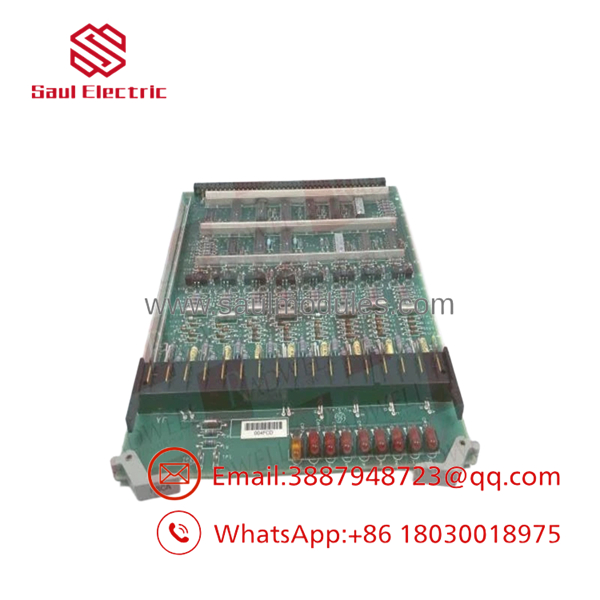
DS3800HSCA
The Veteran’s Tech Trap Guide (Crucial Value-Add)
⚠️ 1. Match Hardware Gain Jumpers: The HSCA card utilizes onboard jumper blocks to configure attenuation ratios and gain multipliers for different encoder/tachometer voltage levels. Take a clear photograph of your original board’s jumper settings and match every block on the replacement unit prior to power-up!
❗ 2. Clean Gold Edge Fingers Safely: Decades of panel service leave an oxide film on card-edge connectors. Never use abrasive sandpaper or wire brushes—they strip the gold plating down to raw copper. Clean edge fingers using a lint-free swab with high-purity isopropyl alcohol or a rubber contact cleaner pad.
⚠️ 3. Use Onboard Test Points for Diagnostics: The board features exposed test points along the card edge. Use these points with a handheld oscilloscope to verify incoming signal integrity and output scaling without unseating the board or interrupting active rack backplane communications.
❗ 4. Always Power Down Before Unseating: Never hot-swap the DS3800HSCA board. Removing or inserting this board while the rack backplane is energized breaks active feedback loops, which can trigger emergency system trips or cause arc-flash damage to edge connector pins.
Frequently Asked Questions (FAQ for Conversion)
Q: Is the GE DS3800HSCA hot-swappable?
A: No. Hot-swapping the HSCA board severs live speed/signal feedback lines, causing backplane voltage surges and immediate control trips. Always lock out panel power before replacing the module.
Q: What do the revision suffixes (e.g., 1E1C or 1D1D) indicate?
A: Suffixes represent factory artwork, trace layout, and component revisions implemented by GE during production. A higher-revision board is backward-compatible with earlier revisions, provided hardware jumper arrays are set identically.
Q: Does this board require software downloading or programming?
A: No. The HSCA operates strictly at the analog/hardware layer. All configuration is handled through physical onboard jumpers and hardware signal scaling—no software loading is required.
Q: Are these units brand new OEM directly from GE?
A: GE discontinued the DS3800 series years ago. Our available stock consists of New Surplus (unused OEM factory spares) and Refurbished / Bench-Tested cards sourced from clean, decommissioned industrial facilities globally.
Q: What warranty coverage do you provide on legacy cards?
A: Every comes backed by our full 12-month operational replacement warranty. If any functional or signal-conditioning fault occurs under normal operating conditions within one year, we will provide an advance replacement unit or issue a full credit.

 Start Chat


