





Description
Product Introduction & Engineering Value
Some automation projects demand more than standard PLC logic. Integrating barcode scanners, industrial scales, serial printers, or legacy RTUs can quickly consume CPU resources and complicate application development.
The GE IC693PCM301 is a Programmable Coprocessor Module (PCM) for the Series 90-30 PLC platform. It operates as an independent microcomputer, allowing custom communication routines and application logic to run alongside the PLC without increasing the CPU scan time. With support for MegaBasic, C programming, Modbus RTU, and GE Fanuc CCM, it provides a practical solution for advanced serial communication and protocol conversion tasks.
Technical Specifications
| Parameter | Specification |
|---|---|
| Manufacturer | GE Fanuc (Emerson) |
| Model | IC693PCM301 |
| Product Family | Series 90-30 |
| Module Type | Programmable Coprocessor Module (PCM) |
| Total Memory | 192 KB |
| MegaBasic User Memory | 47 KB |
| Programming Languages | MegaBasic, C |
| Supported Protocols | Modbus RTU, GE Fanuc CCM |
| Serial Interfaces | Two serial ports via common front connector |
| Memory Backup | Lithium battery-backed RAM |
| Replacement Battery | IC693ACC301 |
| Internal Power Consumption | 425 mA @ 5 VDC |
| Operating Modes | RUN and PROGRAM |
| LED Indicators | OK, US1, US2 |
| Restart Control | Front-panel Restart Pushbutton |
| Installation Location | Any slot in the main CPU baseplate except Slot 1 |
| Expansion Rack Support | Not supported |
| Embedded CPU Compatibility | Not compatible with CPU311, CPU313, or CPU323 embedded CPU racks |
| Operating Temperature | 0°C to 60°C (32°F to 140°F) |
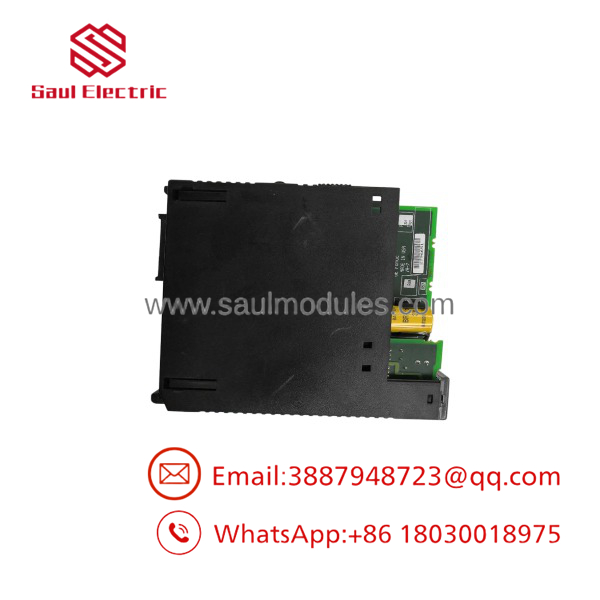
IC693PCM301
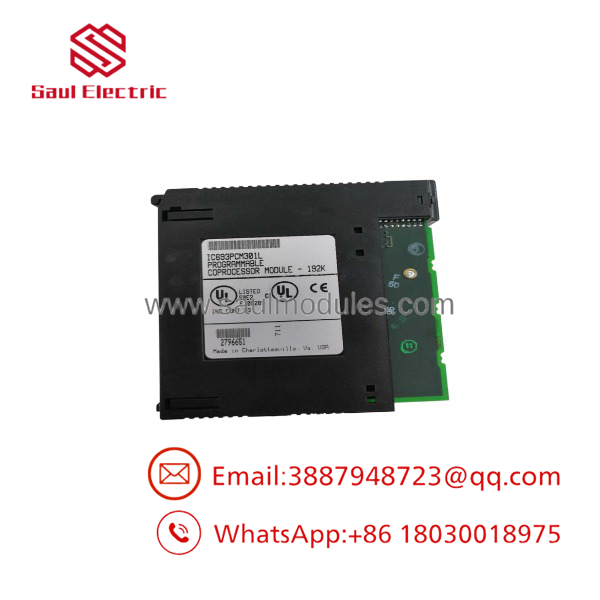
IC693PCM301
Field Application & The “Trench” Experience
A warehouse automation system needed to collect barcode data from multiple packaging stations while simultaneously exchanging information with an older Modbus RTU weighing system. The existing Series 90-30 CPU was already approaching its available scan time, making additional communication logic undesirable.
Rather than replacing the controller, engineers installed an IC693PCM301. Custom MegaBasic routines handled serial communications independently, forwarding processed data back to the PLC only when required. The result was a stable control system that supported legacy devices without affecting machine cycle time.
Typical applications include:
- Barcode scanner integration for automated packaging lines
- Industrial weighing systems using Modbus RTU serial communications
- Legacy RTU data collection and protocol conversion in utility control systems
Transparency SOP: QA & Testing
Before shipment, every IC693PCM301 completes a documented inspection and operational validation process.
- Confirm catalog number, hardware revision, and firmware identification.
- Inspect PCB assemblies, serial connector, battery compartment, and backplane contacts.
- Install the module in a Series 90-30 CPU baseplate.
- Verify RUN and PROGRAM operating modes.
- Test both serial communication ports using Modbus RTU and GE Fanuc CCM diagnostics.
- Validate battery-backed memory retention and restart functionality.
- Perform repeated cold-start and warm-start tests before ESD-safe packaging.
New Surplus modules are inspected to verify unused OEM condition. Refurbished modules undergo additional communication, memory, and burn-in testing prior to shipment.
The Veteran’s Tech Trap Guide
⚠️ It Doesn’t Work in Expansion Racks
The IC693PCM301 must be installed in the main CPU baseplate. It is not supported in expansion racks, remote racks, or embedded CPU systems such as the CPU311, CPU313, and CPU323.
⚠️ Don’t Forget the Battery
Application memory depends on the internal lithium battery. If the battery is disconnected or depleted during storage, RAM-resident programs may be lost. Check battery condition whenever installing a replacement module.
PRO TIP: Back up both the PLC application and the PCM program separately. Replacing the coprocessor without restoring its MegaBasic or C application often results in communication failures even though the PLC itself starts normally.
⚠️ Plan the Serial Wiring
Both communication channels are accessed through a single front-panel connector using the IC693CBL305 Wye cable. Installing the wrong cable or omitting the breakout assembly is a common commissioning mistake.
Dynamic FAQ
Q1. What is the purpose of the IC693PCM301?
The functions as an independent programmable coprocessor that executes custom communication and processing tasks while working alongside a Series 90-30 PLC CPU.
Q2. Which communication protocols does the module support?
It supports Modbus RTU and GE Fanuc CCM, making it suitable for connecting serial devices such as barcode readers, printers, industrial scales, operator terminals, and RTU equipment.
Q3. Which programming languages are available?
The module supports both MegaBasic and C, allowing engineers to develop custom communication drivers and application-specific routines.
Q4. Can the be installed in any Series 90-30 rack?
No. It must be installed in the main CPU baseplate and cannot operate in expansion racks, remote racks, or embedded CPU racks using CPU311, CPU313, or CPU323 controllers.
Q5. How is application memory protected during power loss?
The module uses a lithium battery to retain RAM contents. Regular battery inspection is recommended, particularly for systems that experience extended shutdowns.
Q6. How are New Surplus and Refurbished modules verified?
Every module undergoes model verification, connector inspection, dual-port communication testing, battery-backed memory validation, restart testing, LED diagnostics, and repeated power-cycle verification. Refurbished units also complete extended operational burn-in before shipment.

 Start Chat


