





Description
Key Technical Specifications
| Parameter | Specification / Value |
| Form Factor | 6U Eurocard (VMEbus compliant, standard height/depth) |
| Microprocessor | Intel Pentium III (850 MHz) with 256 KB on-die L2 Advanced Transfer Cache |
| System Memory | Accepts 1x 144-pin SDRAM SODIMM (supports up to 512 MB, dual-ported to VMEbus) |
| VMEbus Interface | Universe IIB PCI-to-VME bridge; supports A32/A24/D32/D16/D08(EO)/MBLT64 |
| Ethernet Controllers | Dual Intel 82559 Ethernet controllers (10BaseT / 100BaseTX via dual RJ45) |
| On-Board Storage Interface | Supports up to 192 MB IDE CompactFlash (optional) and IDE Hard Drive / Floppy via P2 |
| Graphics Controller | Chips & Technology AGP SVGA controller with 4 MB SDRAM |
| Expansion Sites | One PMC (PCI Mezzanine Card) expansion site with VMEbus P2 I/O routing |
| Nonvolatile Memory | 32 KB of NVRAM (retains data during power outages) |
| Front Panel Ports | 1x USB 1.1, 2x Micro-DB9 Serial, 1x PS/2 Keyboard/Mouse, 1x SVGA DB15, 2x RJ45 |
| Watchdog Timer | Software-programmable watchdog with automatic system reset capability |
Product Introduction
The GE Fanuc VMIVME-7740-840 (350-07740-840-M) is an industrial-grade, 6U VMEbus Single Board Computer (SBC) designed for real-time legacy computing, data processing, and hardware-in-the-loop simulation. Featuring an 850 MHz Intel Pentium III processor, this single-slot CPU operates as a standard PC/AT platform capable of executing power-on self-tests and booting operating systems like Windows NT, VxWorks, or Linux, while acting as a high-speed VMEbus controller.
Equipped with a Universe IIB PCI-to-VME bridge and hardware-based byte swapping, the VMIVME-7740-840 bridges the gap between little-endian Intel x86 structures and big-endian VMEbus targets without software latency penalties. Control engineers select this module for infrastructure installations, maritime control rigs, and complex aerospace testbeds requiring integrated PMC expandability, stable dual Fast Ethernet routing, and robust hardware watchdog safety loops.
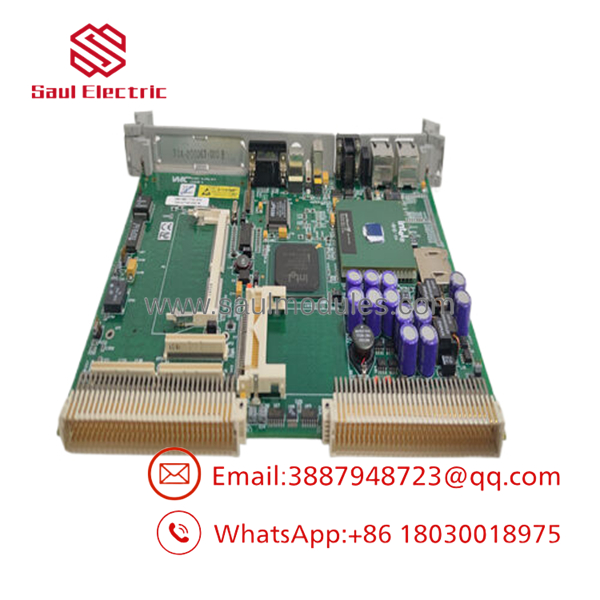
- VMIVME-7740-840 350-07740-840-M
Troubleshooting Quick Reference
| Symptom | Possible Cause | Relevance to this Part | Quick Check Method | Recommendation |
| Front panel SYSFAIL LED remains red after power-up | BIOS boot failure, corrupt NVRAM, or RAM SODIMM contact oxidation | ✅ High | Remove power, extract the card, and reseat the 144-pin SDRAM SODIMM module. Check for dust in the socket. | Clean socket contacts with an ESD-safe brush and isopropyl alcohol. If SYSFAIL persists, swap the SODIMM with a tested PC100/PC133 module. |
| The card powers up but does not output a VGA video signal | Improper BIOS configuration or flat RTC/NVRAM backup battery | ✅ High | Check the onboard lithium coin battery voltage using a multimeter. It should read >3.0 VDC. | If the battery is below 2.8 V, replace it. A dead battery clears BIOS settings, often forcing the display output to redirect from the front panel. |
| System lockups under high CPU utilization or temperature | Thermal throttling due to degraded heat-sink compound or poor chassis airflow | ✅ High | Measure the physical temperature of the CPU passive aluminum heat sink using an infrared thermometer. | Ensure the VME rack fan tray is blowing a minimum of 200 LFM of air across the card. If running hot, clean and re-apply thermal paste under the heat sink. |
| VMEbus transfer timeouts (Bus Errors) when addressing peripheral cards | Universe IIB bridge register configuration mismatch or master/slave byte-swapping configuration errors | ✅ High | Verify that your OS driver has initialized the Universe IIB PCI-to-VME mapping registers to match the slave target’s address space. | Review your software’s endian configuration settings. Use the board’s built-in patent-protected byte-swapping hardware registers if communication with 680×0 cards is failing. |
Note: If the card fails to post to the BIOS screen or encounters persistent hardware interrupts, extract the board, take high-resolution photos of the solder side and jumpers, and contact our engineering support desk with your system terminal log.
Frequently Asked Questions (FAQ)
Q: Can this board boot a modern operating system like Windows 10 or 11?
A: No, the VMIVME-7740-840 is a legacy x86 architecture utilizing an 850 MHz Pentium III processor and a maximum of 512 MB of SDRAM. It lacks the hardware instructions, UEFI support, and physical memory space required by modern operating systems. It is optimized for, and should only be run on, legacy platforms such as Windows NT 4.0, Windows 2000, MS-DOS, VxWorks, or lightweight real-time Linux kernels.
Q: Do I need a special cable to use the serial ports on the front panel?
A: Yes, you cannot plug a standard DB9 serial cable directly into this card. To save front panel real estate, the VMIVME-7740-840 utilizes two micro-DB9 female ports. Interfacing with these ports requires a specialized micro-DB9 to standard DB9 male adapter cable (GE/VMIC part number 360-010050-001 or equivalent). Attempting to force standard connectors will damage the physical pin matrix.
Q: How does the byte-swapping hardware work, and why do I need it?
A: The Pentium III processor natively reads and writes data in “little-endian” format (least significant byte first), whereas most legacy VMEbus modules (like Motorola 680×0 series boards) expect “big-endian” format (most significant byte first). To prevent you from having to write CPU-intensive bit-shifting code, this board incorporates a hardware-level byte-swapping ASIC (Patent No. 6,032,212). It automatically flips the bytes on the fly during PCI-to-VME transactions, protecting real-time loop cycles from software processing lag.
Q: Can I use any standard off-the-shelf 144-pin SODIMM memory module to upgrade the RAM?
A: To be honest, you shouldn’t try it. While the board physically accepts standard 144-pin SDRAM SODIMMs, the on-board chipset is highly sensitive to memory timing, latency, and page organization parameters (PC100/PC133 standards). Using generic retail-grade memory modules often leads to intermittent blue screens, boot loops, or immediate SYSFAIL faults. Always use memory verified to meet the exact industrial-grade dual-port timing requirements specified in the VMIC manual.
Q: What is your physical diagnostic process for testing these legacy boards before they ship?
A: We do not rely on a simple “it turns on” check. Each VMIVME-7740-840 is subjected to a rigorous validation run: we load the board onto our in-house VME chassis, populate the RAM socket to its maximum 512 MB capacity, and install a bootable CompactFlash drive. We boot the system into an interactive test utility to verify the integrity of the Universe IIB bridge, run memory read/write stress sweeps, loop-back test both Fast Ethernet ports, and verify that the AGP graphics adapter renders clean video without artifacting. The unit is only approved for anti-static packaging after surviving a continuous 12-hour burn-in diagnostic without dropping a register.

 Start Chat


