





Description
Product Introduction & Engineering Value
Kawasaki PC2-6400S-555 is an industrial computer memory module rather than a conventional Kawasaki I/O or controller PCB. Its identification points to DDR2-800 SO-DIMM memory, with the “555” designation commonly associated with CL5 timing. For a legacy Kawasaki controller, memory compatibility is determined by more than capacity alone.
The critical checks are physical form factor, memory technology, module capacity, voltage, rank organization, and supported timing. A DDR2 module can fit mechanically while still being unsuitable for the controller.
Technical Specifications
| Parameter | Specification |
|---|---|
| Manufacturer / System Brand | Kawasaki |
| Model | PC2-6400S-555 |
| Memory Type | DDR2 SDRAM |
| Module Type | SO-DIMM |
| Form Factor | 200-pin |
| Memory Speed | DDR2-800 / PC2-6400 |
| Data Rate | 800 MT/s |
| Timing Designation | 555 / CL5-class timing |
| Operating Voltage | Typically 1.8 V |
| ECC | Not confirmed from the model designation alone |
| Registered / Buffered | Not expected for a standard SO-DIMM; verify actual module |
| Capacity | Must be confirmed from the physical module label |
| Application | Kawasaki industrial computer/controller |
| Compatibility | Controller/system dependent |
Procurement warning
Do not specify a memory capacity from PC2-6400S-555 alone. The model identifies the memory technology/speed/timing family, but the actual module capacity should be read from the module label.
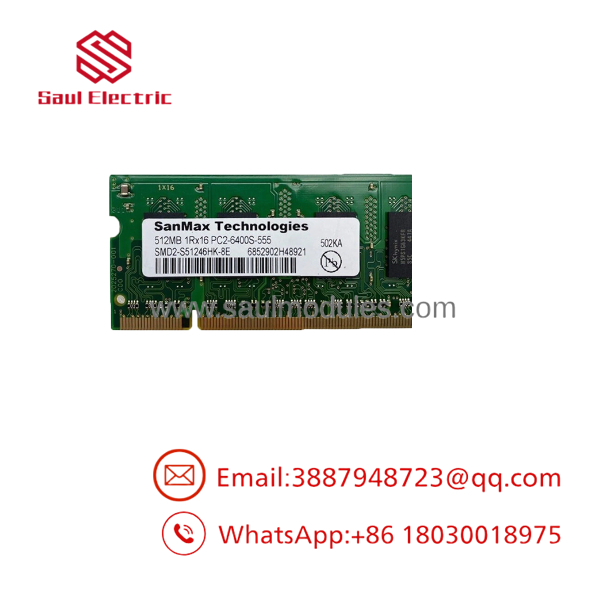
PC2-6400S-555
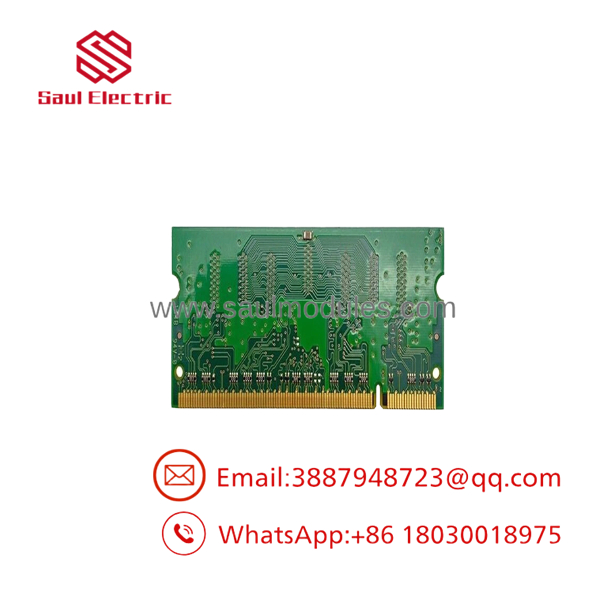
PC2-6400S-555
Field Application & the “Trench” Experience
A legacy Kawasaki controller begins throwing intermittent startup or memory-related faults. The maintenance technician discovers that the system uses a small-form-factor DDR2 module marked PC2-6400S-555.
The obvious replacement is another DDR2-800 SO-DIMM.
That can still be wrong.
Industrial systems can be selective about memory density, rank organization, maximum supported capacity, and module construction. Two 200-pin SO-DIMMs may fit the same socket but behave differently during POST or controller initialization.
The old module is evidence. The controller documentation is authority.
Niche application scenarios
- Legacy Kawasaki robot controller computer: replacement of degraded system memory.
- Industrial HMI/controller PC: restoring boot reliability on aging embedded computer hardware.
- Robot-cell controller refurbishment: replacing obsolete SO-DIMM memory while preserving the existing control computer.
- Semiconductor/precision automation equipment: maintenance of older embedded computing platforms using memory.
Transparency SOP: QA & Testing
For New Surplus or Refurbished PC2-6400S-555, use this memory-specific QA procedure:
- Label verification — Confirm
PC2-6400S-555. - Physical inspection — Check the PCB, contacts, notches, and memory packages.
- Capacity verification — Confirm the actual installed capacity from the module label and system BIOS/diagnostics.
- SPD verification — Read the module’s SPD data where test equipment permits.
- Memory test — Run a full memory diagnostic rather than relying on successful POST.
- Thermal observation — Check for abnormal module heating during extended operation.
- Controller test — Install in the applicable Kawasaki system where practical.
- Cold-start test — Verify repeated power-up behavior.
- Extended test — Run the controller for an appropriate burn-in period.
- QA documentation — Record capacity, SPD characteristics, test results, and warranty.
For memory, intermittent faults are the enemy. A module that boots once has not necessarily passed a meaningful production test.
The Veteran’s Tech Trap Guide
⚠️ Trap #1 — Assuming PC2-6400 means any -800 module will work
Not necessarily.
Check capacity, rank structure, density, voltage, and SPD programming against the Kawasaki computer.
PRO TIP: Keep the original memory module until the replacement has completed an extended system test.
⚠️ Trap #2 — Confusing SO-DIMM with desktop DIMM
The “S” in PC2-6400S indicates the SO-DIMM family. Do not substitute a standard 240-pin desktop DIMM simply because it is also labeled PC2-6400.
⚠️ Trap #3 — Assuming “555” means the complete timing specification
The model designation suggests CL5-class timing, but the complete SPD profile should be checked on the actual module.
⚠️ Trap #4 — Replacing memory without checking existing capacity
If the original Kawasaki system uses a specific memory density or capacity, replacing it with a higher-capacity module can create compatibility problems even when the speed rating is identical.
Dynamic FAQ
What is Kawasaki ?
It is a SO-DIMM memory module designation used in Kawasaki industrial computing/control equipment.
What does PC2-6400 mean?
PC2-6400 identifies memory with an effective data rate of approximately 800 MT/s.
What does the “S” mean?
The S identifies the SO-DIMM form factor, commonly used in compact industrial computers and embedded systems.
Is 800 MHz memory?
It is normally classified as DDR2-800 / PC2-6400. DDR memory’s commonly quoted “800 MHz” terminology refers to the effective data-transfer rate; technically, the memory clock is lower.
What capacity is this Kawasaki memory module?
The designation alone does not establish the module capacity. Verify the capacity from the actual module label or system documentation before purchasing.
Can I use another -800 SO-DIMM?
Only after checking the Kawasaki controller’s memory requirements. Verify capacity, rank/density, voltage, SPD, and supported memory configuration.
Is New Surplus available?
New-surplus status must be established from the actual supplier and unit. Ask whether the module is unused OEM/industrial stock, pulled working stock, refurbished, or tested used inventory.
How should refurbished memory be tested?
Request a documented memory diagnostic, SPD verification, repeated cold-boot test, and extended burn-in, preferably with the module installed in the intended Kawasaki system.
What warranty should I request?
For a production-critical memory spare, request a written functional warranty covering memory errors, POST failures, and early-life failures. A third-party warranty is not the same as a Kawasaki OEM warranty.

 Start Chat


